V-MMS-03 — ALE manufactured solution, prescribed smooth mesh motion
Tags: mms, ale, gcl, order_verification
References:
- docs/guide/technicalreference/18verification-validation.md §18.2 (MMS driver, ALE cases)
- Thomas & Lombard, AIAA J. 17 (1979) — geometric conservation law
Problem statement
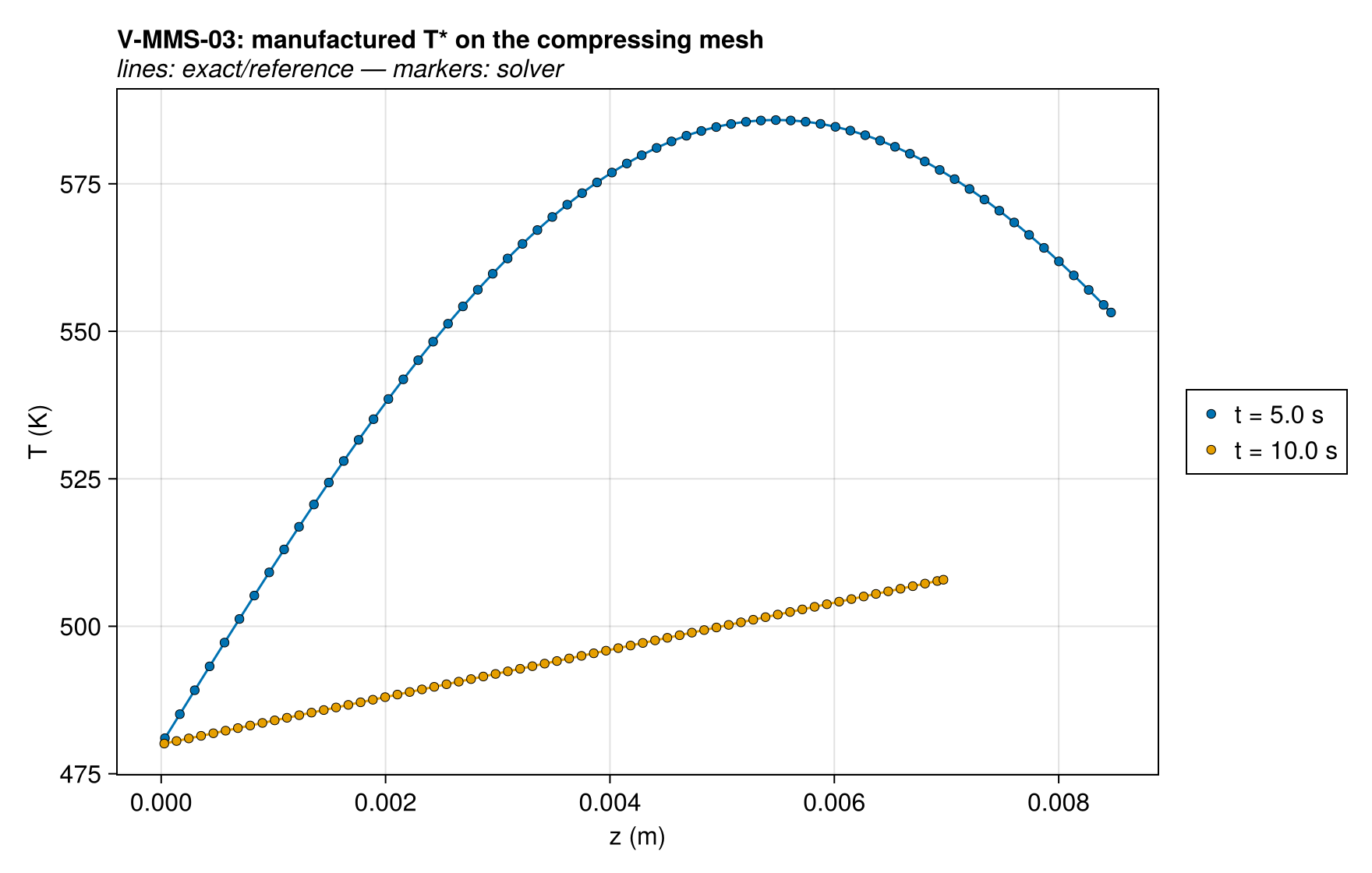
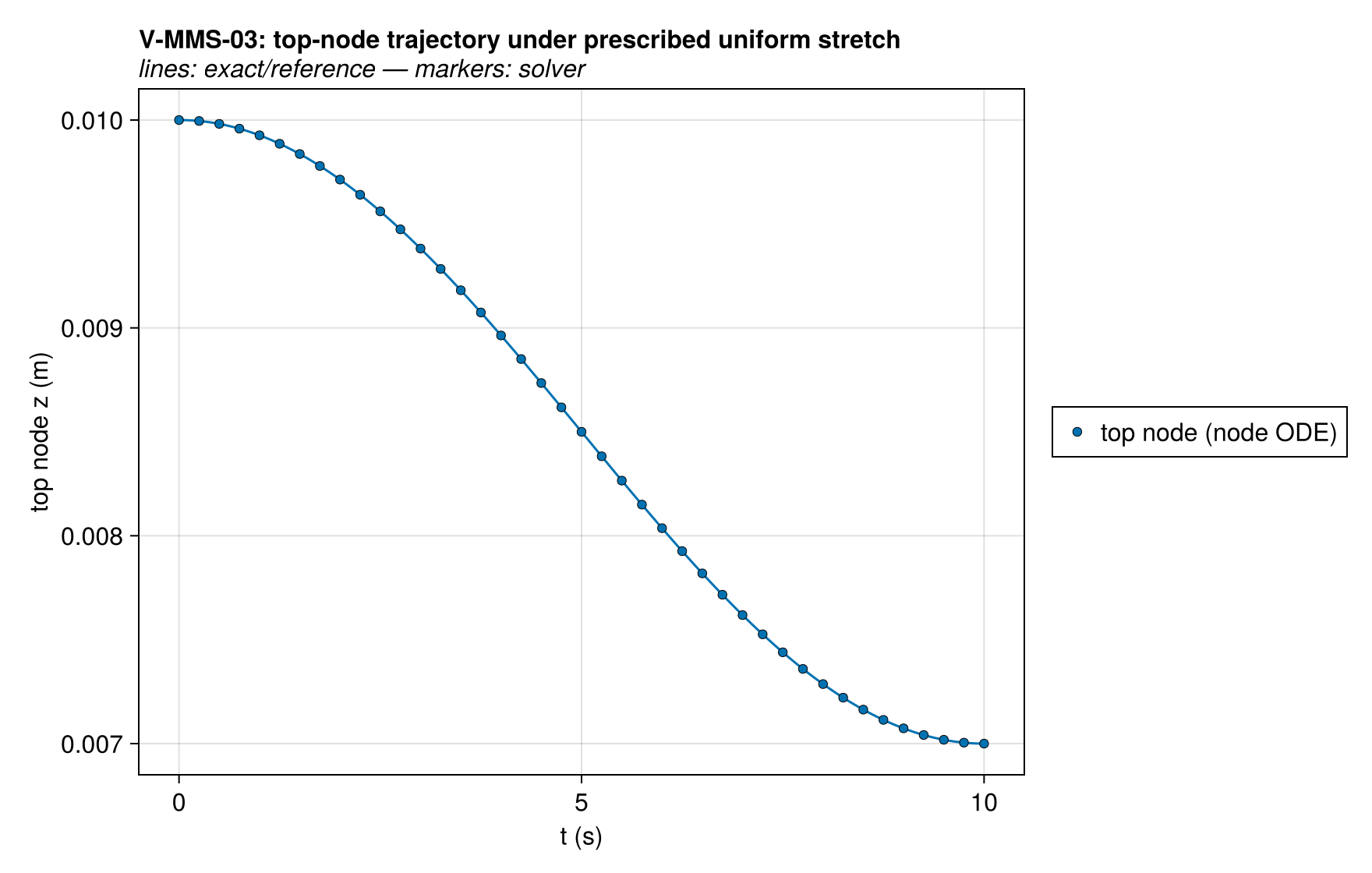
The moving-mesh order-verification companion to V-MMS-01: non-trivial manufactured fields solved on a mesh compressed to 70 % of its thickness by the prescribed uniform-stretch velocity
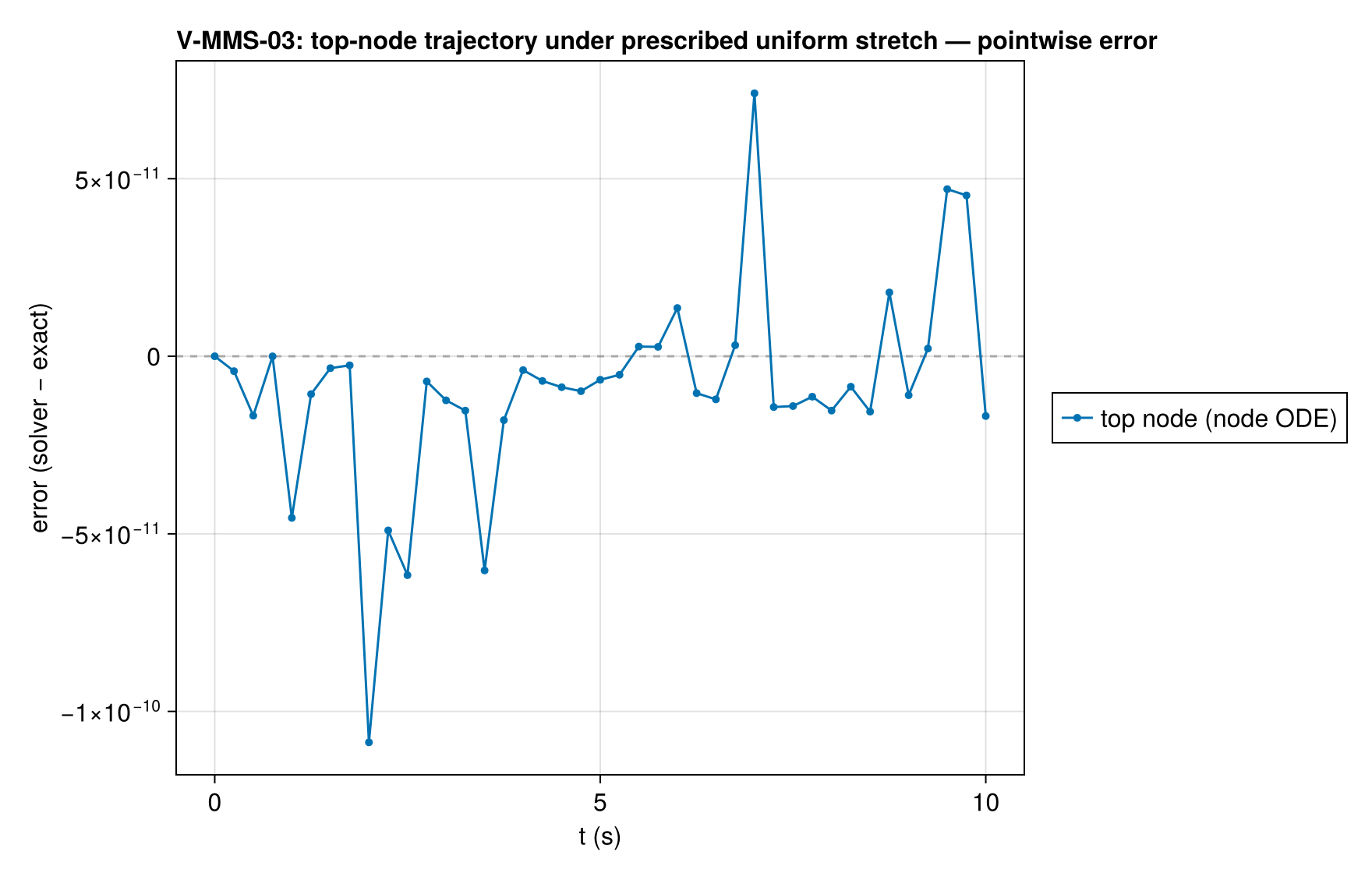
w*(z, t) = (ṡ/s)·z, s(t) = 1 − 0.15·(1 − cos(2πt/20)), zi(t) = zi(0)·s(t)
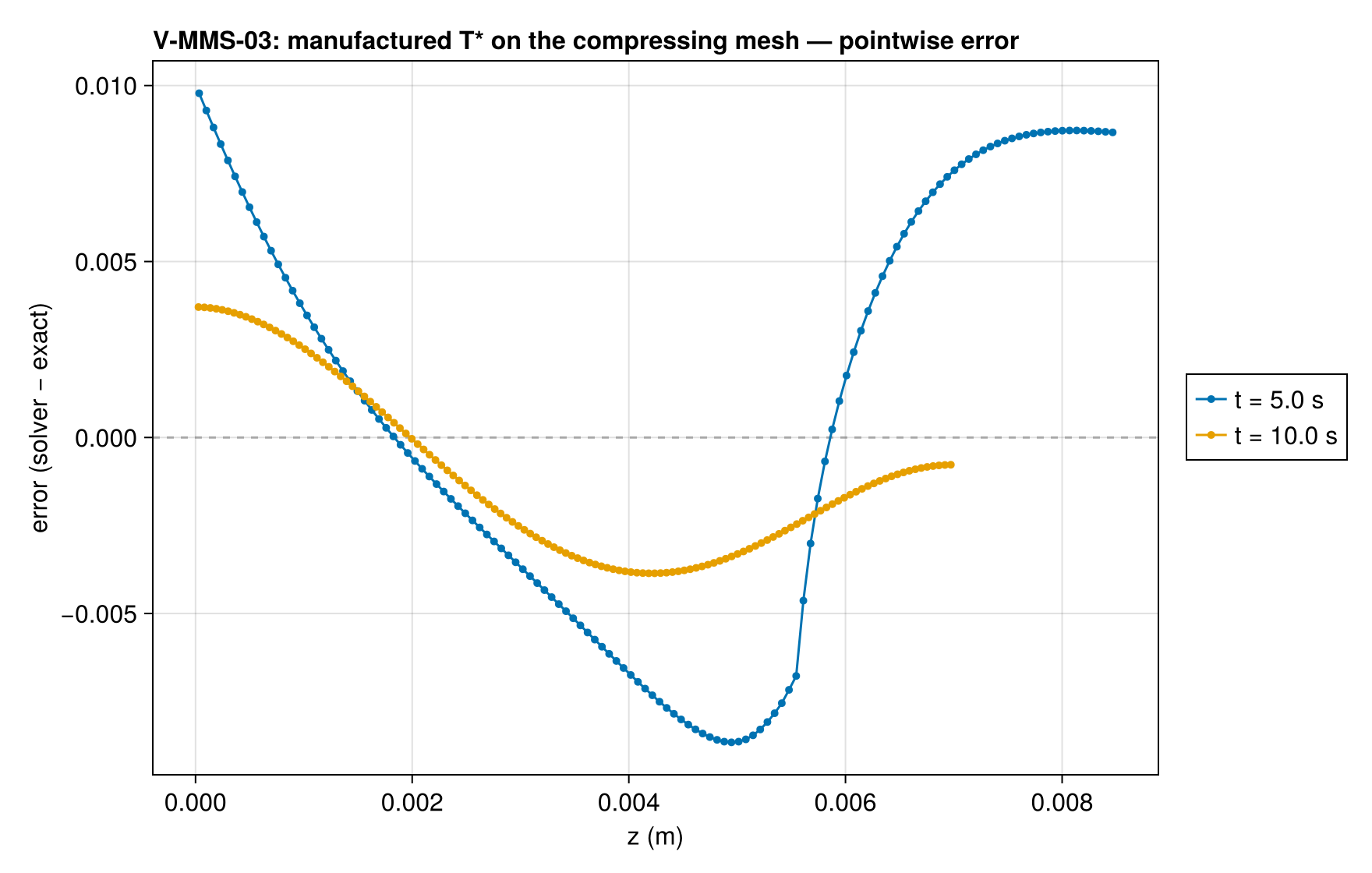
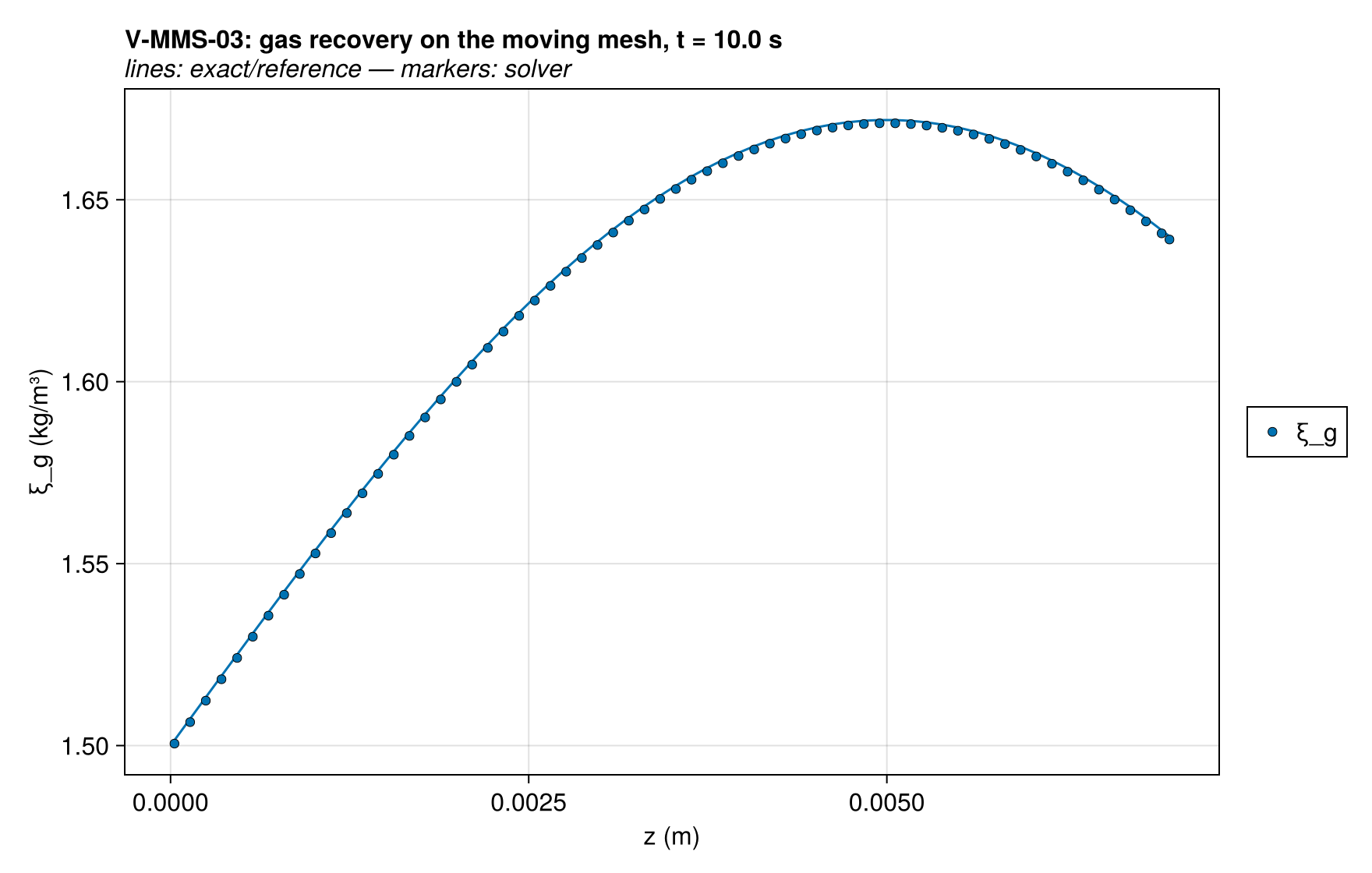
through the Workspace.w_override hook. On a grid point moving with w, the grid time derivative is ∂tT* + w·∂zT; the discrete ALE advection term supplies the w·∂zT part, so the same Eulerian manufactured sources — evaluated at the LIVE cell centers read from the z-block — make T, ξ the exact solution on the moving mesh (see exact/mms.jl header, "ALE"). The error norms therefore measure exactly the moving-mesh transport truncation: ALE advection (van-Leer-limited upwind reconstruction) + lab-frame operators on a nonuniform-in-time mesh.
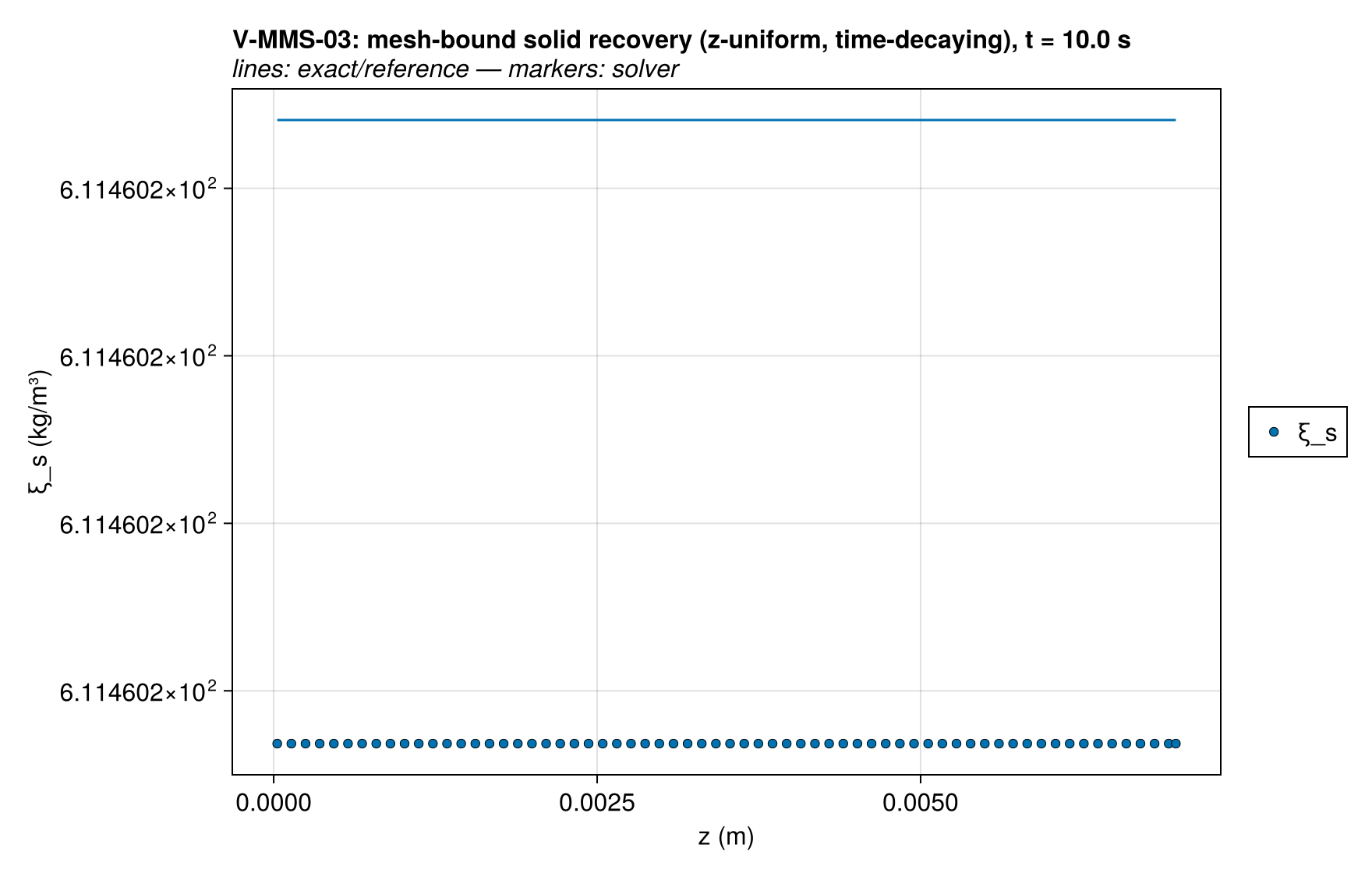
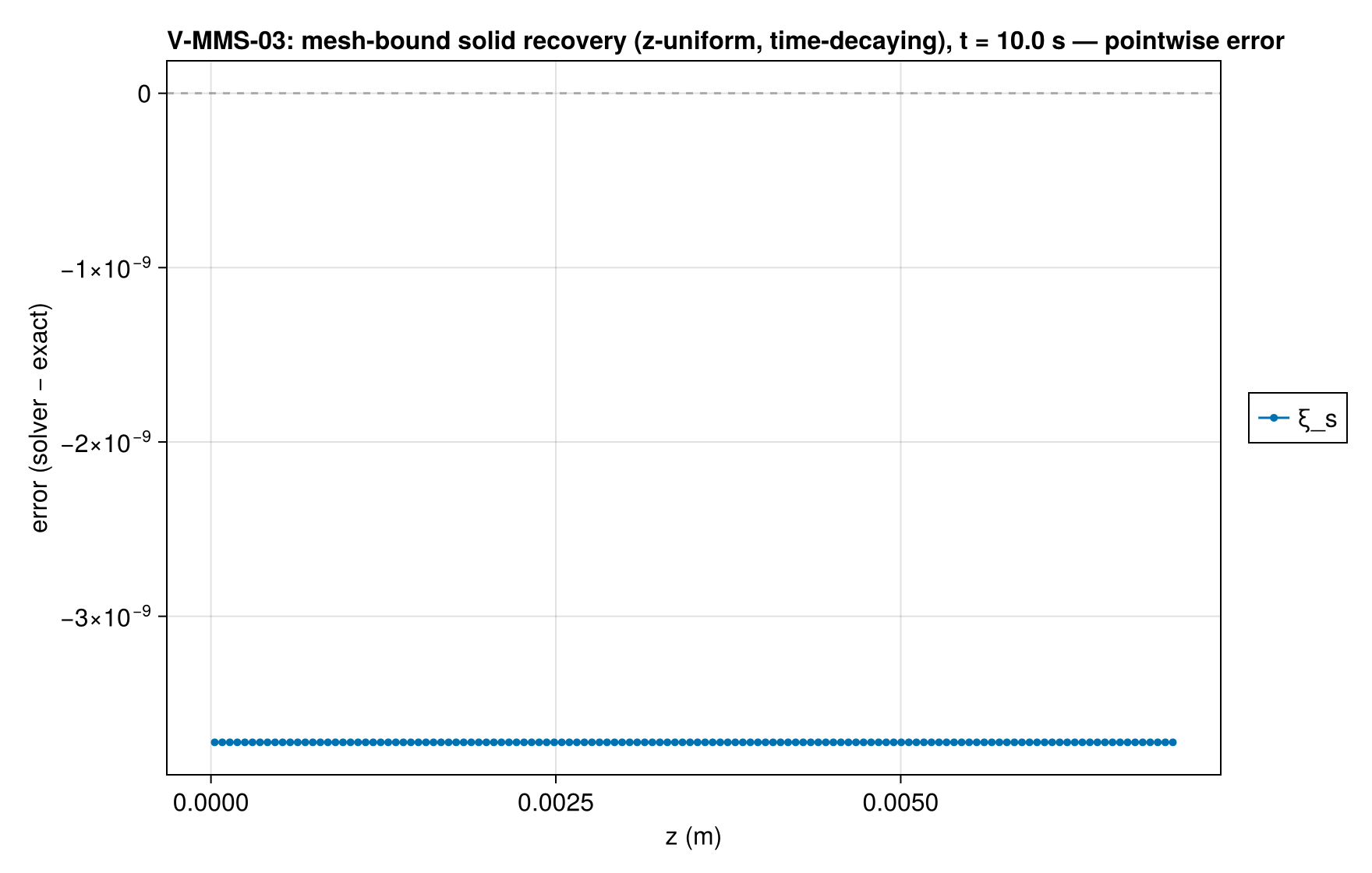
No reactions: mesh motion is prescribed, not volume-change-driven, so the case isolates GCL/advection from kinetics (V-MMS-01 covers those). The solid field is spatially UNIFORM but time-varying: condensed phases are mesh-bound in this ALE formulation (vsolid = w ⇒ no advection operator, see computealespeciesadvection!), so a z-varying solid target under prescribed non-material motion would have no operator to balance its w·∂zξ* term (constraint documented in exact/mms.jl). The time variation keeps the solid source-injection path active; T and the gas field carry the full space–time structure and exercise the moving-mesh advection.
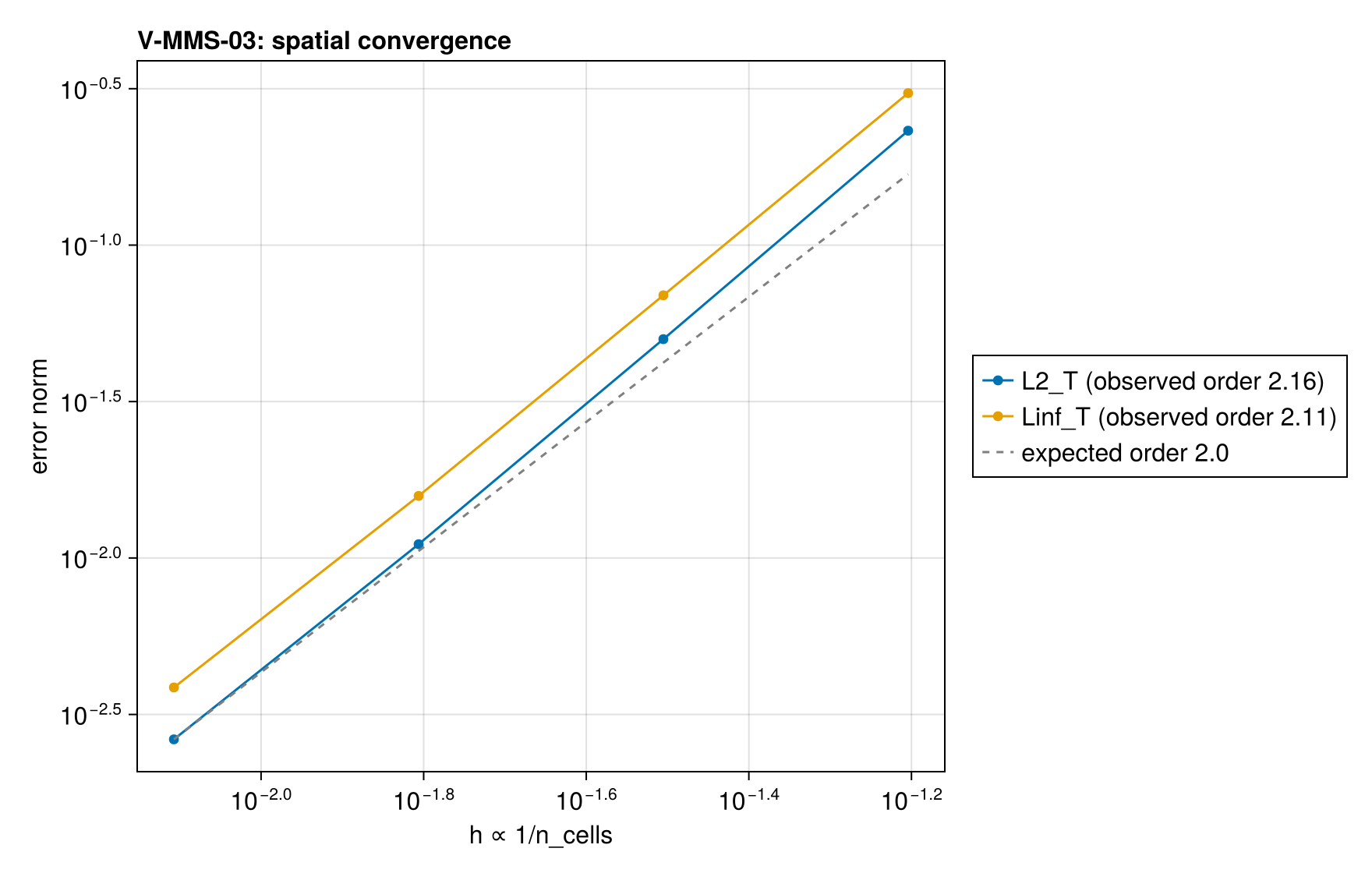
Expected order: the limiter's slope reconstruction is formally 2nd order on smooth data but clips at extrema (the sin peak crosses the domain), so the observed order sits between 1.5 and 2 — recorded at pin time; a drop below min_order flags a moving-mesh transport regression.
Jacobian: dense FD (jacobian = :fd) — the structured geometry Jacobian assumes reaction-driven mesh velocity (see Workspace.w_override note).
Quantities of interest (n = 128)
| QoI | value | exact | error | tolerance | within tol | provenance |
|---|---|---|---|---|---|---|
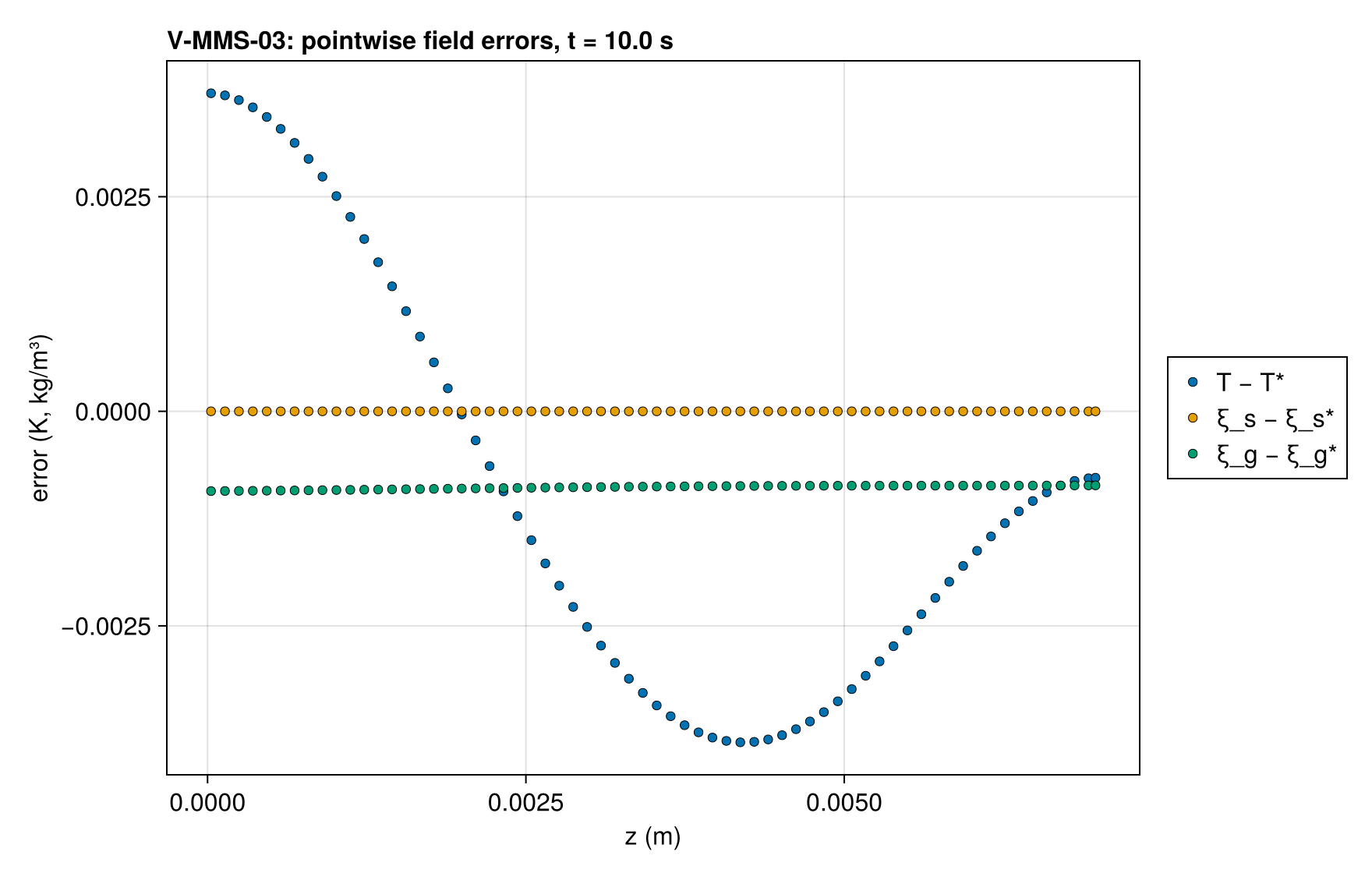
| L∞ T error on moving mesh, t=10.0 s | 0.003857 | — | 0.003857 | 0.25 | yes | manufactured T* on 30%-compressed mesh |
| relative L∞ ξ_solid (mesh-bound) error, t=10.0 s | 6.204e-12 | — | 6.204e-12 | 1e-10 | yes | uniform solid: verifies the Lagrangian (no-advection) solid path + source injection |
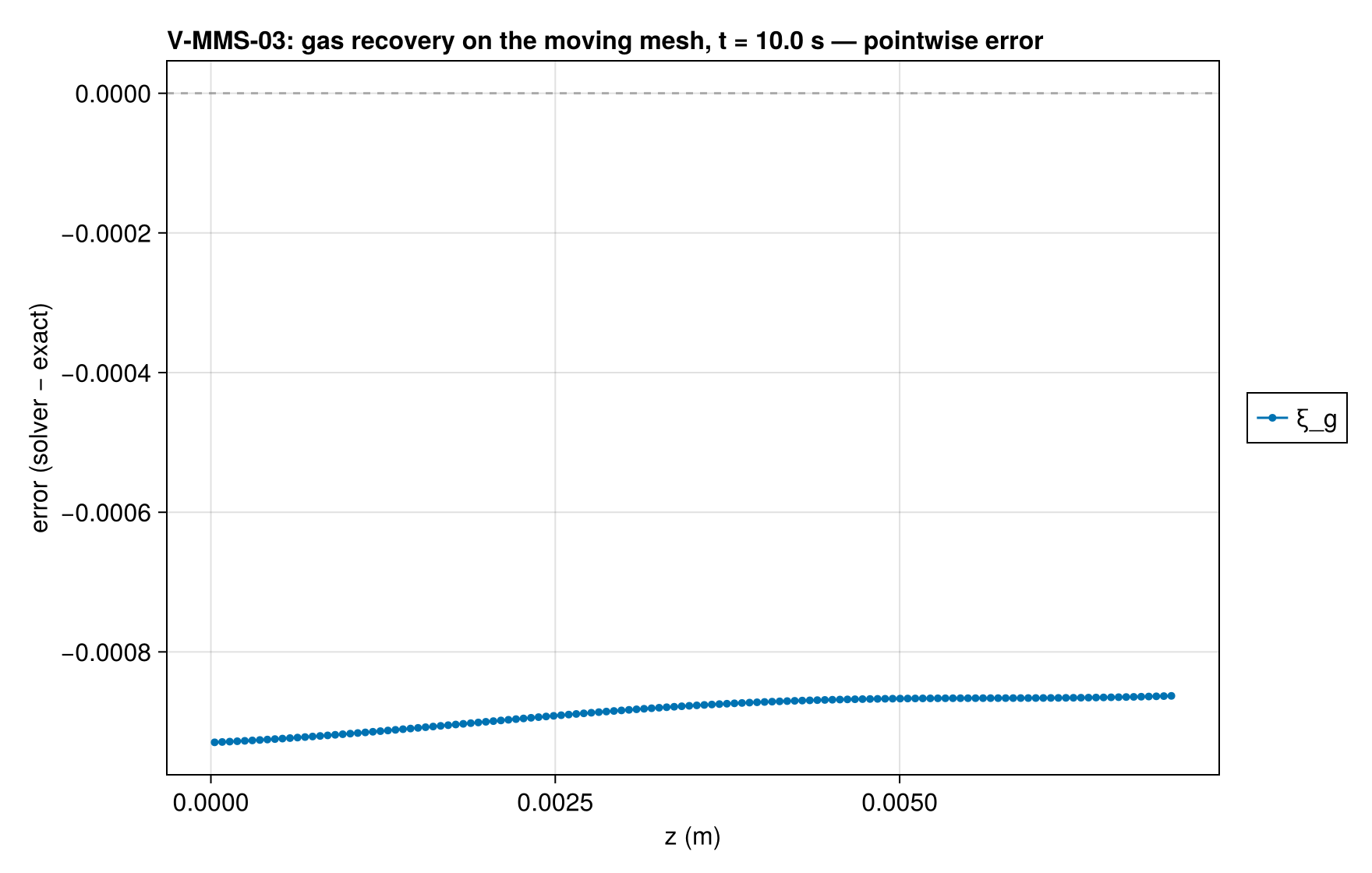
| relative L∞ ξ_gas error, t=10.0 s | 0.0006197 | — | 0.0006197 | 0.006 | yes | gas is advected relative to the mesh: moving-mesh transport error channel |
Convergence
| n_cells | h | wall (s) | L2_T | Linf_T |
|---|---|---|---|---|
| 16 | 0.0625 | 0.1125 | 0.2321 | 0.3061 |
| 32 | 0.03125 | 0.6345 | 0.05006 | 0.06913 |
| 64 | 0.01562 | 1.222 | 0.01107 | 0.01579 |
| 128 | 0.007812 | 8.375 | 0.002632 | 0.003857 |
Observed order 2.156 (L2_T), expected 2.0.
Solver configuration
| setting | value |
|---|---|
| integrator | KenCarp4 (default) |
| abstol | 1.0e-11 |
| reltol | 1.0e-9 |