V-CPL-01 — Neumann Stefan problem via apparent heat capacity (Gpyro params)
Tags: moving_front, latent_heat, state_dependent_properties, coupled
References:
- Carslaw & Jaeger (1959) §11.2
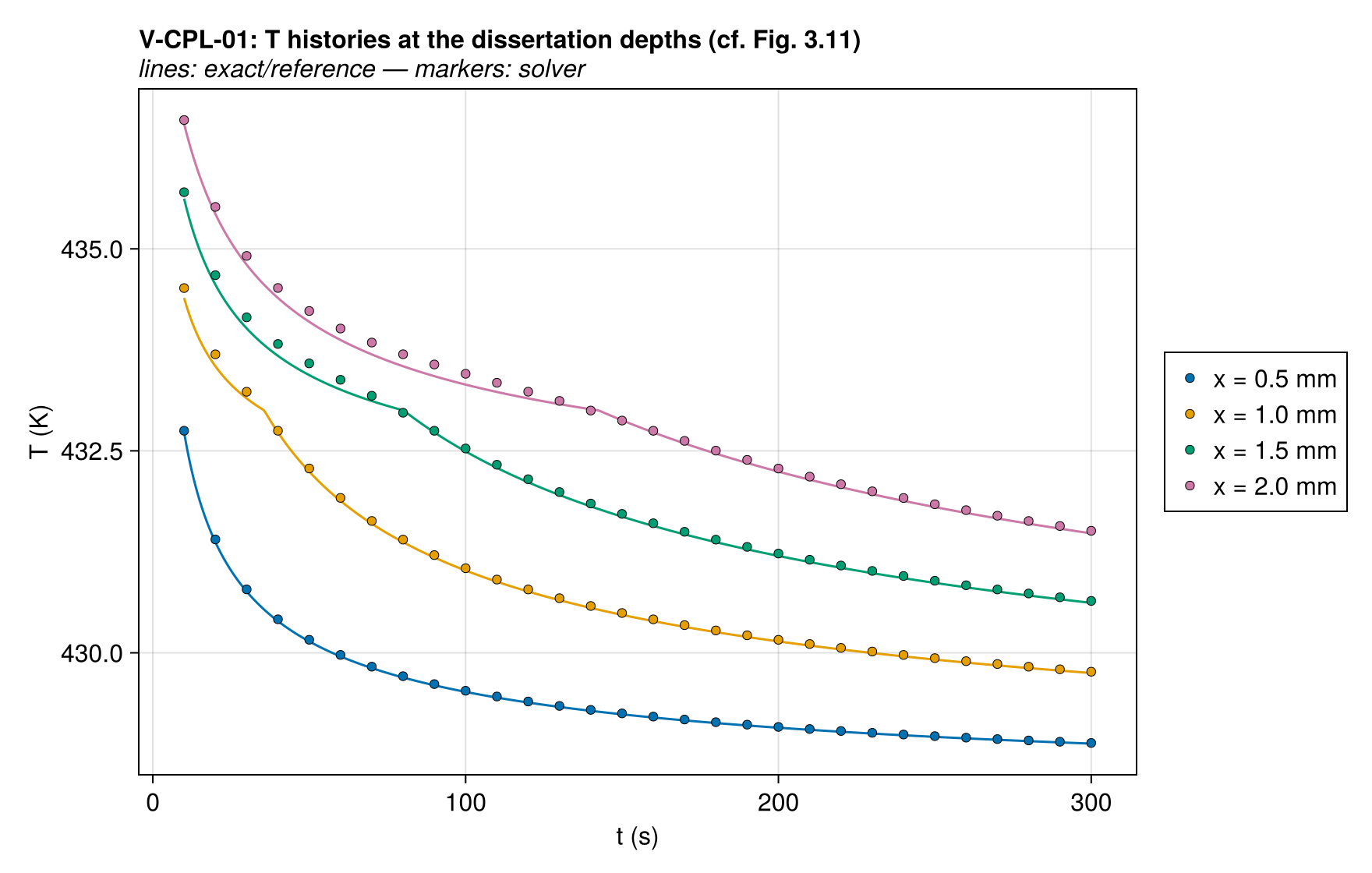
- Lautenberger dissertation (2007) §3.4.3, Eqs. 3.137–3.138, Fig. 3.11
Problem statement
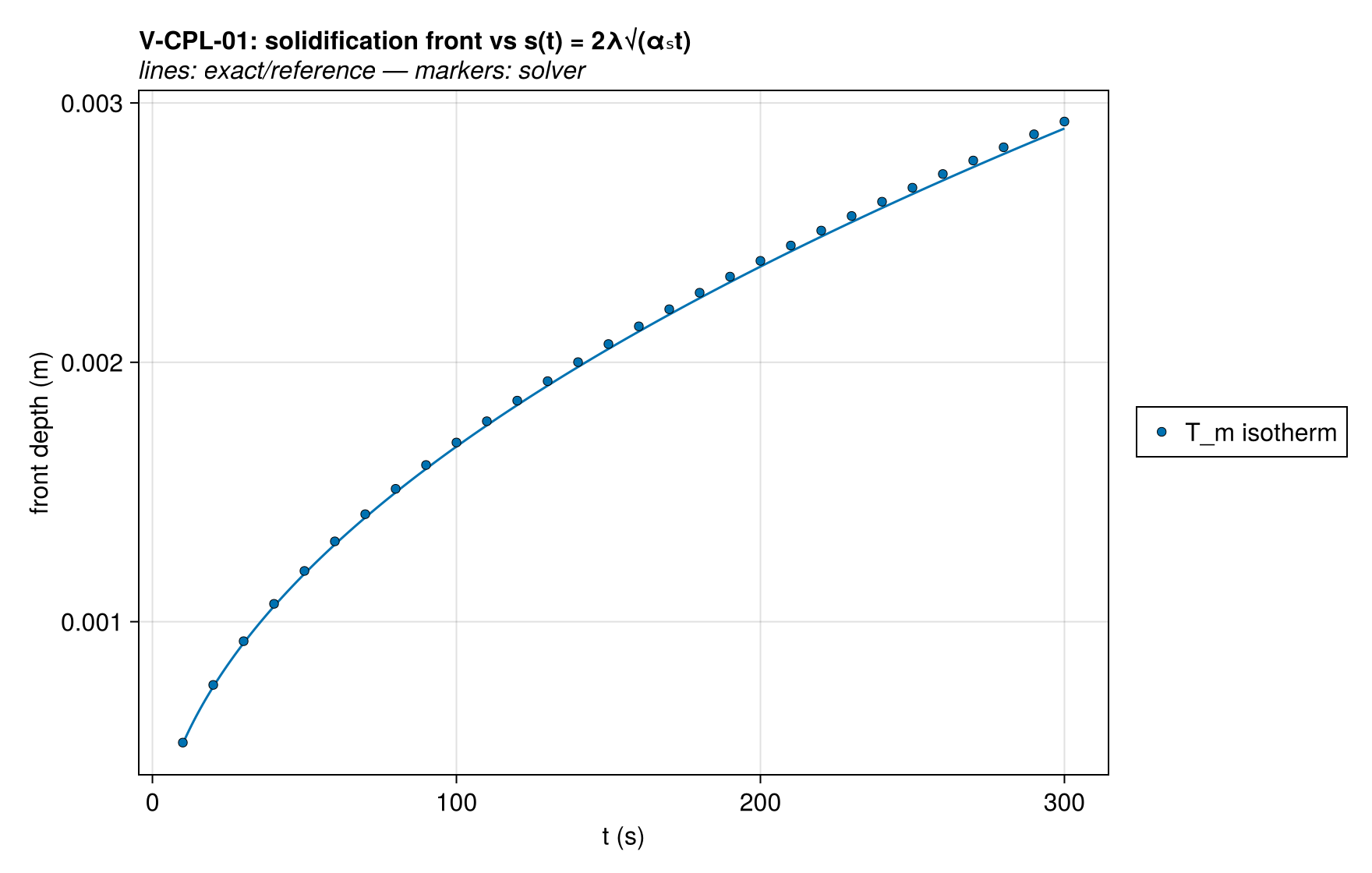
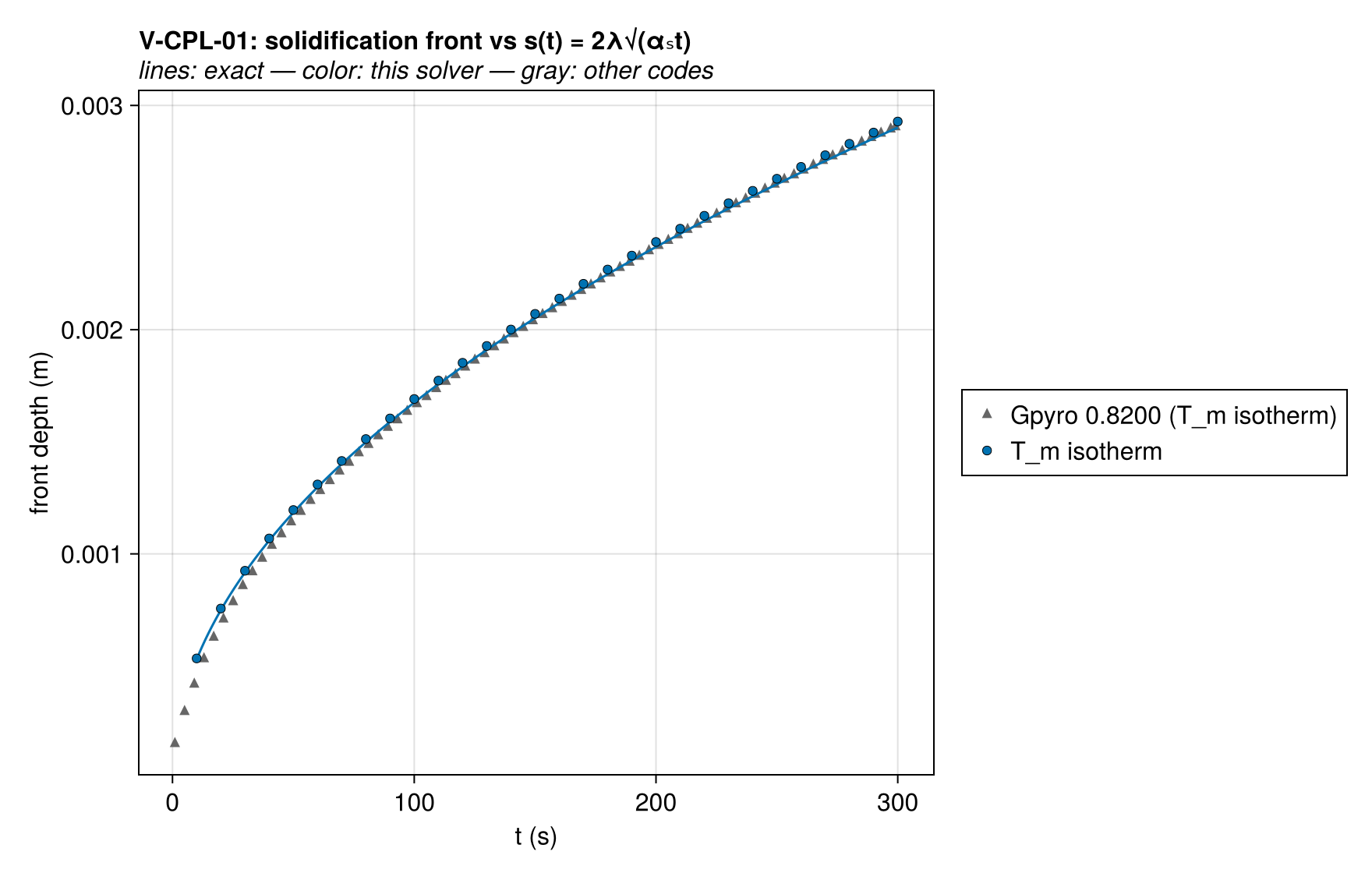
Gpyro's flagship moving-front verification (Lautenberger §3.4.3, Eqs. 3.137–3.138; Carslaw & Jaeger §11.2). Liquid initially at T₀ > Tm; wall (top face) dropped to T∞ < Tm at t = 0; a solidification front s(t) = 2λ√(αₛt) propagates inward releasing ΔH_m. Exact solution and eigenvalue in exact/stefan.jl (λ = 0.2317 for the dissertation parameters — self-tested against the published value and an independent quadrature energy balance).
Two solver realizations:
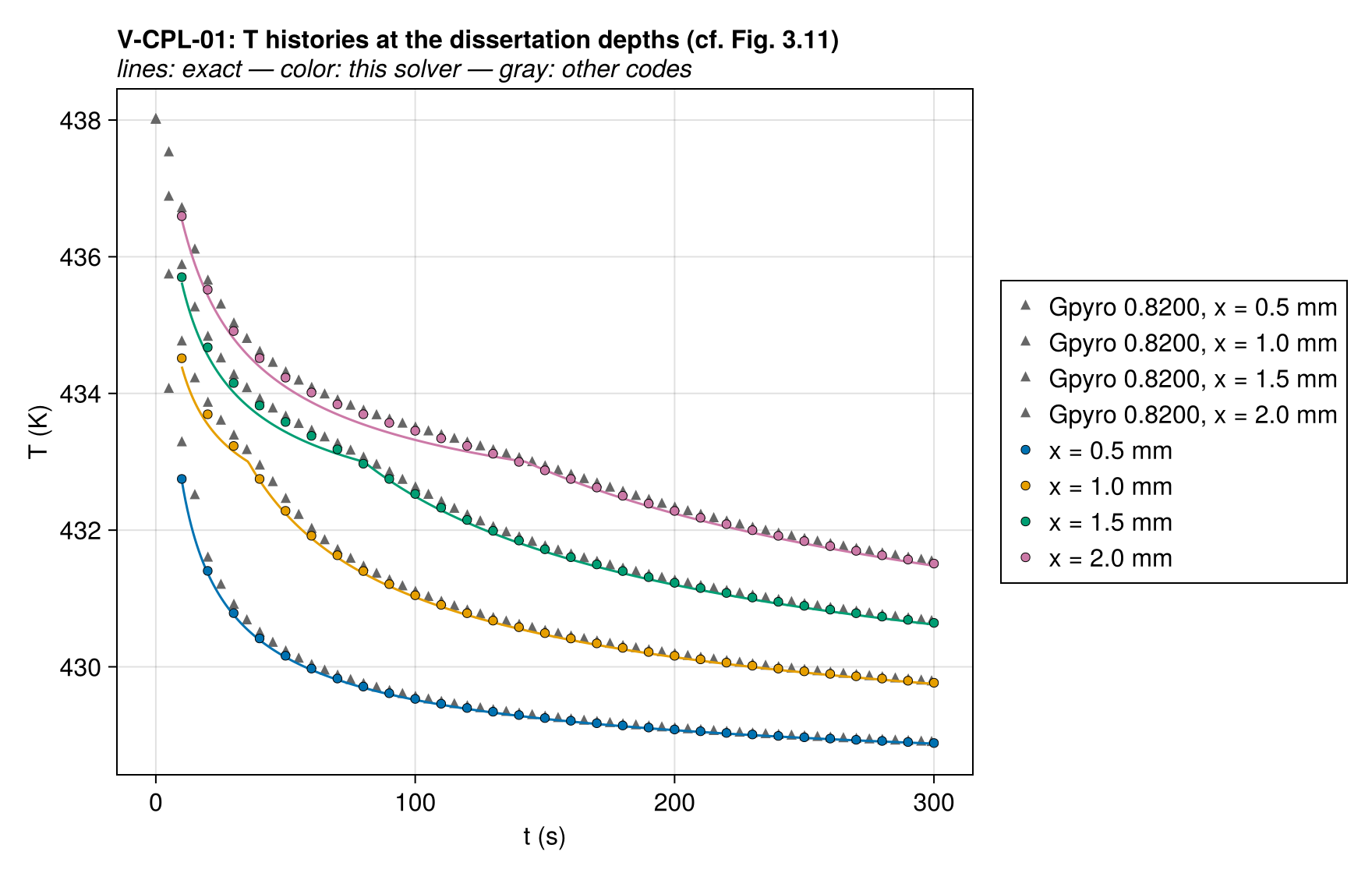
Route A (this case): apparent heat capacity — Gaussian cp peak of variance σ² = 0.1 K² (Gpyro Eq. 3.5c with σm² = 0.1) carrying the full ΔH_m, exercising the T-dependent property path + property-derivative Jacobian through a 38× spike in c. Uses the dissertation's polypropylene-like parameter set verbatim, so profiles compare to dissertation Fig. 3.11.
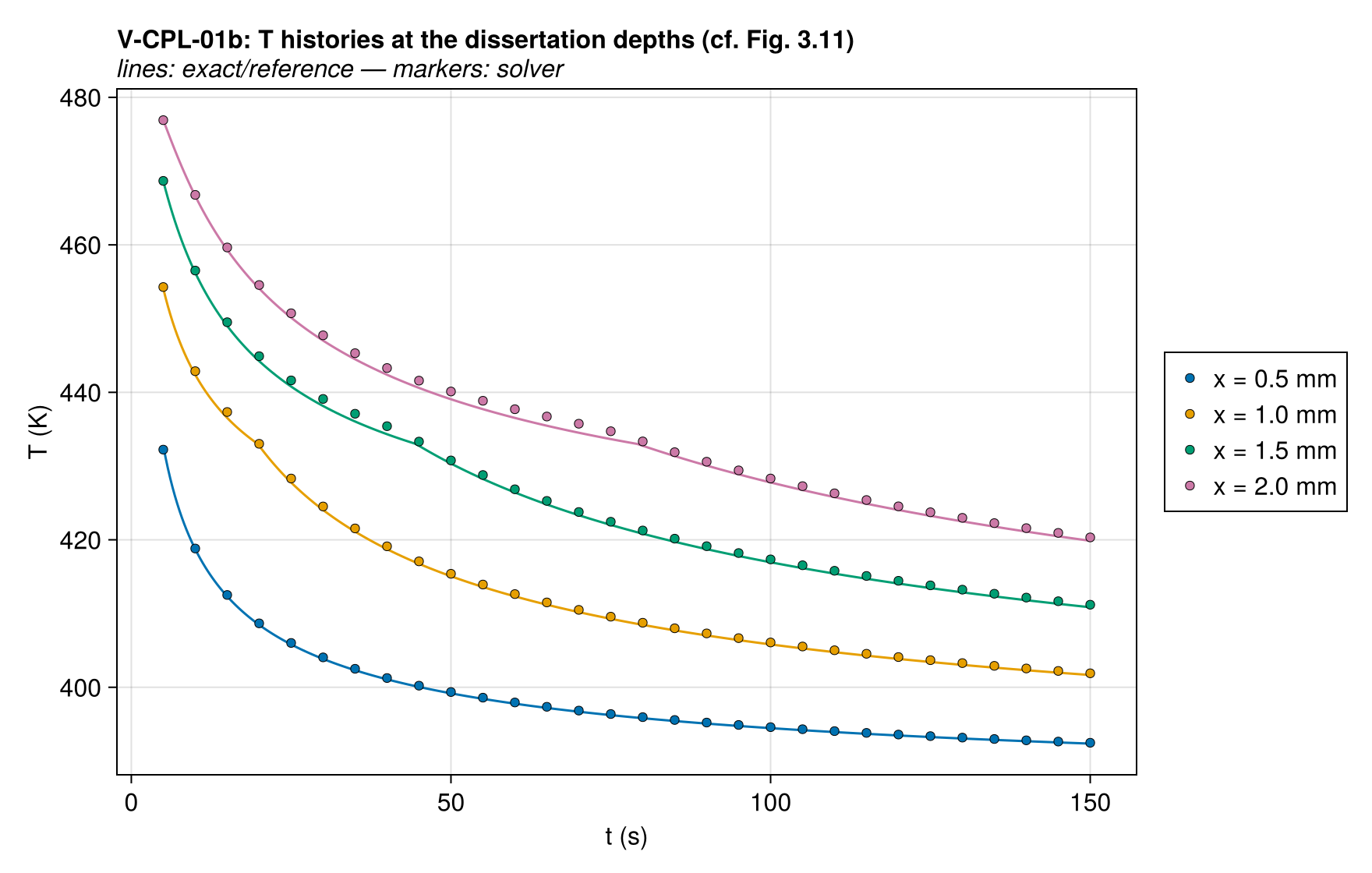
Route B (V-CPL-01b): latent heat via a Tmax-gated reaction melt → solid (h = −ΔHm: solidification releases heat; our h > 0 = endothermic). The temperature gate is a tanh ramp of configurable width (Reaction(...; gate_width) [K], default 1.0; src/Physics/kinetics.jl). At the default 1 K width the dissertation's 5 K driving ΔT shifts the effective freezing point by ~20% of the driving force (measured: front 19% slow), so this CI case rescales to ±50 K driving ΔT (own exact λ from the same library), making the gate a ~1–2% effect. The dissertation parameter set with a narrow gate (e.g. 0.1 K) and the gate-width → 0 convergence sweep belong in report mode.
Geometry: cold Dirichlet wall on TOP (z = L; depth x = L − z), adiabatic bottom, L = 4 cm ≫ liquid penetration √(4αl t) ≈ 1.25 cm (back-face guard asserts undisturbedness). Geometrically stretched mesh, finest at the wall (Δztop ≈ 14 μm, ≈ 103 μm at the deepest front position ≈ 3 mm — Gpyro used uniform 50 μm).
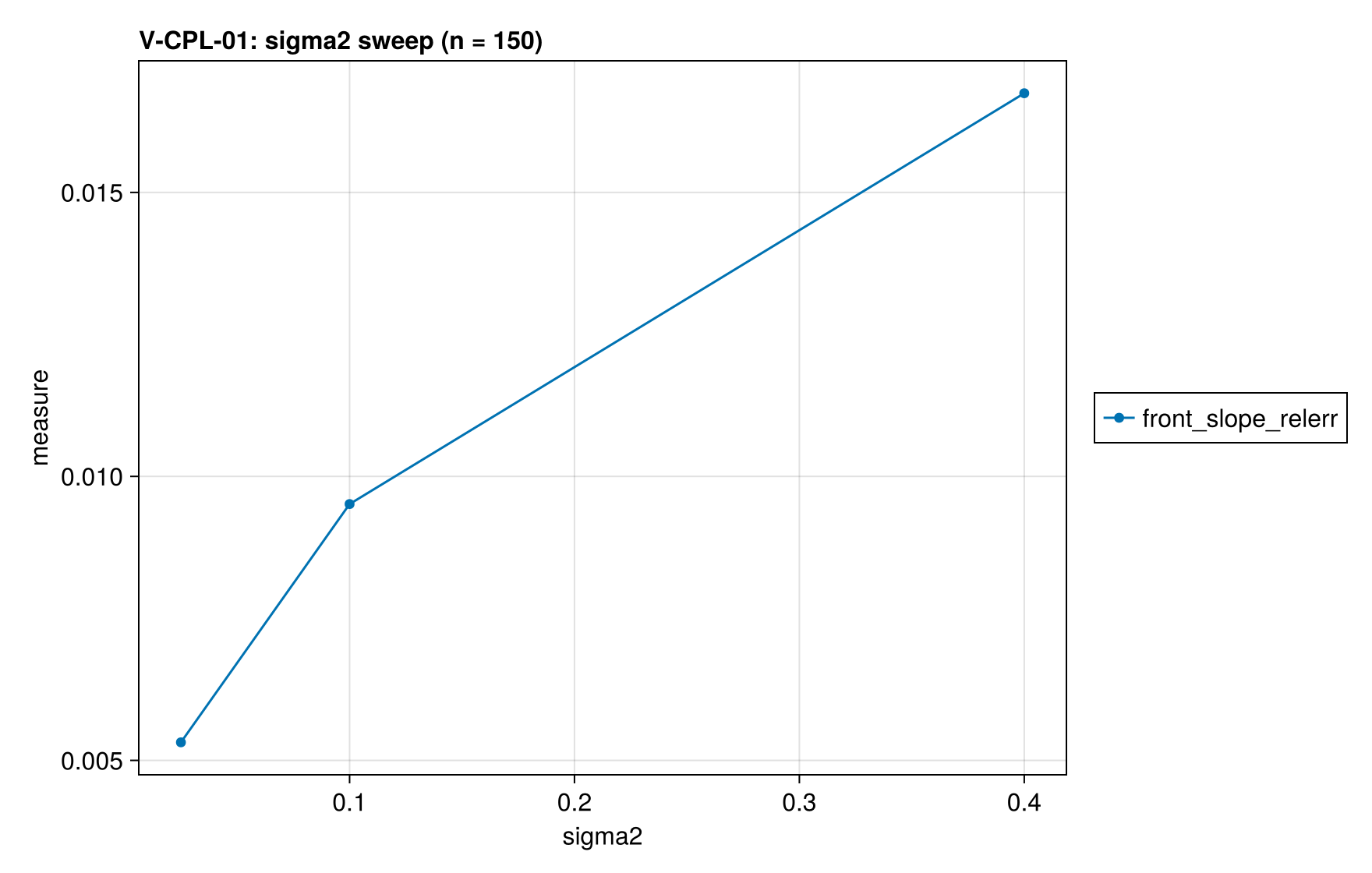
No CI ConvergenceSpec: with fixed peak width σ (route A) or gate width (route B) the solver converges to the smeared problem, whose offset from the sharp-front Stefan solution dominates the mesh error — a meaningful order study is the σ → 0 + mesh ladder (a report-mode peak-width convergence study).
V-CPL-01 — Neumann Stefan problem via apparent heat capacity (Gpyro params)
Quantities of interest (n = 800)
| QoI | value | exact | error | tolerance | within tol | provenance |
|---|---|---|---|---|---|---|
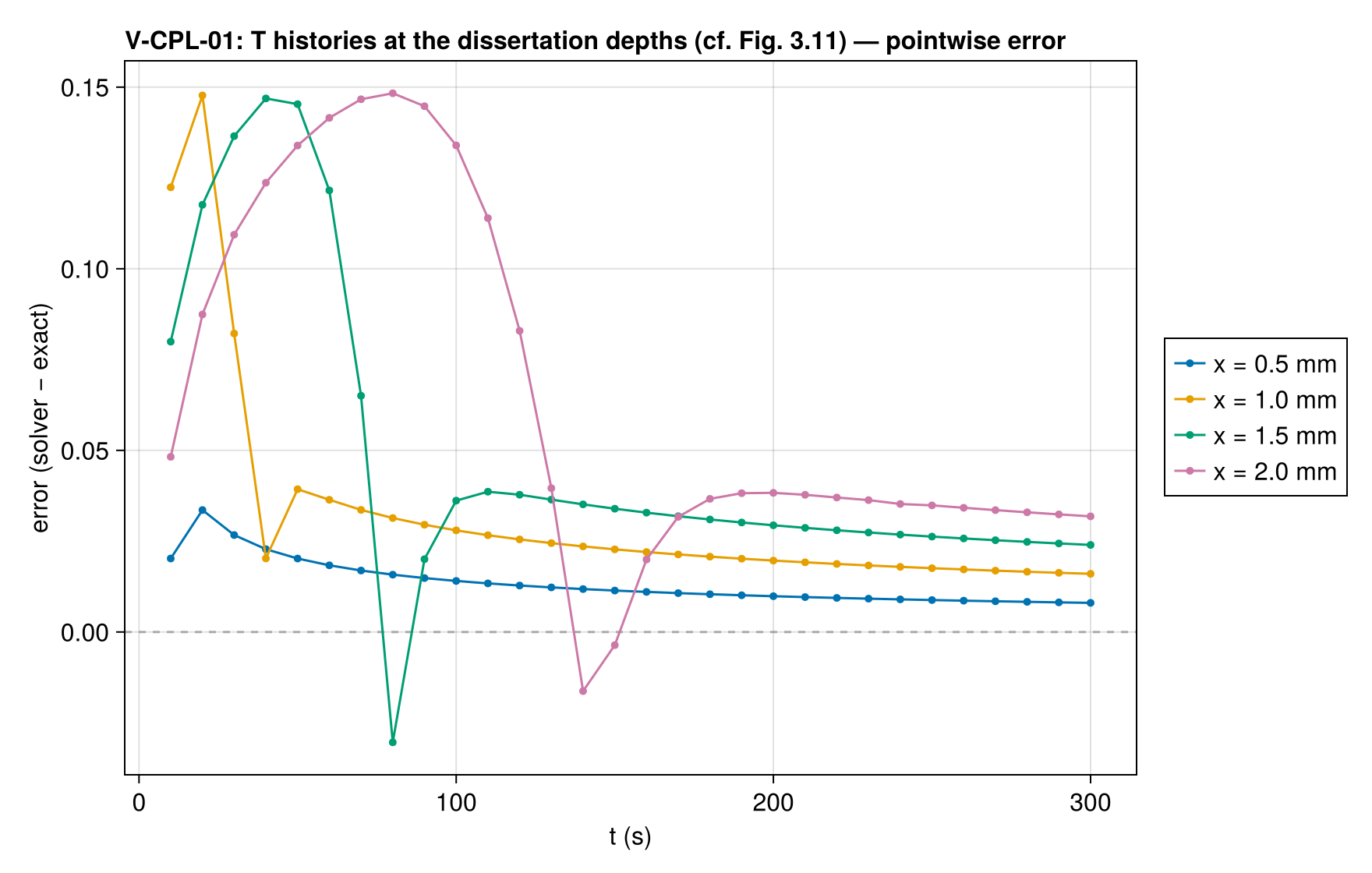
| T-history L∞ error at x = 0.5 mm | 0.01396 | — | 0.01396 | 0.05 | yes | vs exact two-phase profile, t ≥ 100.0 s |
| T-history L∞ error at x = 1.0 mm | 0.02778 | — | 0.02778 | 0.1 | yes | vs exact two-phase profile, t ≥ 100.0 s |
| T-history L∞ error at x = 1.5 mm | 0.03838 | — | 0.03838 | 0.12 | yes | vs exact two-phase profile, t ≥ 100.0 s |
| T-history L∞ error at x = 2.0 mm | 0.1338 | — | 0.1338 | 0.4 | yes | vs exact two-phase profile, t ≥ 100.0 s |
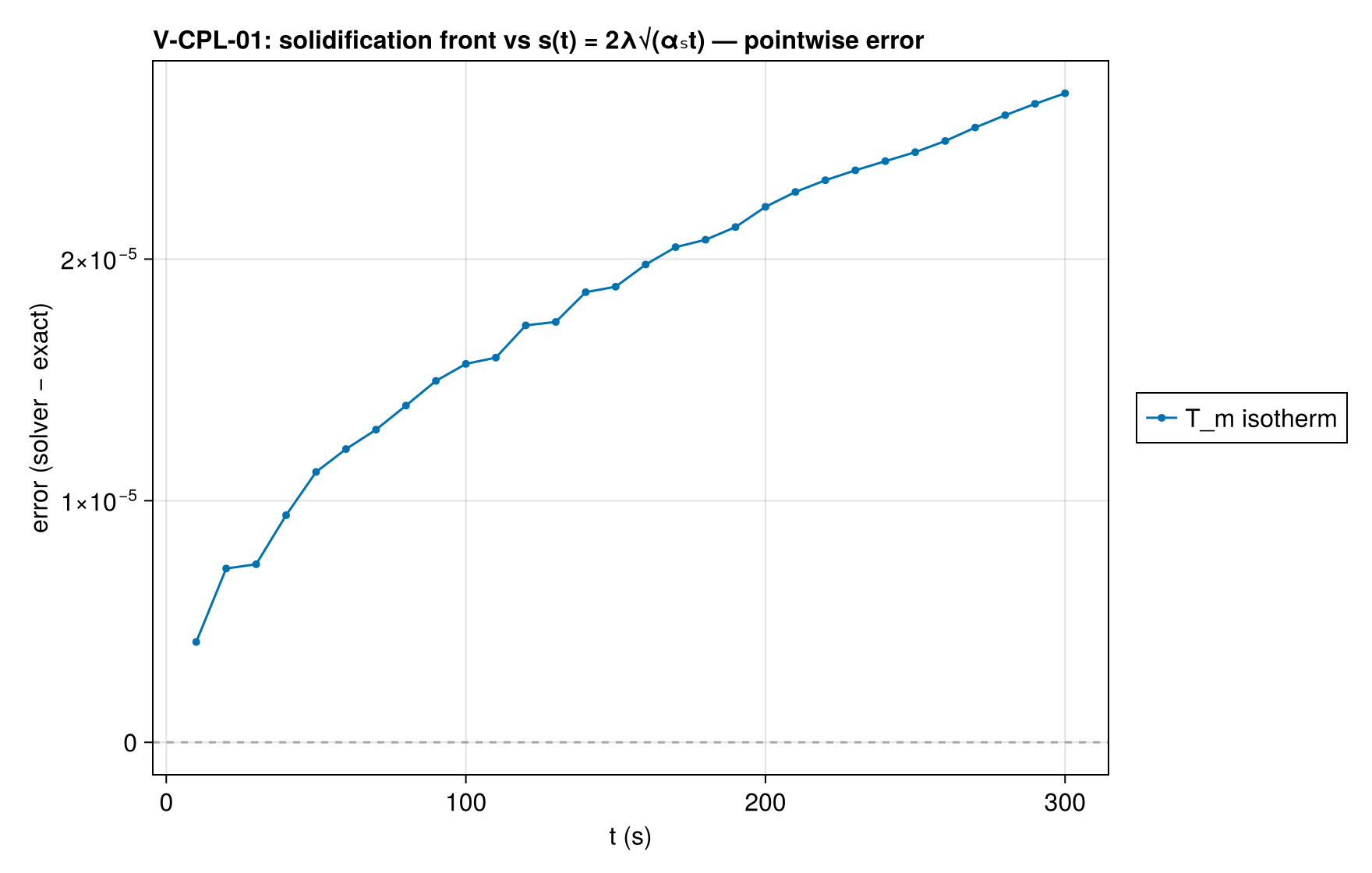
| front position at t = 100.0 s | 0.001691 | 0.001675 | 0.009417 | 0.03 | yes | s(t) = 2λ√(αₛt), λ = 0.23166 |
| front position at t = 200.0 s | 0.002391 | 0.002369 | 0.009389 | 0.03 | yes | s(t) = 2λ√(αₛt), λ = 0.23166 |
| front position at t = 300.0 s | 0.002928 | 0.002901 | 0.009282 | 0.03 | yes | s(t) = 2λ√(αₛt), λ = 0.23166 |
| √t front-growth coefficient | 0.0001691 | 0.0001675 | 0.009312 | 0.03 | yes | fit over t ∈ [100.0, 300.0] s |
| back-face disturbance (semi-infinite validity) | 8.173e-05 | 0 | 8.173e-05 | 0.01 | yes | L = 4 cm vs penetration ≈ 1.25 cm |
Comparison with other codes
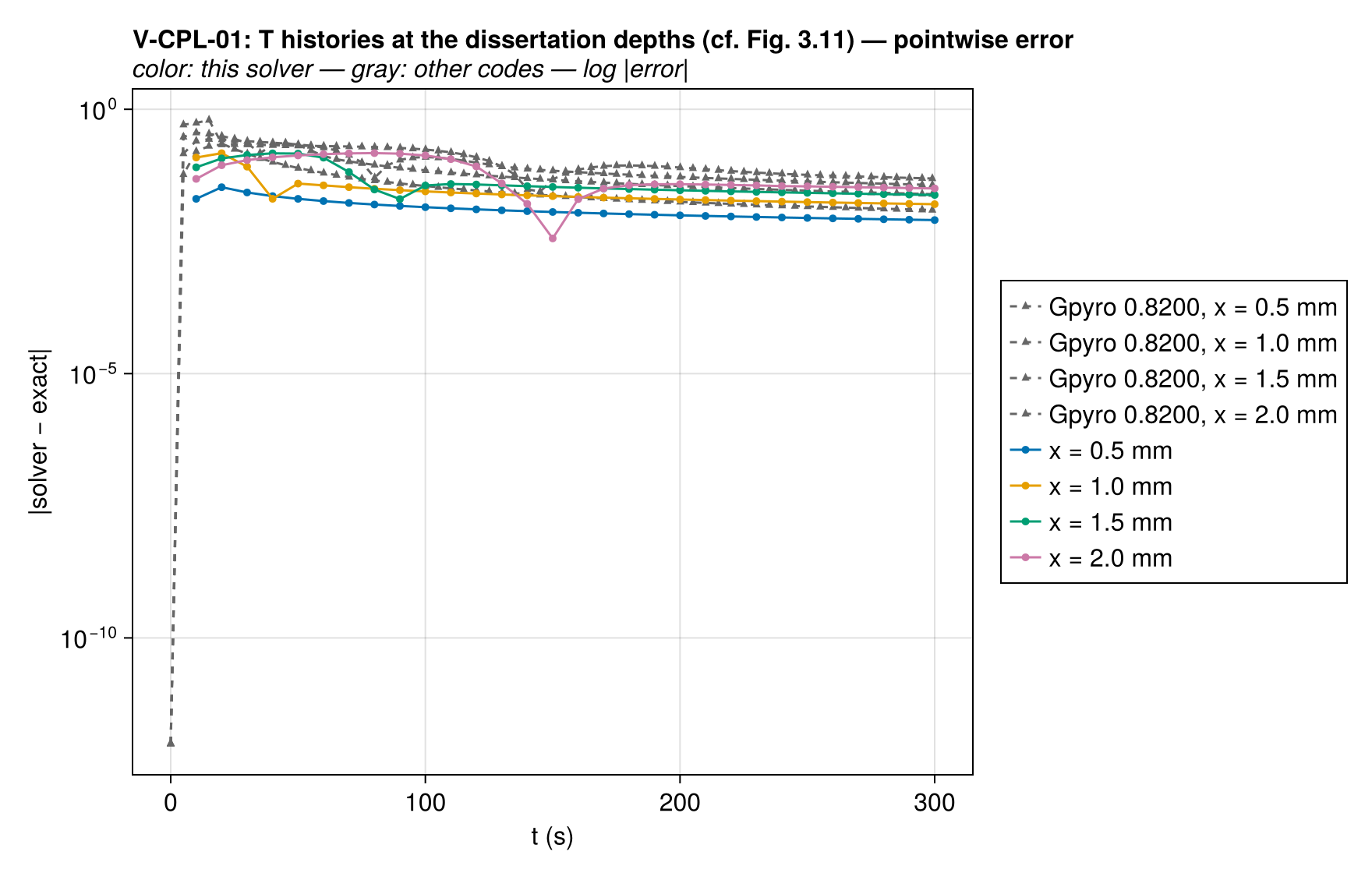
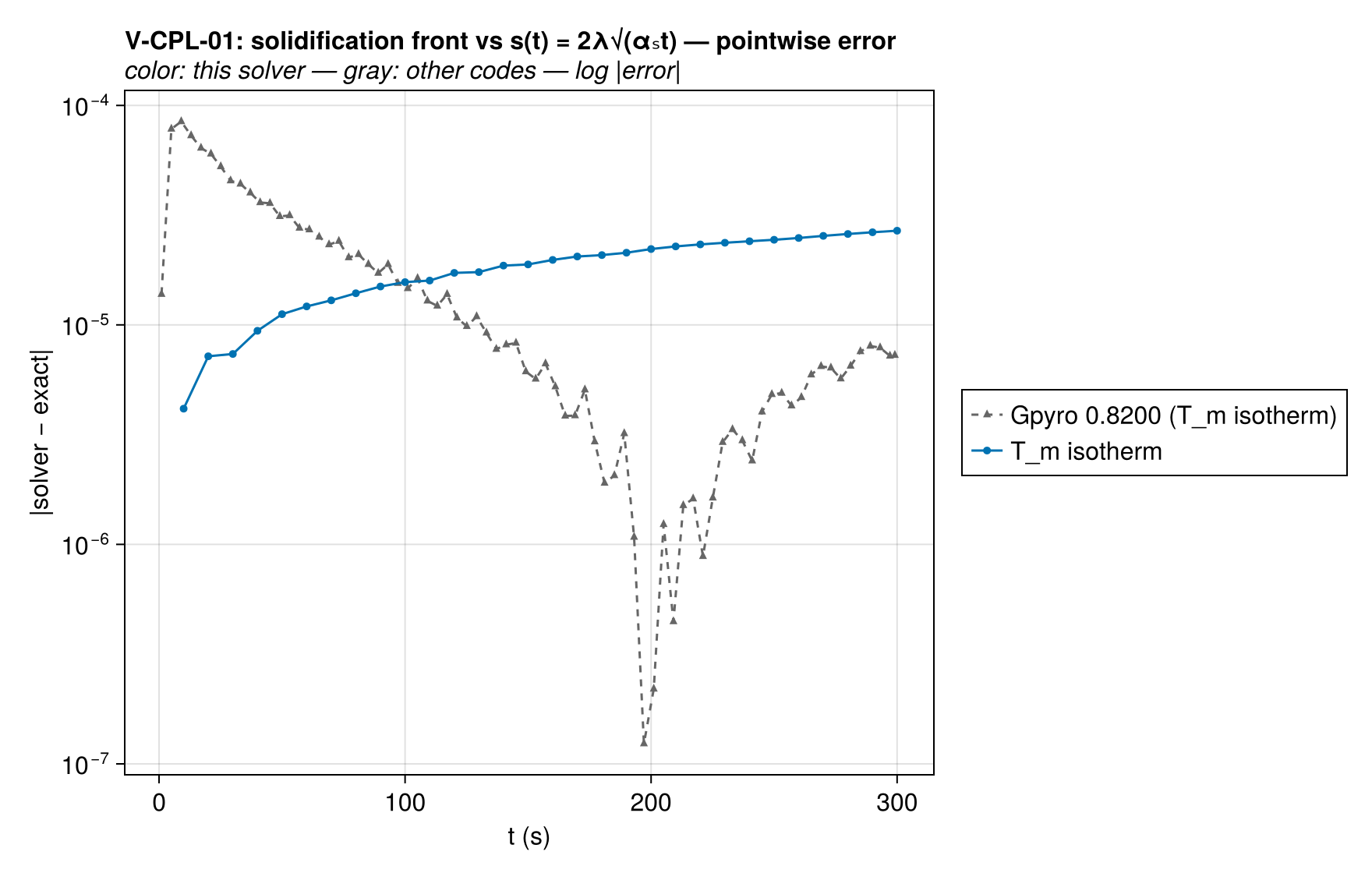
The same case was solved with Gpyro 0.8200 at 801 nodes (Δz=0.05 mm); decks, outputs, and run provenance are committed under test/verification/reference/. Each code's error against the same exact solution is drawn below on a log scale, muted gray behind this solver's series — the signed linear-scale panel above shows where the error lives, this one compares magnitudes across codes.
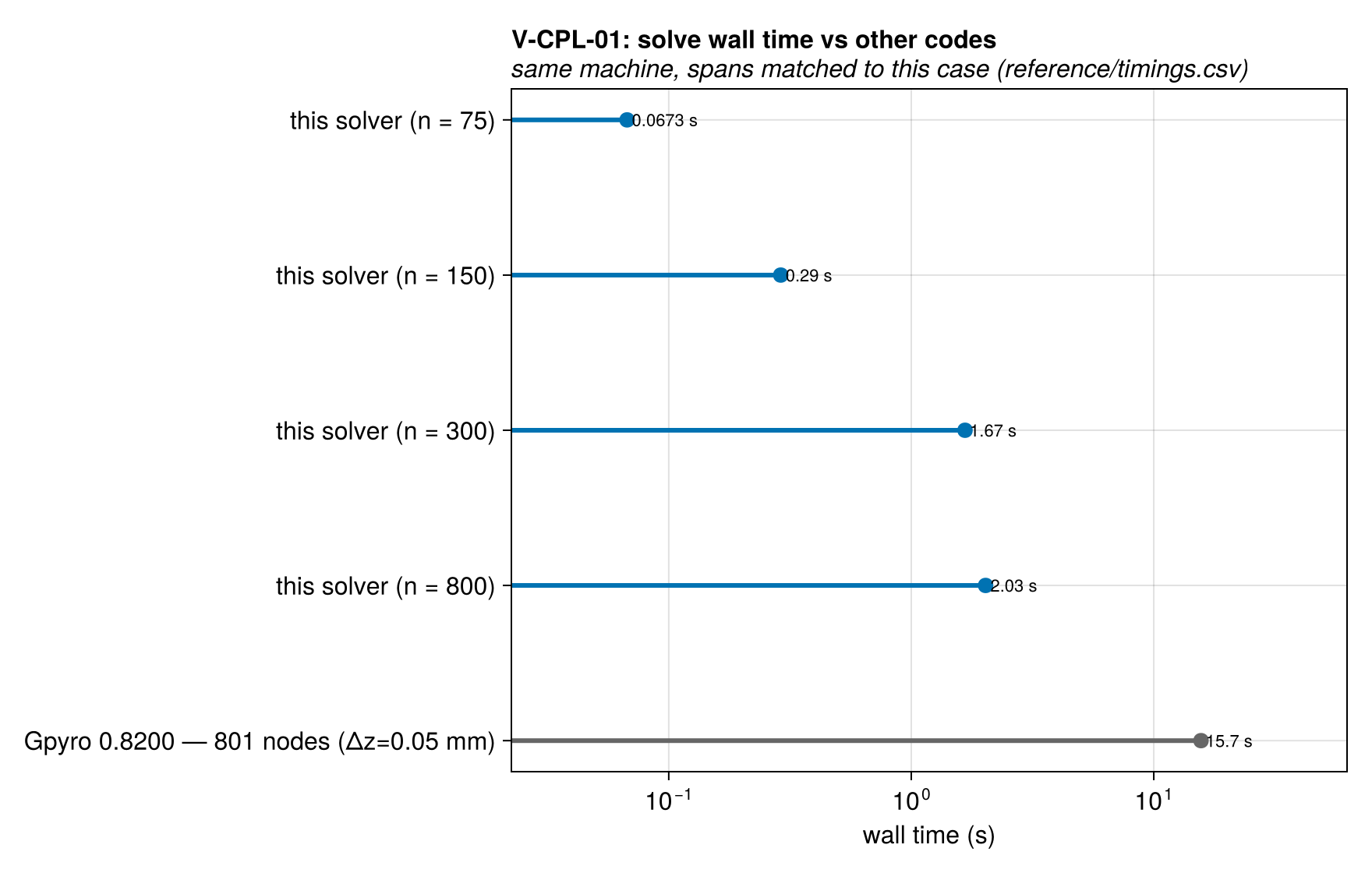
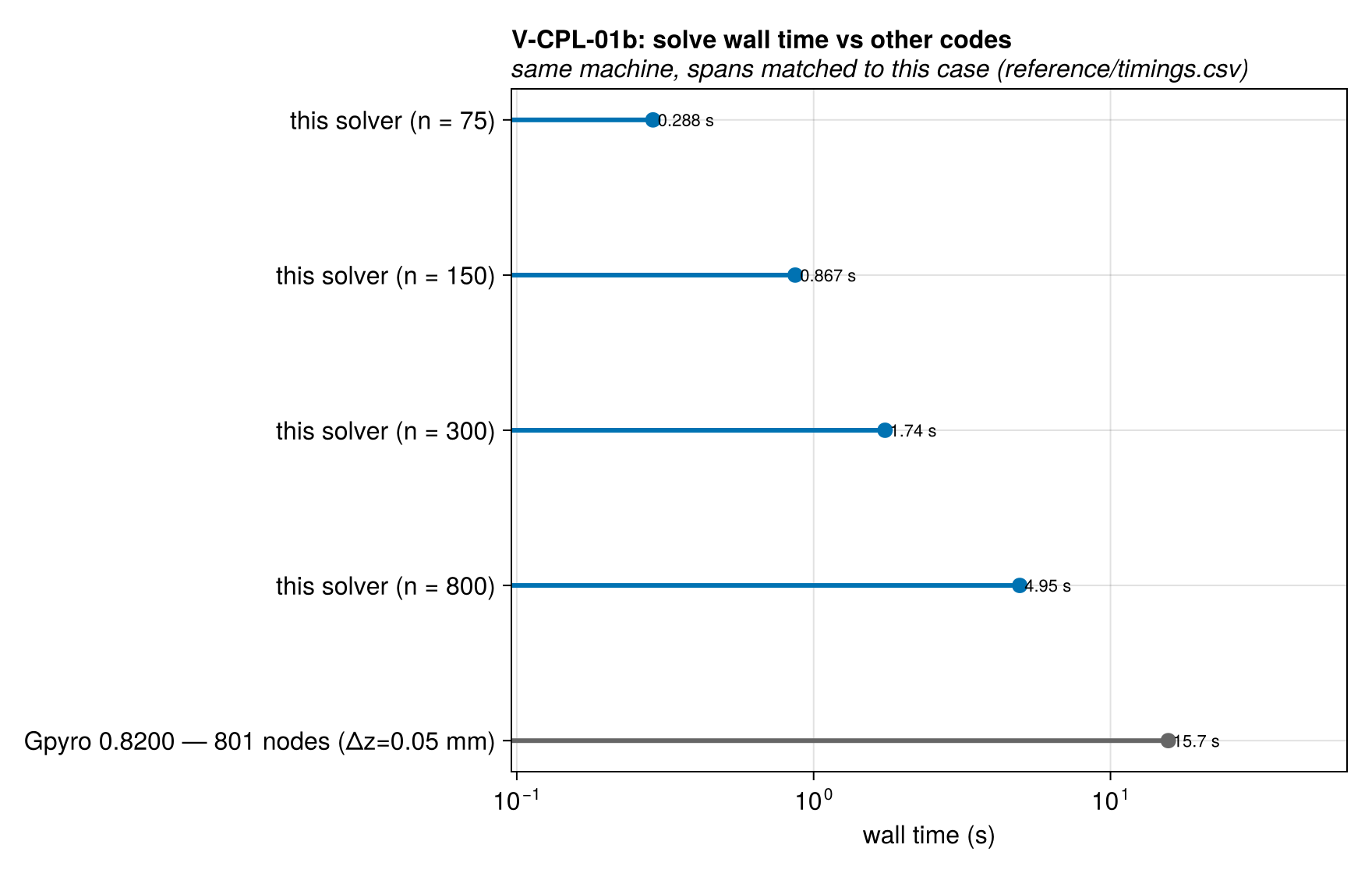
Wall times at every ladder rung against the reference runs. Resolutions and simulated spans differ where noted (details in reference/timings.csv), so cross-code timings are indicative rather than a controlled benchmark; rungs at a matched resolution are directly comparable.
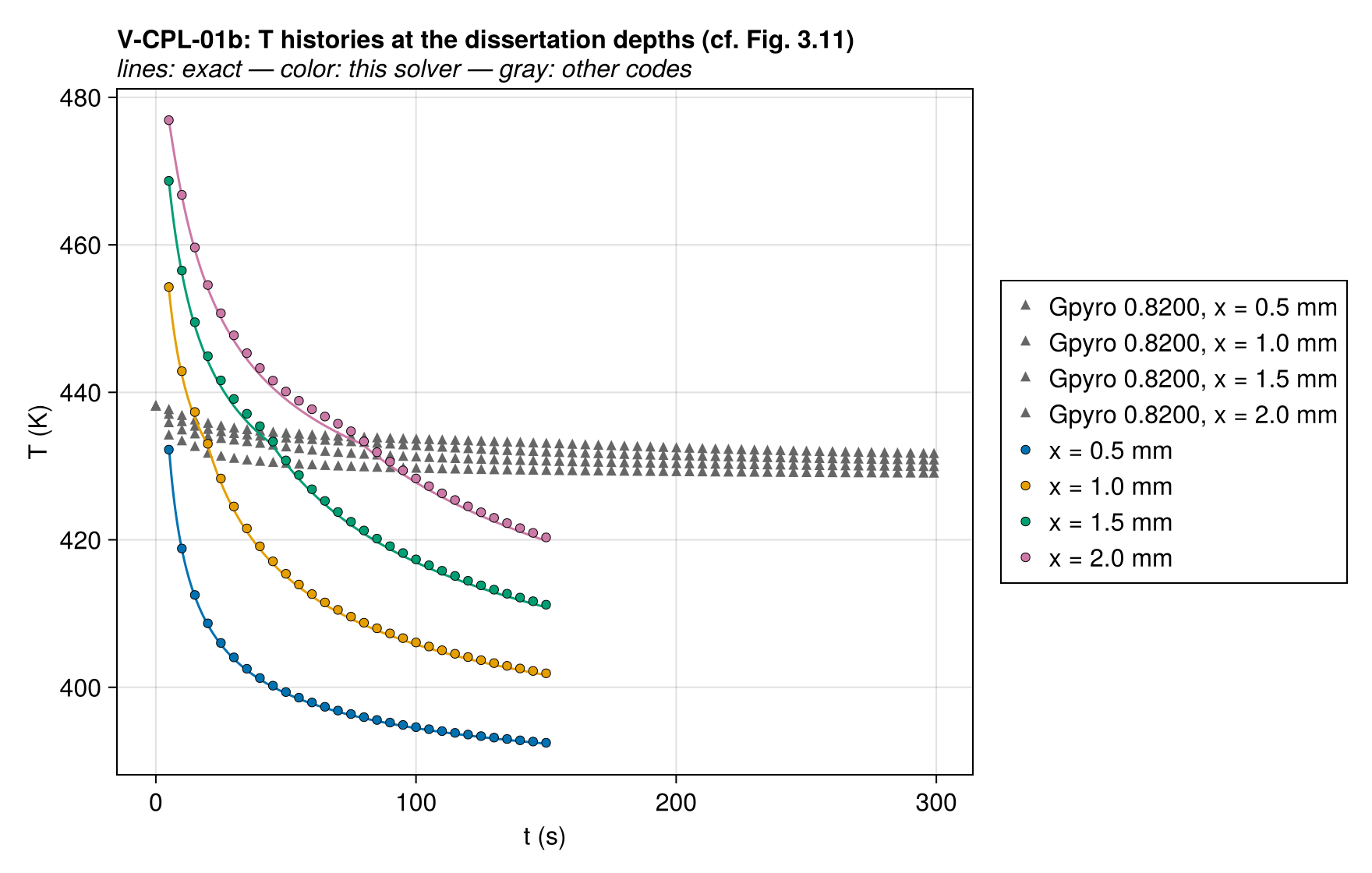
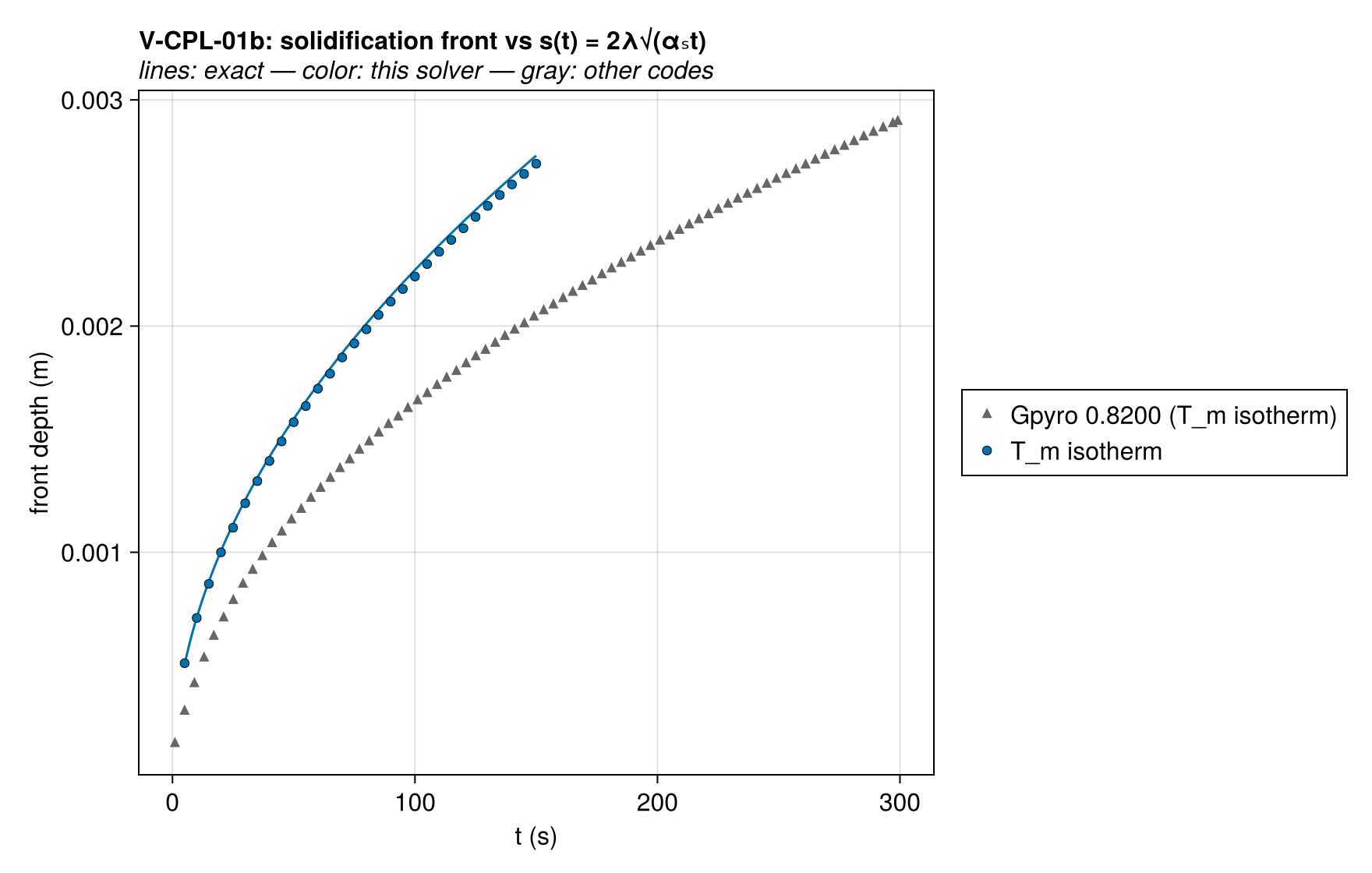
Solution overlays including the other codes' points: Thistoriesatdepthsvs_codes, fronttrajectoryvs_codes.
Solver configuration
| setting | value |
|---|---|
| integrator | KenCarp4 (default) |
| abstol | 1.0e-8 |
| reltol | 1.0e-6 |
V-CPL-01b — Neumann Stefan problem via gated reaction (±50 K rescaled)
Quantities of interest (n = 800)
| QoI | value | exact | error | tolerance | within tol | provenance |
|---|---|---|---|---|---|---|
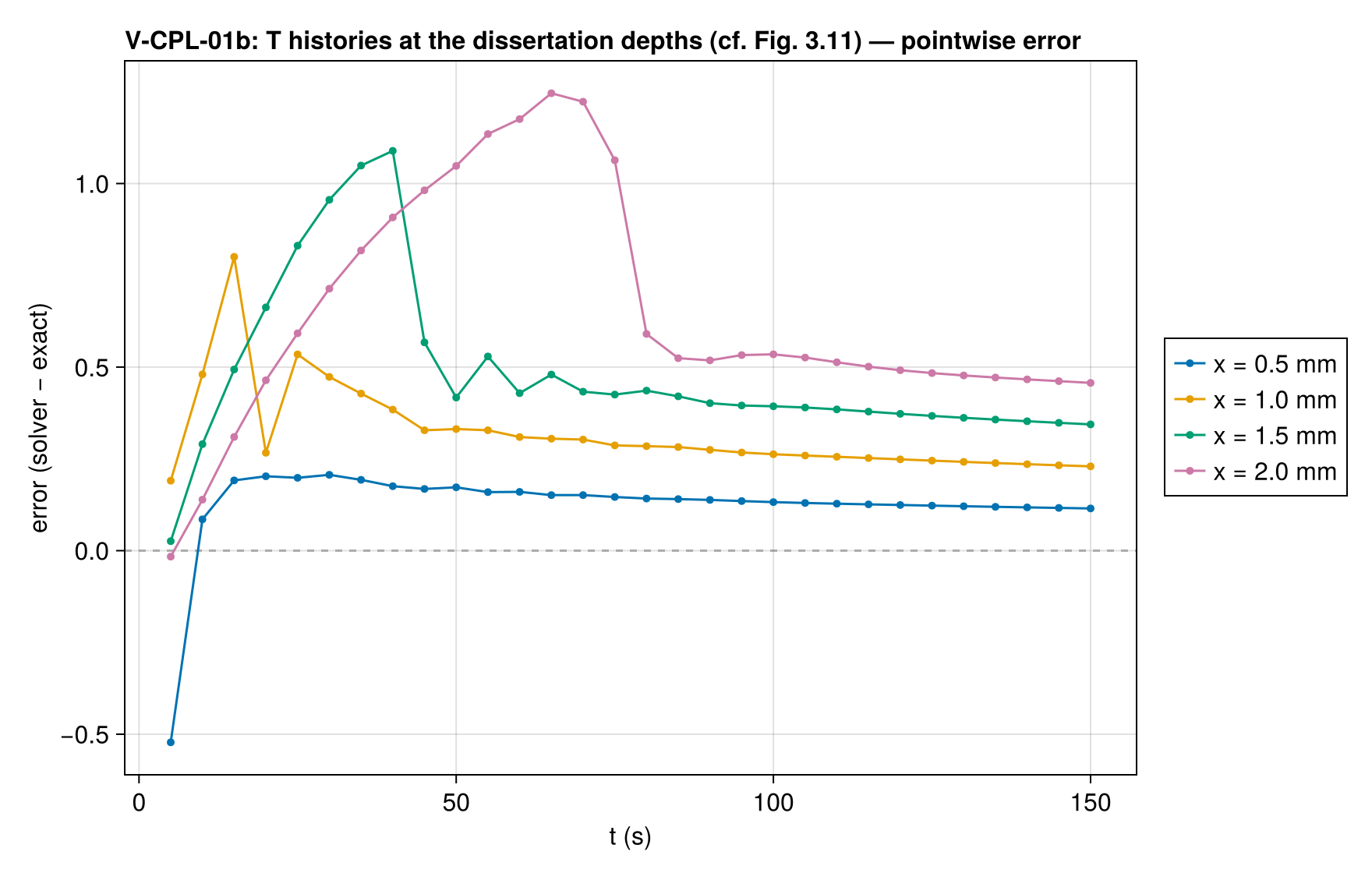
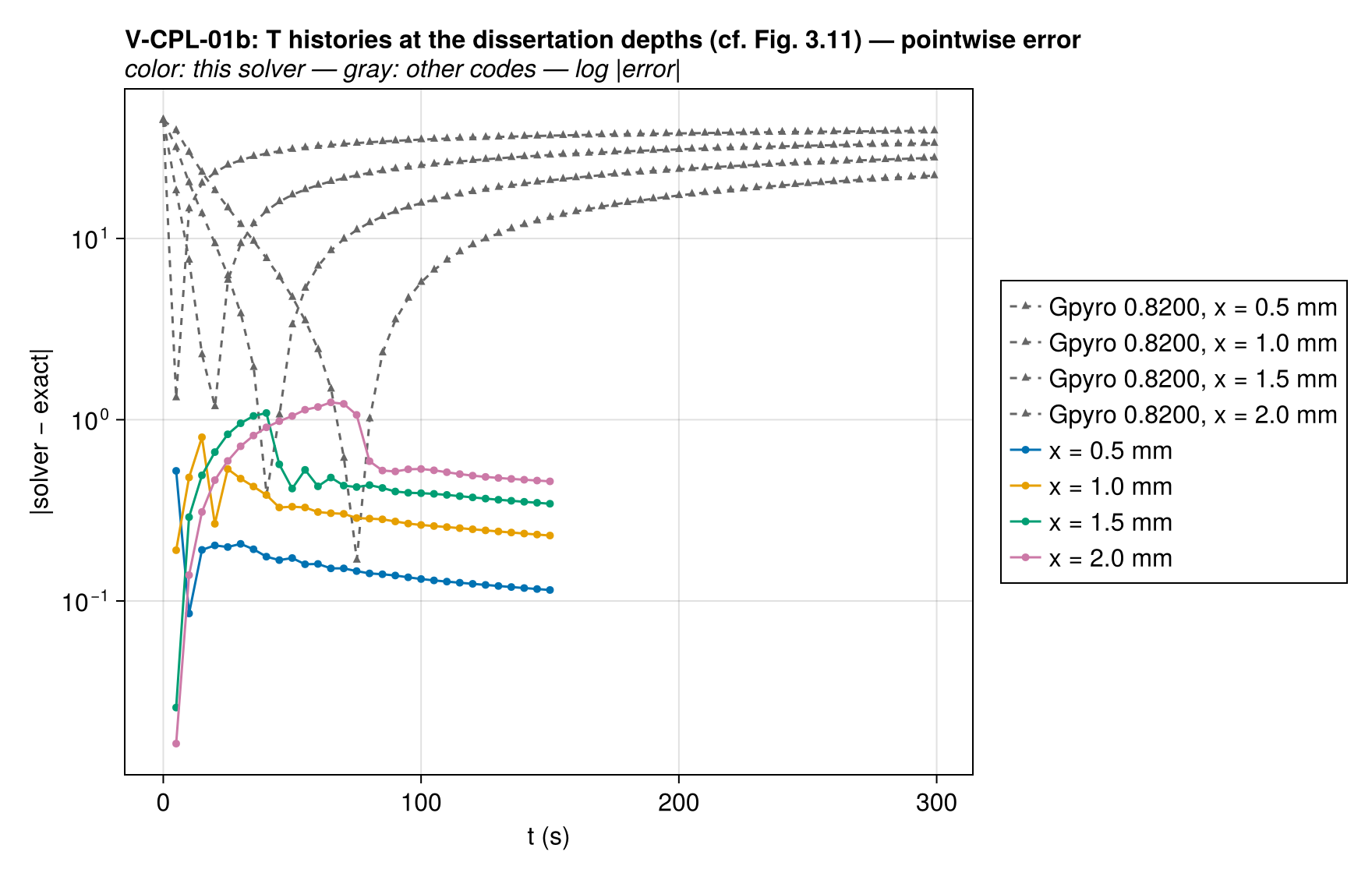
| T-history L∞ error at x = 0.5 mm | 0.1725 | — | 0.1725 | 0.55 | yes | vs exact two-phase profile, t ≥ 50.0 s |
| T-history L∞ error at x = 1.0 mm | 0.3313 | — | 0.3313 | 1.1 | yes | vs exact two-phase profile, t ≥ 50.0 s |
| T-history L∞ error at x = 1.5 mm | 0.5289 | — | 0.5289 | 1.9 | yes | vs exact two-phase profile, t ≥ 50.0 s |
| T-history L∞ error at x = 2.0 mm | 1.246 | — | 1.246 | 3.8 | yes | vs exact two-phase profile, t ≥ 50.0 s |
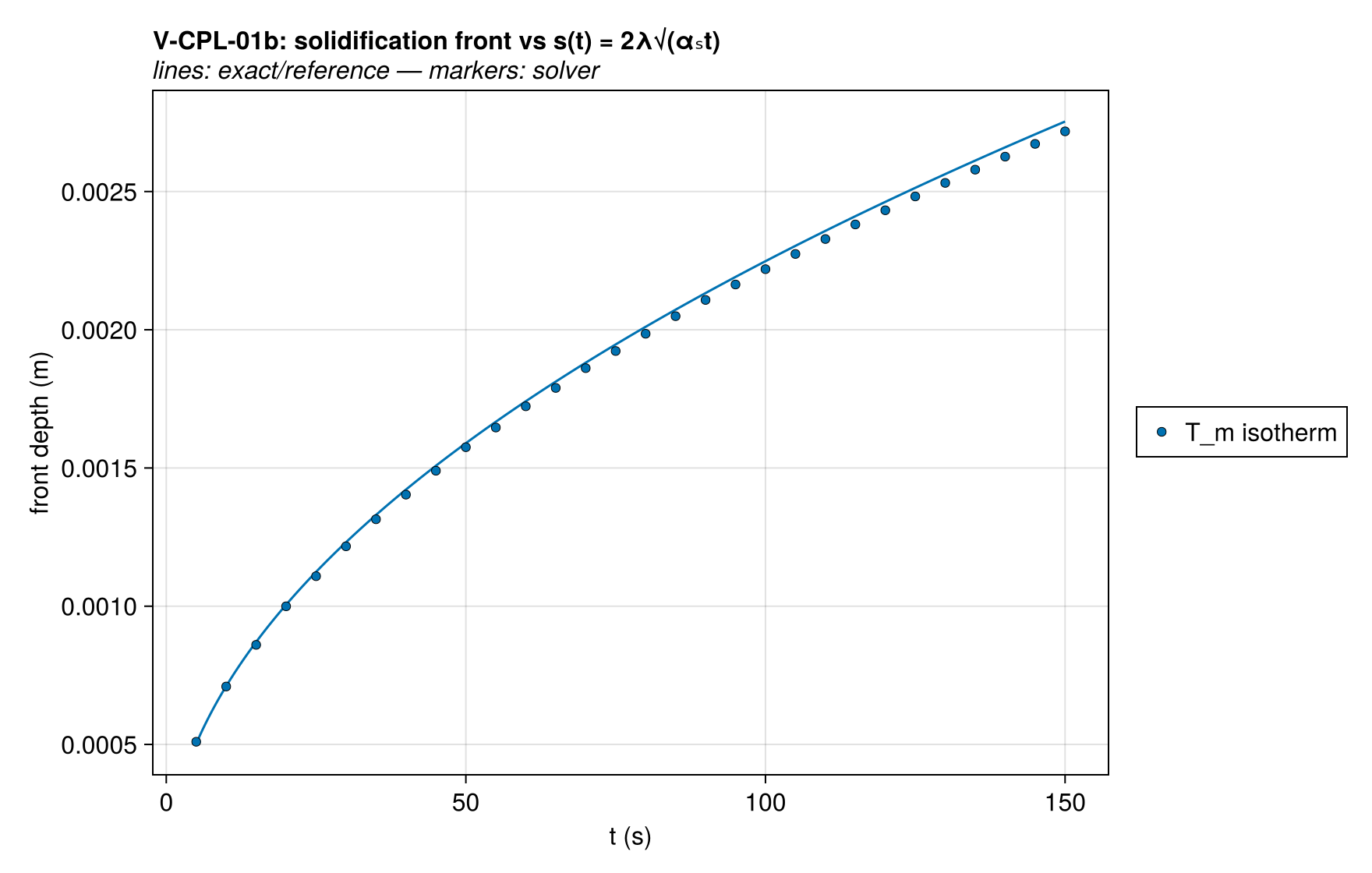
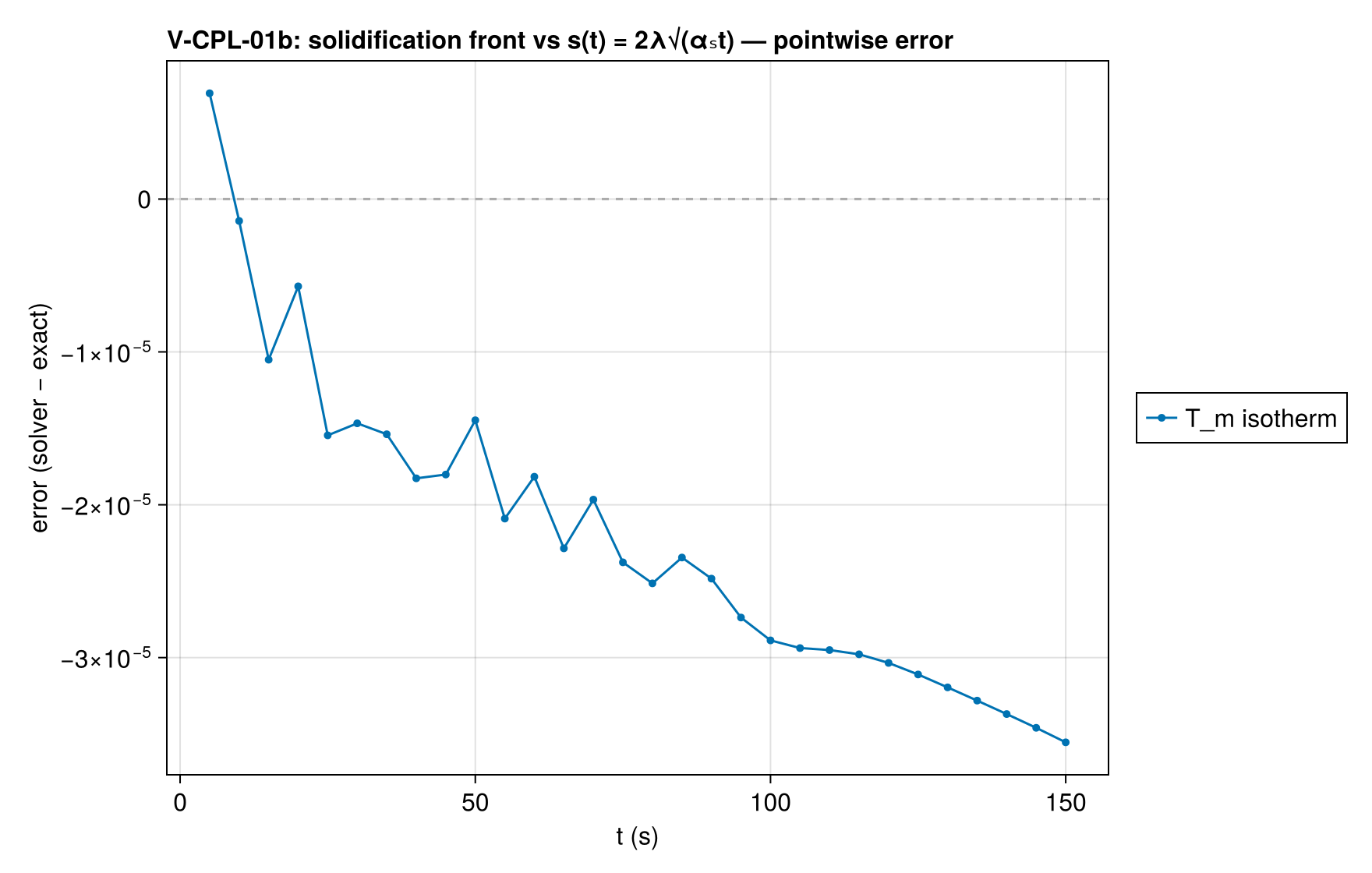
| front position at t = 50.0 s | 0.001575 | 0.00159 | 0.009104 | 0.045 | yes | s(t) = 2λ√(αₛt), λ = 0.31088 |
| front position at t = 100.0 s | 0.002219 | 0.002248 | 0.01284 | 0.045 | yes | s(t) = 2λ√(αₛt), λ = 0.31088 |
| front position at t = 150.0 s | 0.002718 | 0.002753 | 0.01291 | 0.045 | yes | s(t) = 2λ√(αₛt), λ = 0.31088 |
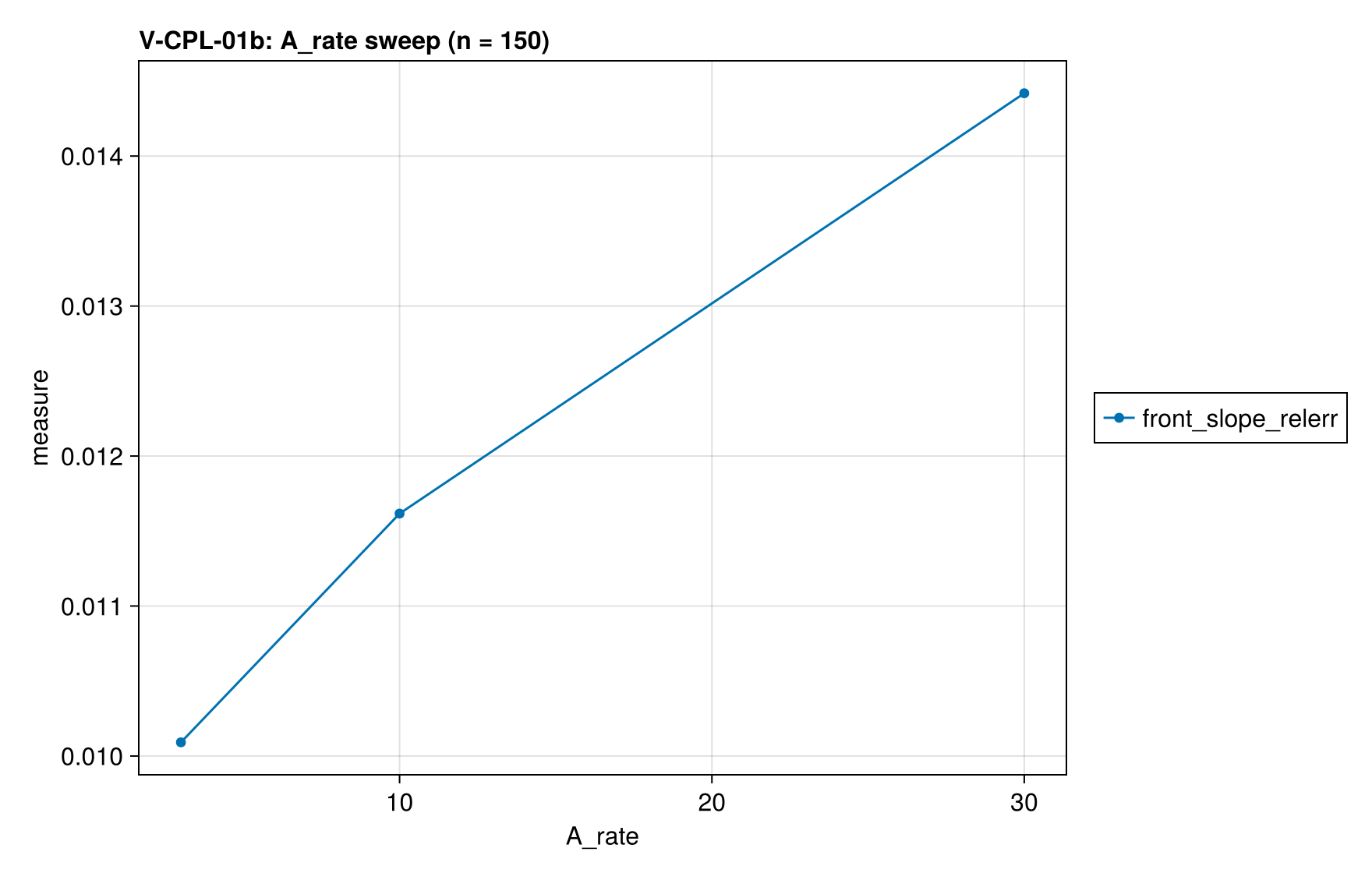
| √t front-growth coefficient | 0.000222 | 0.0002248 | 0.01227 | 0.035 | yes | fit over t ∈ [50.0, 150.0] s |
| back-face disturbance (semi-infinite validity) | 2.541e-08 | 0 | 2.541e-08 | 0.01 | yes | L = 4 cm vs penetration ≈ 1.25 cm |
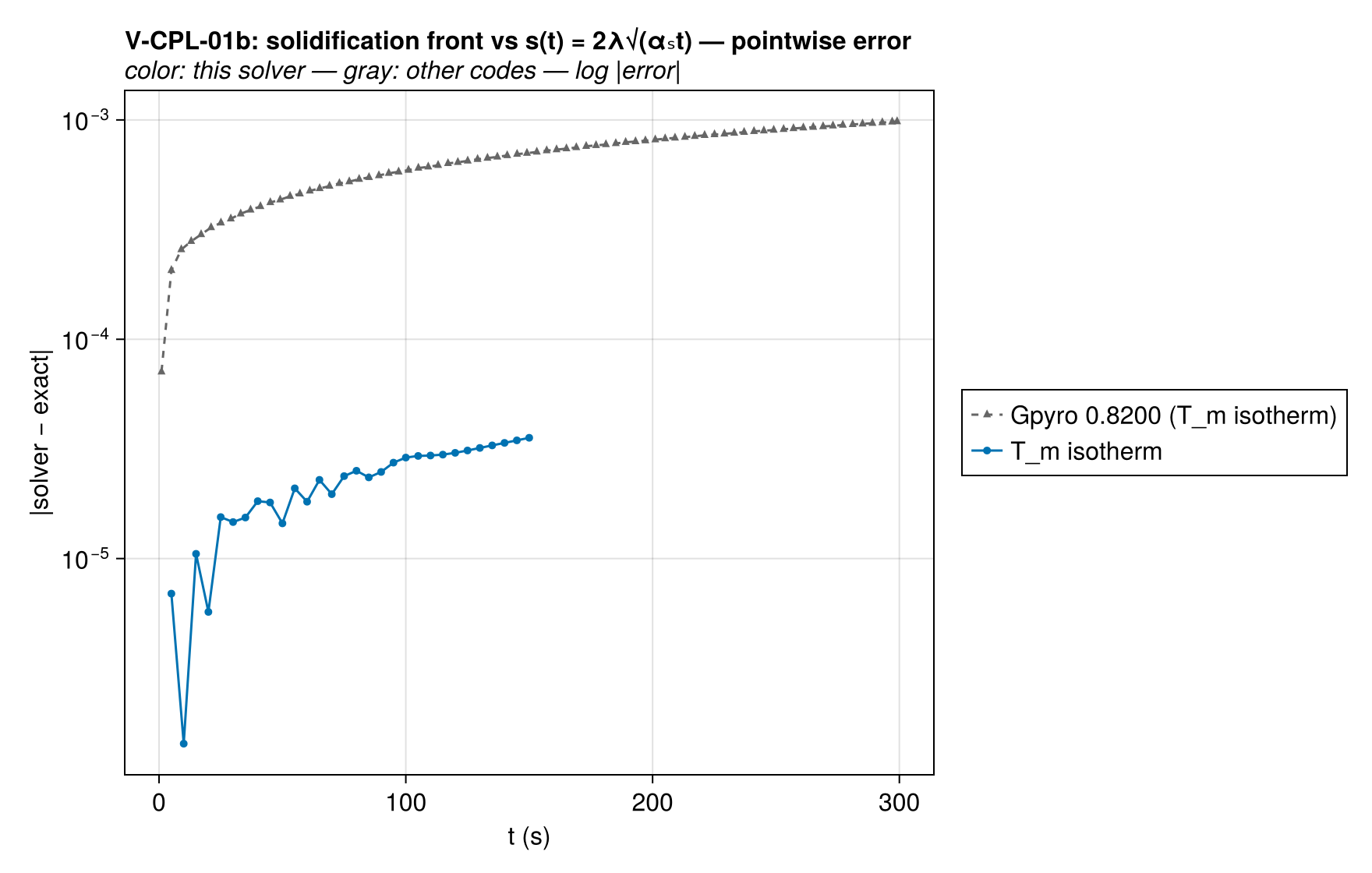
Comparison with other codes
The same case was solved with Gpyro 0.8200 at 801 nodes (Δz=0.05 mm); decks, outputs, and run provenance are committed under test/verification/reference/. Each code's error against the same exact solution is drawn below on a log scale, muted gray behind this solver's series — the signed linear-scale panel above shows where the error lives, this one compares magnitudes across codes.
Wall times at every ladder rung against the reference runs. Resolutions and simulated spans differ where noted (details in reference/timings.csv), so cross-code timings are indicative rather than a controlled benchmark; rungs at a matched resolution are directly comparable.
Solution overlays including the other codes' points: Thistoriesatdepthsvs_codes, fronttrajectoryvs_codes.
Solver configuration
| setting | value |
|---|---|
| integrator | KenCarp4 (default) |
| abstol | 1.0e-8 |
| reltol | 1.0e-6 |