V-CPL-03 — shrink/swell exact endpoints (6 permutations + WithChi law)
Tags: ale, volume_change, swelling, chi, mass_conservation
References:
- FDS Verification Guide
shrink_swell(endpoint concept) - Technical reference Ch. 10/11 (volumetric strain model)
Problem statement
FDS verifies exact final thickness/density for ρproduct ≷ ρreactant permutations. Under OUR volumetric-strain model the endpoint follows from (technical reference Ch. 10/11; src/Physics/volume_change.jl):
V̇/V = θ = Σⱼ (γⱼ/ρⱼ) ω̇ⱼ
with ω̇ⱼ the reaction mass rates [kg/m³/s]. For a single reaction A → Σⱼ yⱼ Bⱼ (Σyⱼ = 1) at rate r: ω̇A = −r, ω̇Bⱼ = +yⱼ r, so per cell
dV = (γA/ρA − Σⱼ yⱼ γⱼ/ρⱼ) dmA (r V dt = −dmA)
— LINEAR in the converted mass, hence path-independent: the endpoint is exact regardless of rate history, temperature, or spatial distribution. Integrating from mA = ξA0·V₀ to 0, with the standard initialization ξA0 = ρA (bulk density) and γ_A = 1:
Vf/V₀ = 1 − γA + Σⱼ yⱼ γⱼ ρA/ρⱼ = Σⱼ yⱼ γⱼ ρA/ρⱼ
and a pure solid product ends exactly at bulk density ρB/γB. All ρ here are the components' BULK densities (the strain kernel uses bulk ρ, not ρ_intrinsic — see the SolidComponent docstring note).
NOTE a γ > 1 intumescent branch is NOT representable: γ is validated to [0, 1] (universal volume-fraction semantics shared with mixture density and conductivity mixing). Swelling is exercised through ρB < ρA (P1) and the partial-contribution branch through γ_B ∈ (0, 1) (P6). Documented as a model limitation.
Permutations (ρA = 1000, γA = 1, isothermal via E = 0, h = 0, everything impermeable). Mass QoIs: EVERY permutation asserts total-mass conservation to integrator tolerance — the gas mesh-motion transport is the conservative flux form (tech-ref §11.2.3), so held gas in a collapsing impermeable matrix compresses (ξg ↑ as V ↓) instead of being deleted with the vanishing volume (a non-telescoping pointwise form would lose tens of percent of total mass in P4 — that configuration is the regression anchor). Gas-producing permutations additionally assert the SOLID ledger (char endpoint = ychar·m_A0 exactly).
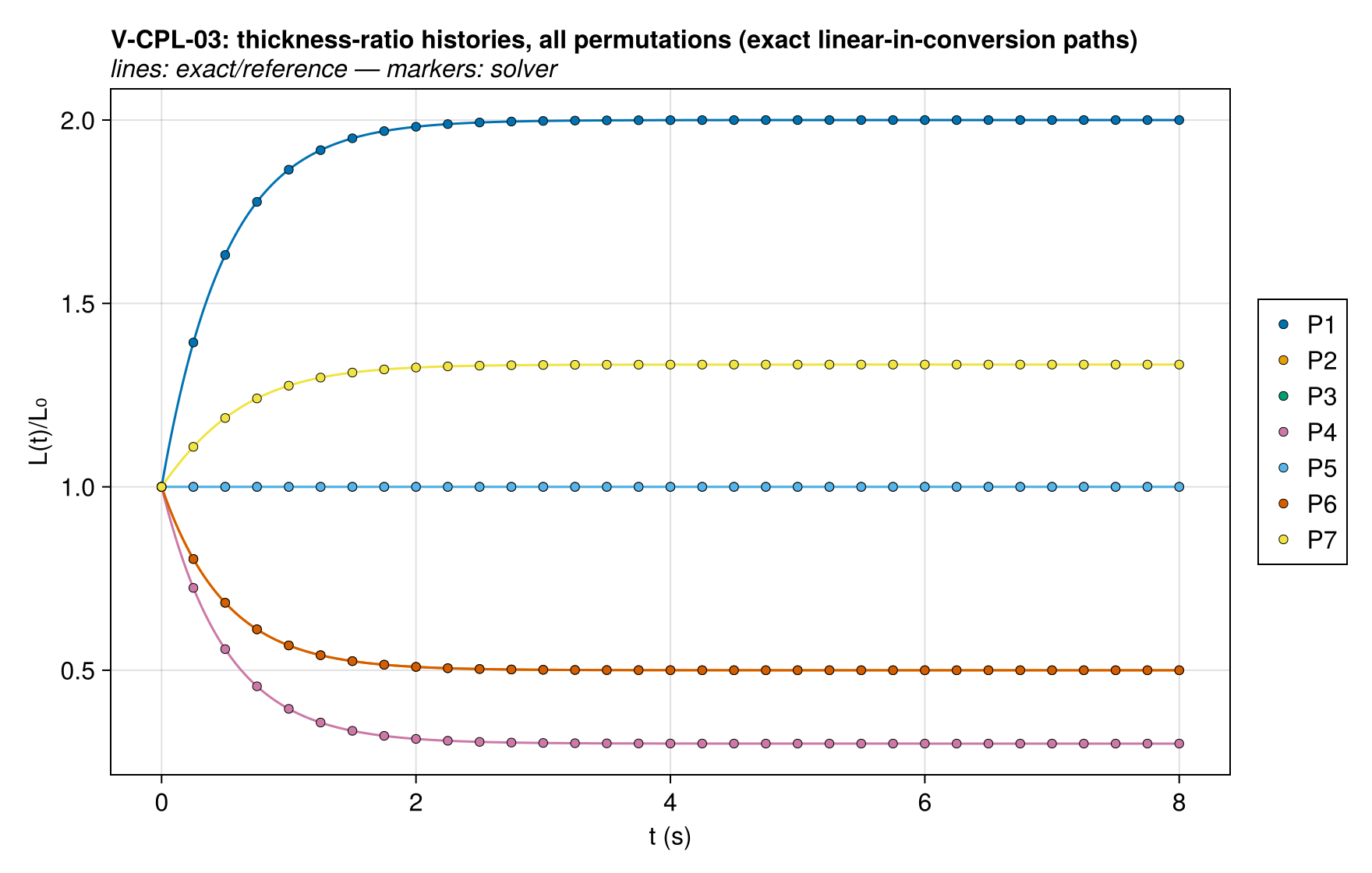
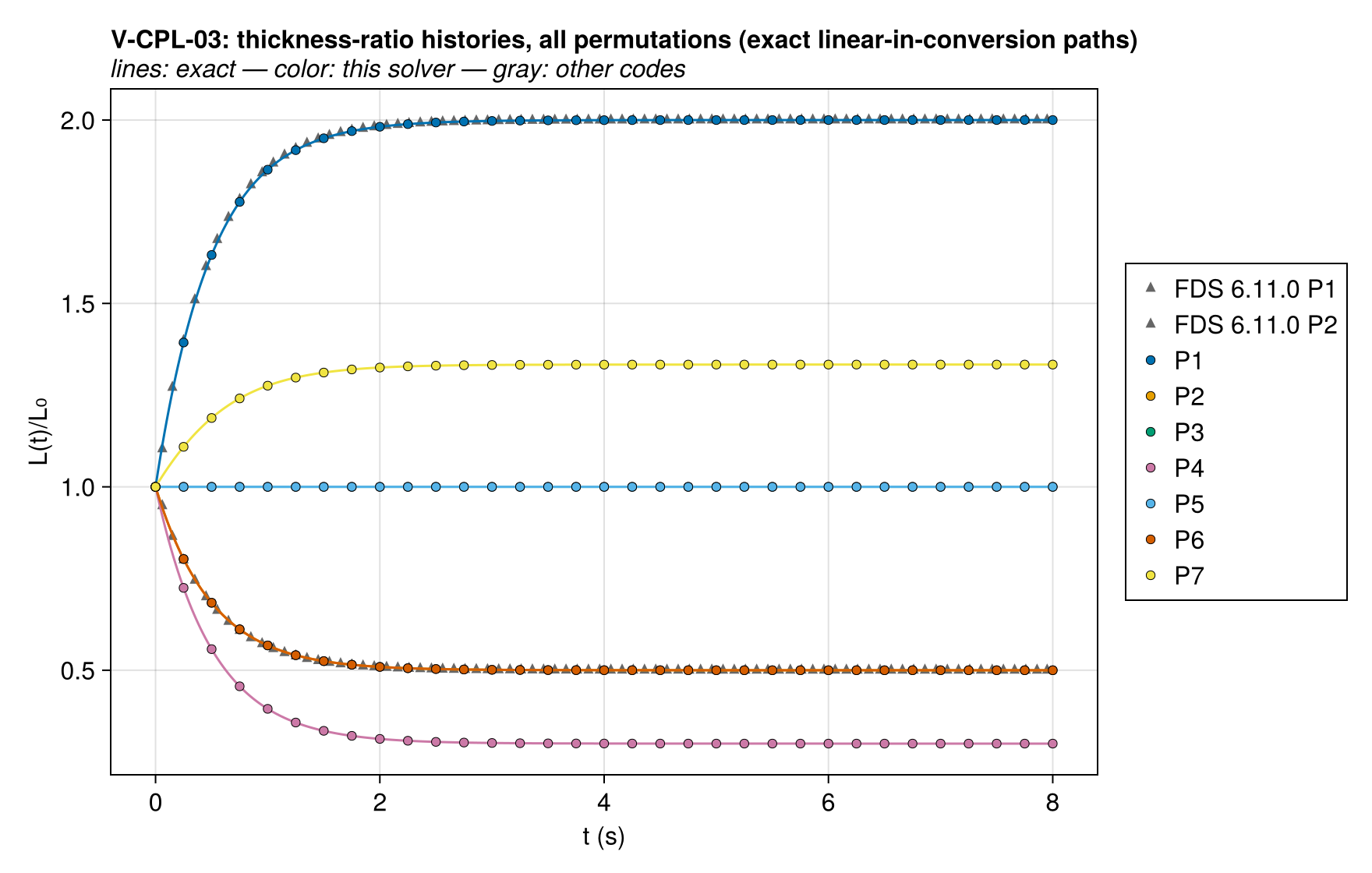
P1 swell: A → B(ρ=500) Vf/V₀ = 2 P2 shrink: A → B(ρ=2000) Vf/V₀ = 1/2 P3 neutral: A → B(ρ=1000) Vf/V₀ = 1 P4 char + gas: A → 0.3 C(ρ=1000) + 0.7 G Vf/V₀ = 0.3 P5 mass loss, ΔV=0: A → 0.5 C(ρ=500) + 0.5 G Vf/V₀ = 1 P6 partial γ: A → B(ρ=1000, γ=0.5) Vf/V₀ = 1/2 P7 WithChi: P5 chemistry + lateral law A/A₀ = 1 − 0.5·χ̄ χ̄f = 0.5 (released dry-mass fraction) ⇒ Af/A₀ = 0.75 exactly, Lf/L₀ = (Vf/V₀)/(A_f/A₀) = 4/3.
P1 (the swelling branch, exercising mesh GROWTH) runs through the standard harness path; the remaining permutations are solved inside qois (each is a ~1 s, 8-cell isothermal solve) so the whole family stays one case.
First-order kinetics with Ar·tend = 16 ⇒ residual conversion e⁻¹⁶ ≈ 1e-7 bounds the endpoint error; the depletion limiter is disabled so the decay stays exactly first-order (with it, the tail below ~1 kg/m³ slows and the residual at fixed t_end grows ~1000×).
Quantities of interest (n = 8)
| QoI | value | exact | error | tolerance | within tol | provenance |
|---|---|---|---|---|---|---|
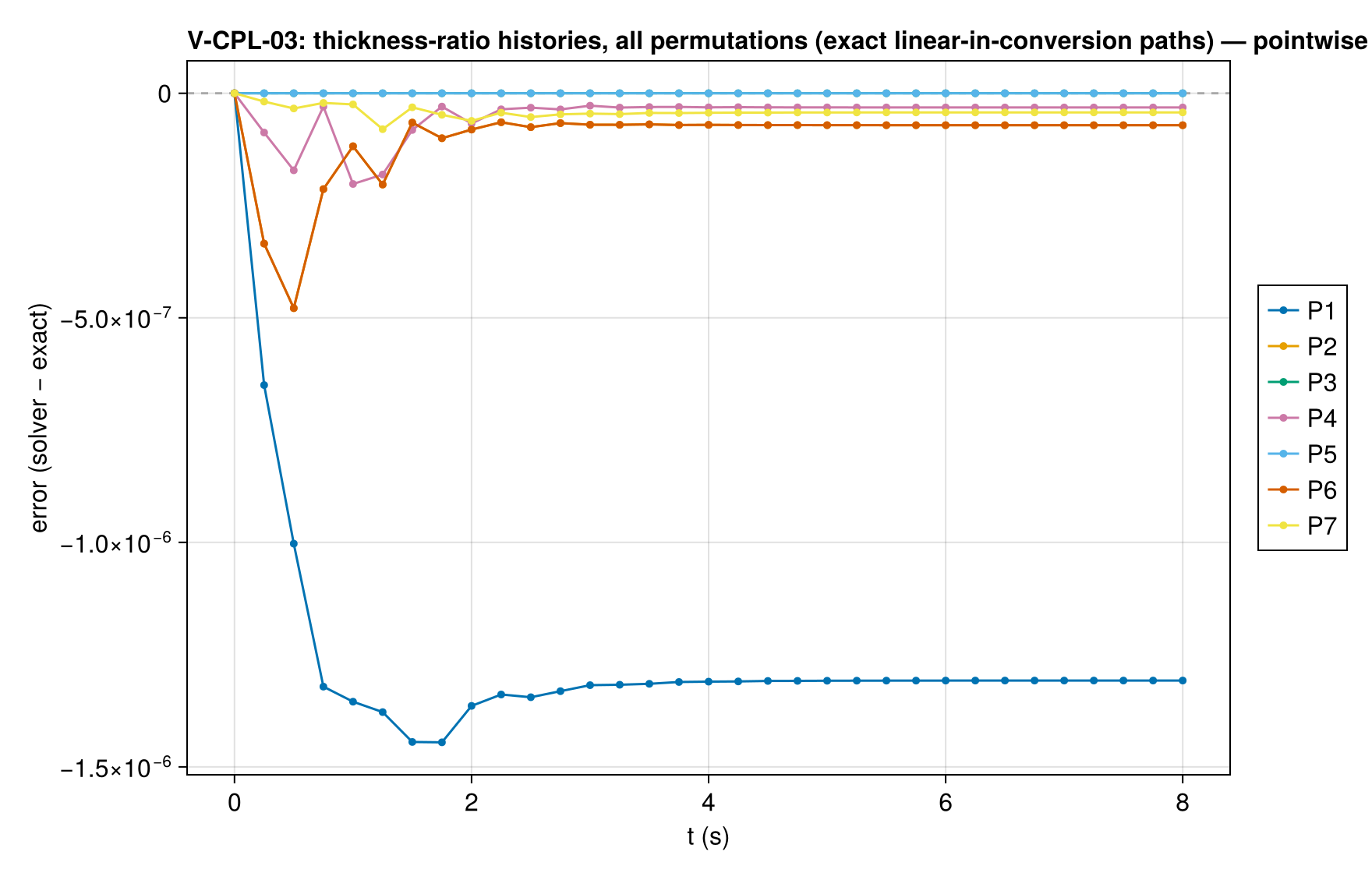
| P1: final thickness ratio | 2 | 2 | 7.102e-07 | 3e-06 | yes | path-independent endpoint of θ = Σγⱼω̇ⱼ/ρⱼ (case header) |
| P1: total mass conservation | 2 | 2 | 6.539e-07 | 2e-06 | yes | solid-only permutation; impermeable everywhere |
| P2: final thickness ratio | 0.5 | 0.5 | 2.981e-08 | 3e-06 | yes | path-independent endpoint of θ = Σγⱼω̇ⱼ/ρⱼ (case header) |
| P2: total mass conservation | 2 | 2 | 1.423e-07 | 2e-06 | yes | solid-only permutation; impermeable everywhere |
| P3: final thickness ratio | 1 | 1 | 0 | 3e-06 | yes | path-independent endpoint of θ = Σγⱼω̇ⱼ/ρⱼ (case header) |
| P3: total mass conservation | 2 | 2 | 0 | 2e-06 | yes | solid-only permutation; impermeable everywhere |
| P4: final thickness ratio | 0.3 | 0.3 | 1.571e-07 | 3e-06 | yes | path-independent endpoint of θ = Σγⱼω̇ⱼ/ρⱼ (case header) |
| P4: total mass conservation | 2 | 2 | 1.055e-07 | 2e-06 | yes | held gas compresses under collapse (flux form); the P4 corner is the Finding-2 regression anchor |
| P4: final char mass (solid ledger) | 0.6 | 0.6 | 2.18e-07 | 2e-06 | yes | char endpoint is path-independent; complements the total-mass anchor |
| P5: final thickness ratio | 1 | 1 | 0 | 3e-06 | yes | path-independent endpoint of θ = Σγⱼω̇ⱼ/ρⱼ (case header) |
| P5: total mass conservation | 2 | 2 | 6.661e-16 | 2e-06 | yes | held gas compresses under collapse (flux form); the P4 corner is the Finding-2 regression anchor |
| P5: final char mass (solid ledger) | 1 | 1 | 1.125e-07 | 2e-06 | yes | char endpoint is path-independent; complements the total-mass anchor |
| P6: final thickness ratio | 0.5 | 0.5 | 2.981e-08 | 3e-06 | yes | path-independent endpoint of θ = Σγⱼω̇ⱼ/ρⱼ (case header) |
| P6: total mass conservation | 2 | 2 | 1.423e-07 | 2e-06 | yes | solid-only permutation; impermeable everywhere |
| P7: final thickness ratio | 1.333 | 1.333 | 6.951e-08 | 3e-06 | yes | path-independent endpoint of θ = Σγⱼω̇ⱼ/ρⱼ (case header) |
| P7: total mass conservation | 2 | 2 | 1.979e-08 | 2e-06 | yes | held gas compresses under collapse (flux form); the P4 corner is the Finding-2 regression anchor |
| P7: final char mass (solid ledger) | 1 | 1 | 1.323e-07 | 2e-06 | yes | char endpoint is path-independent; complements the total-mass anchor |
| P7: final lateral area ratio A_f/A₀ = law(χ̄ = 1/2) | 0.75 | 0.75 | 4.972e-08 | 3e-06 | yes | χ̄f = released dry-mass fraction = ygas = 0.5 |
Comparison with other codes
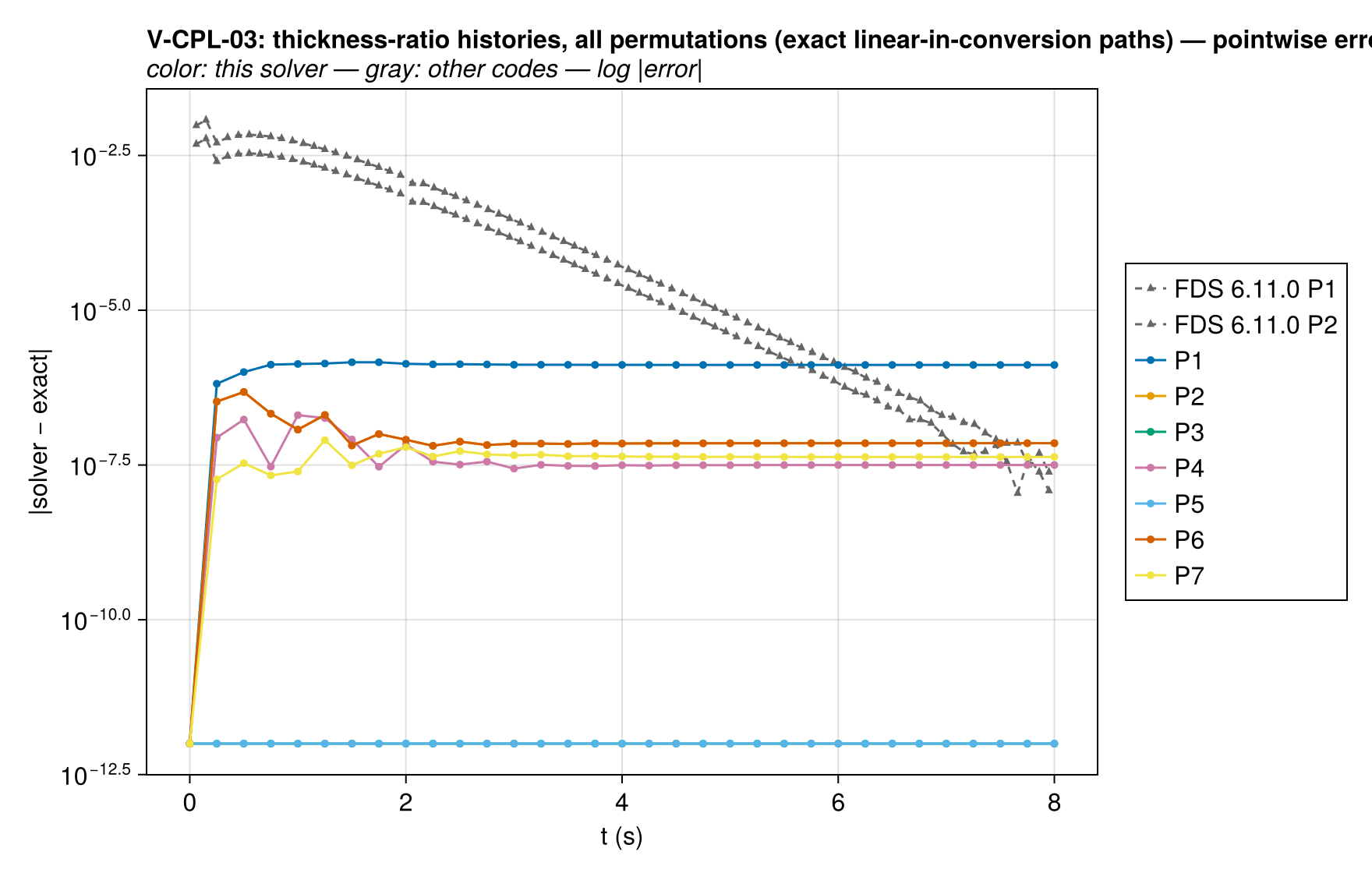
The same case was solved with FDS 6.11.0 at 4 cells (2 mm slab; stretched); decks, outputs, and run provenance are committed under test/verification/reference/. Each code's error against the same exact solution is drawn below on a log scale, muted gray behind this solver's series — the signed linear-scale panel above shows where the error lives, this one compares magnitudes across codes.
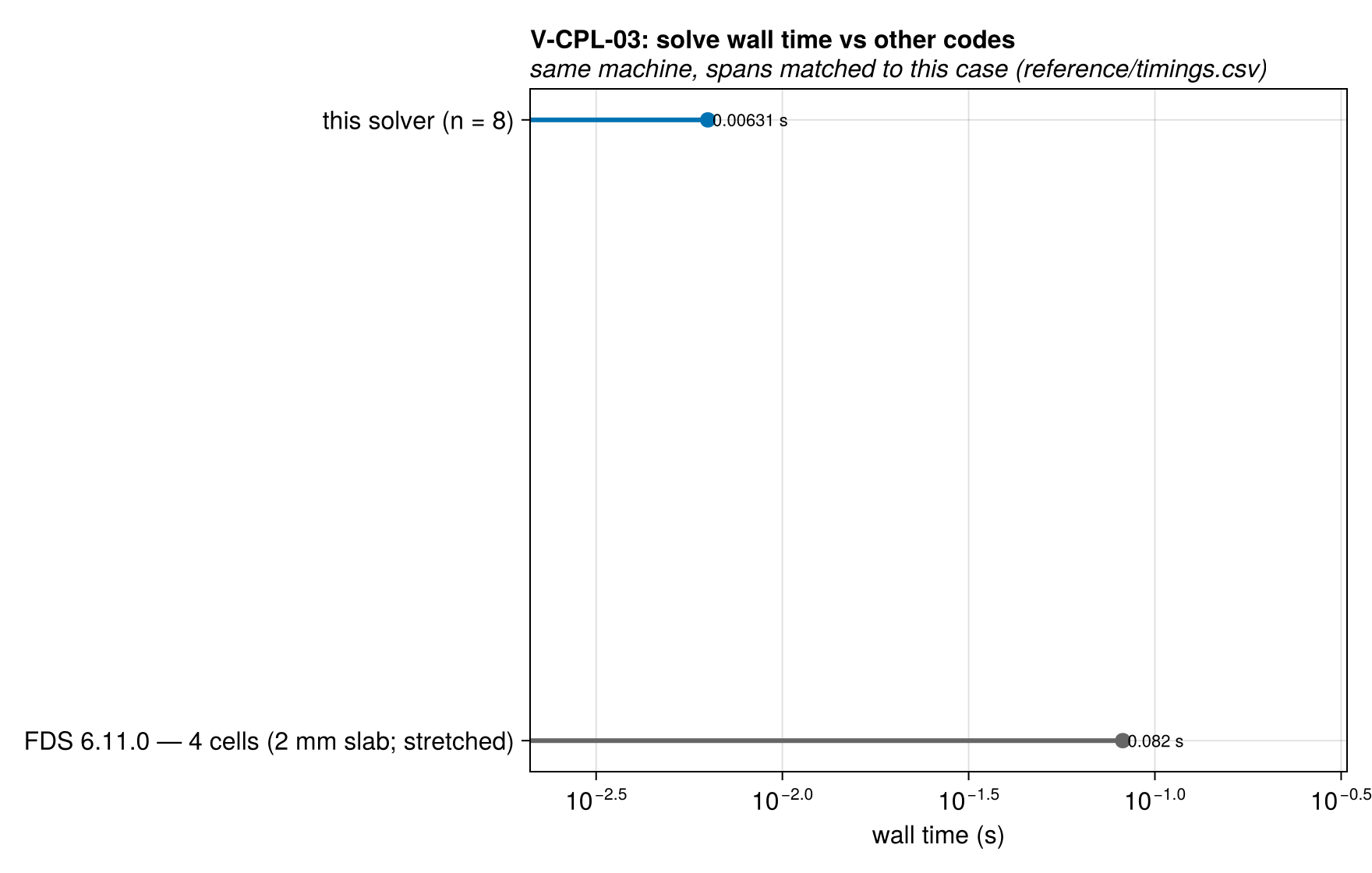
Wall times at every ladder rung against the reference runs. Resolutions and simulated spans differ where noted (details in reference/timings.csv), so cross-code timings are indicative rather than a controlled benchmark; rungs at a matched resolution are directly comparable.
Solution overlays including the other codes' points: thicknesshistoriesvs_codes.
Solver configuration
| setting | value |
|---|---|
| integrator | KenCarp4 (default) |
| use_ale | true |
| min_thickness | 1.0e-5 |
| abstol | 1.0e-10 |
| reltol | 1.0e-8 |