V-MMS-01 — manufactured solution, coupled kinetics + T-props + gas transport
Tags: mms, coupled, kinetics, gas_transport, order_verification
References:
- Roache, Verification and Validation in Computational Science (MMS methodology)
- docs/guide/technicalreference/18verification-validation.md §18.2 (the documented gap)
- FDS Verification Guide (MMS usage precedent, fluid phase)
Problem statement
Method of Manufactured Solutions over the coupled energy + kinetics + gas transport operators — the only formal order-of-accuracy verification of the coupled system (every other case has zero residual source; tech ref §18.2 documents this gap; FDS uses MMS for the same reason in the fluid phase).
Active couplings, all with O(1) contributions over the space–time domain:
- T-dependent k(T), c(T) on both condensed components (mixture rules live, composition varying in z and t);
- two-step kinetics A → 0.65 B + 0.35 gas (endothermic) and B → gas (exothermic): intermediate B produced and consumed, reaction heat feeding back into the energy equation, gas produced into the transport field;
- Fickian gas transport in the ThermaKin volume-fraction-gradient form J = −(λeff/T)∂z(ξT), with per-component λ so λeff is state-dependent;
- gas-advection energy source Sconv = −cpg·J·∂zT;
- manufactured Neumann BCs (HeatFluxBC/MassFluxBC callables of t) — the Dirichlet face reconstruction is first-order and would cap the observed order (see exact/mms.jl header, design decision 3).
The manufactured sources are assembled by nested ForwardDiff through the package's own property/kinetics functions (exact/mms.jl), injected at the state-derivative level so the analytic Structured Jacobian remains exact — this case runs with the DirectSolve Jacobian attached (its agreement with colored FD is asserted in the driver self-tests).
The depletion limiter is left at the material default: the source generator evaluates the identical rate law, and every reactant concentration stays
20× the 1 kg/m³ threshold, where the tanh factor is exactly 1.0 in
Float64. Temperature gates are at defaults (fully open).
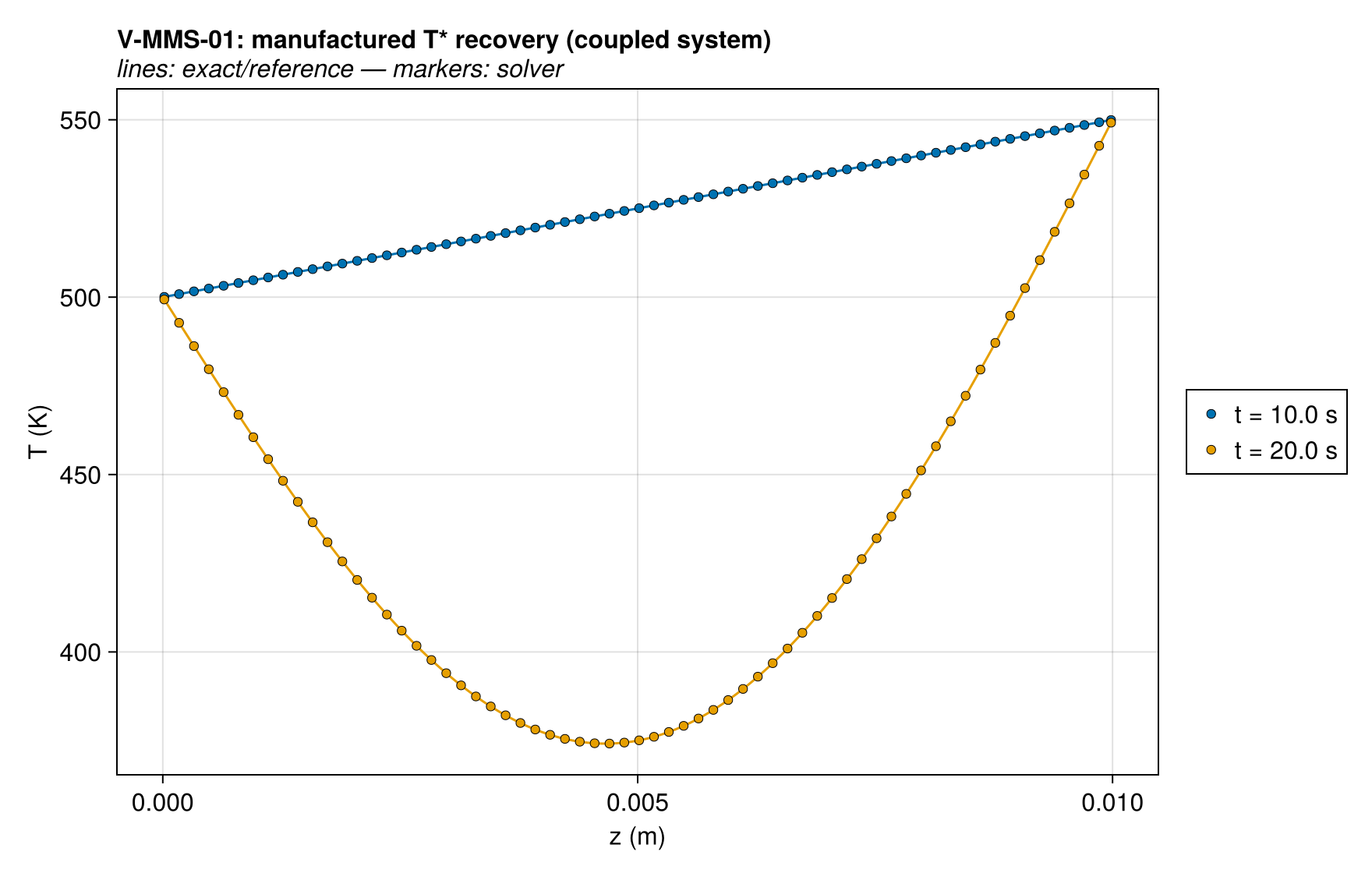
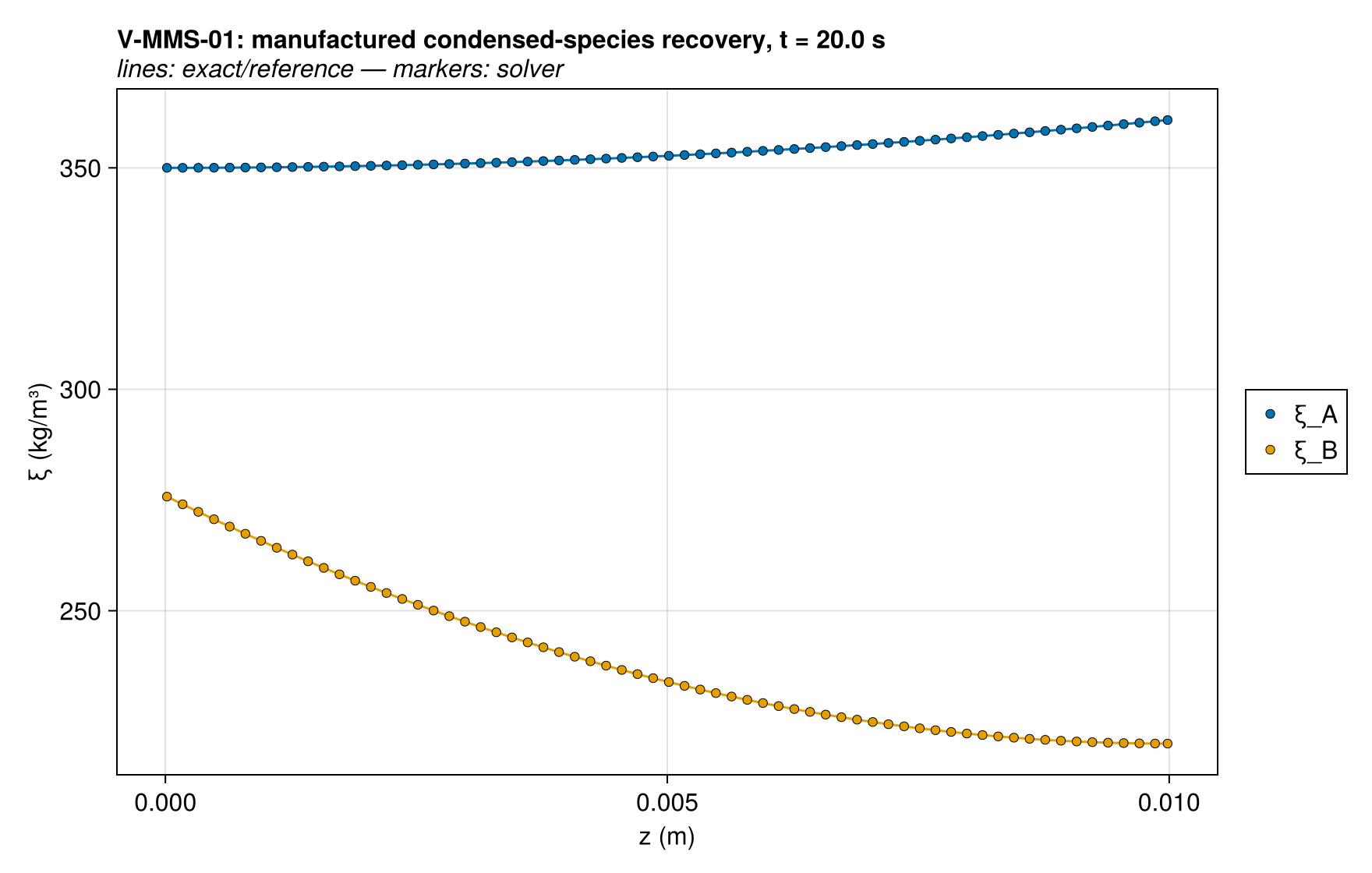
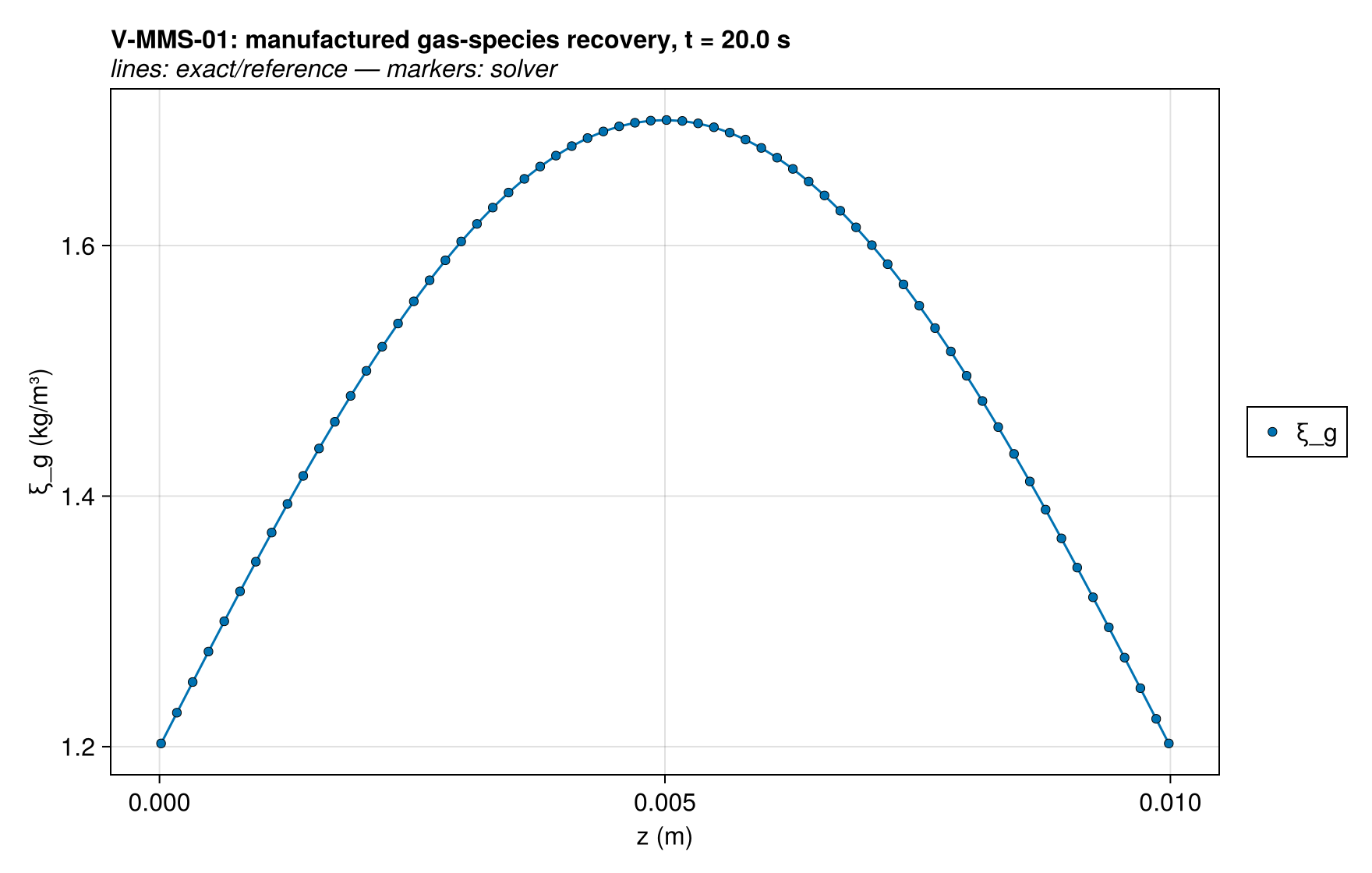
Fields (z̃ = z/L, smooth, strictly positive concentrations): T* = 500 + 150·sin(πz̃)·cos(ωt) + 50·z̃ [K] (≈ 350–700 K) ξ_A = 350 + 80·z̃²·e^(−t/τ) [kg/m³] ξB = 220 + 60·(1−z̃)²·(1 − 0.5·e^(−t/τ)) [kg/m³] ξ*g = 1.2 + 0.5·sin(πz̃)·(1 + 0.3·sin(ωt)) [kg/m³]
Quantities of interest (n = 320)
| QoI | value | exact | error | tolerance | within tol | provenance |
|---|---|---|---|---|---|---|
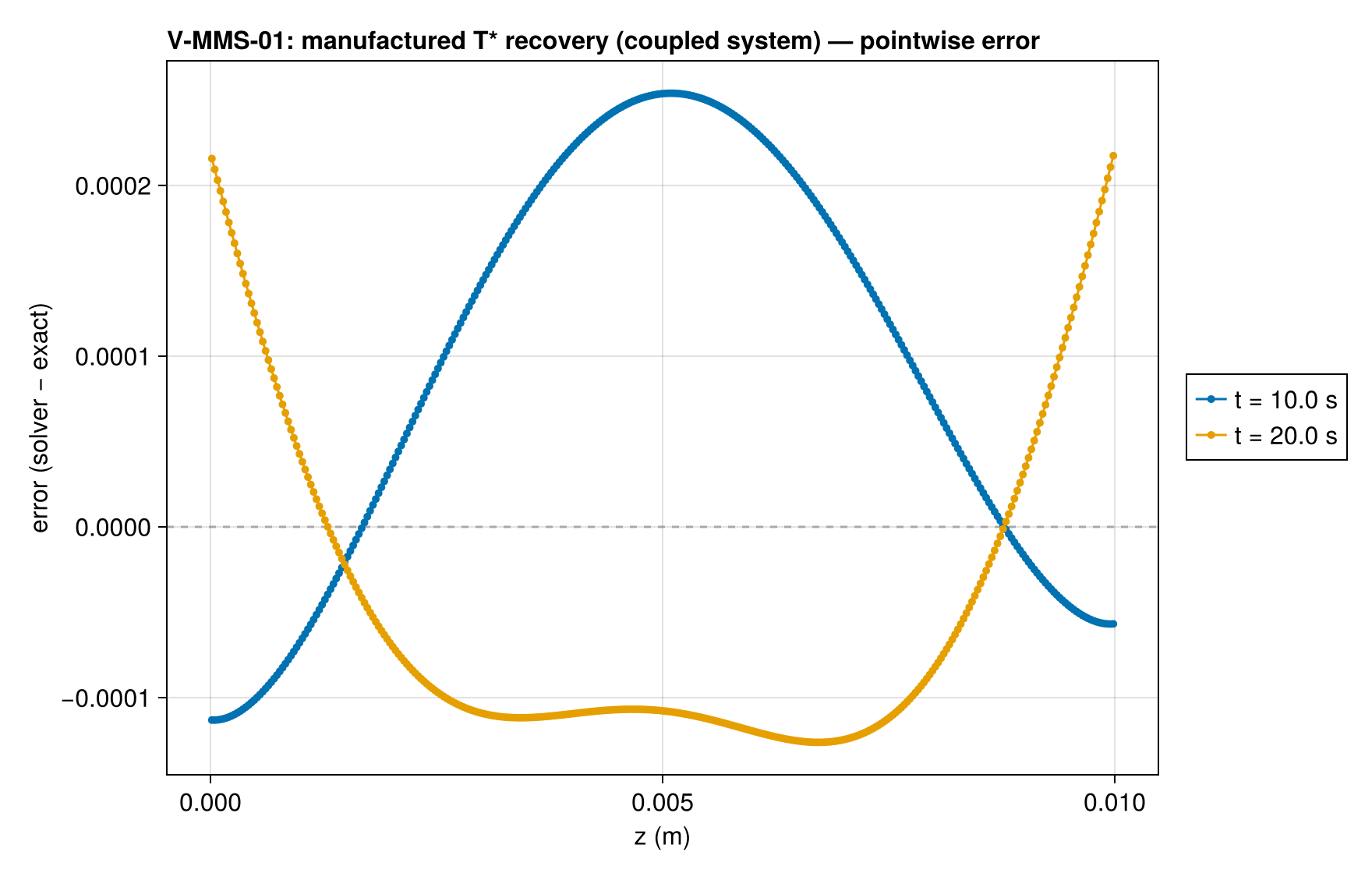
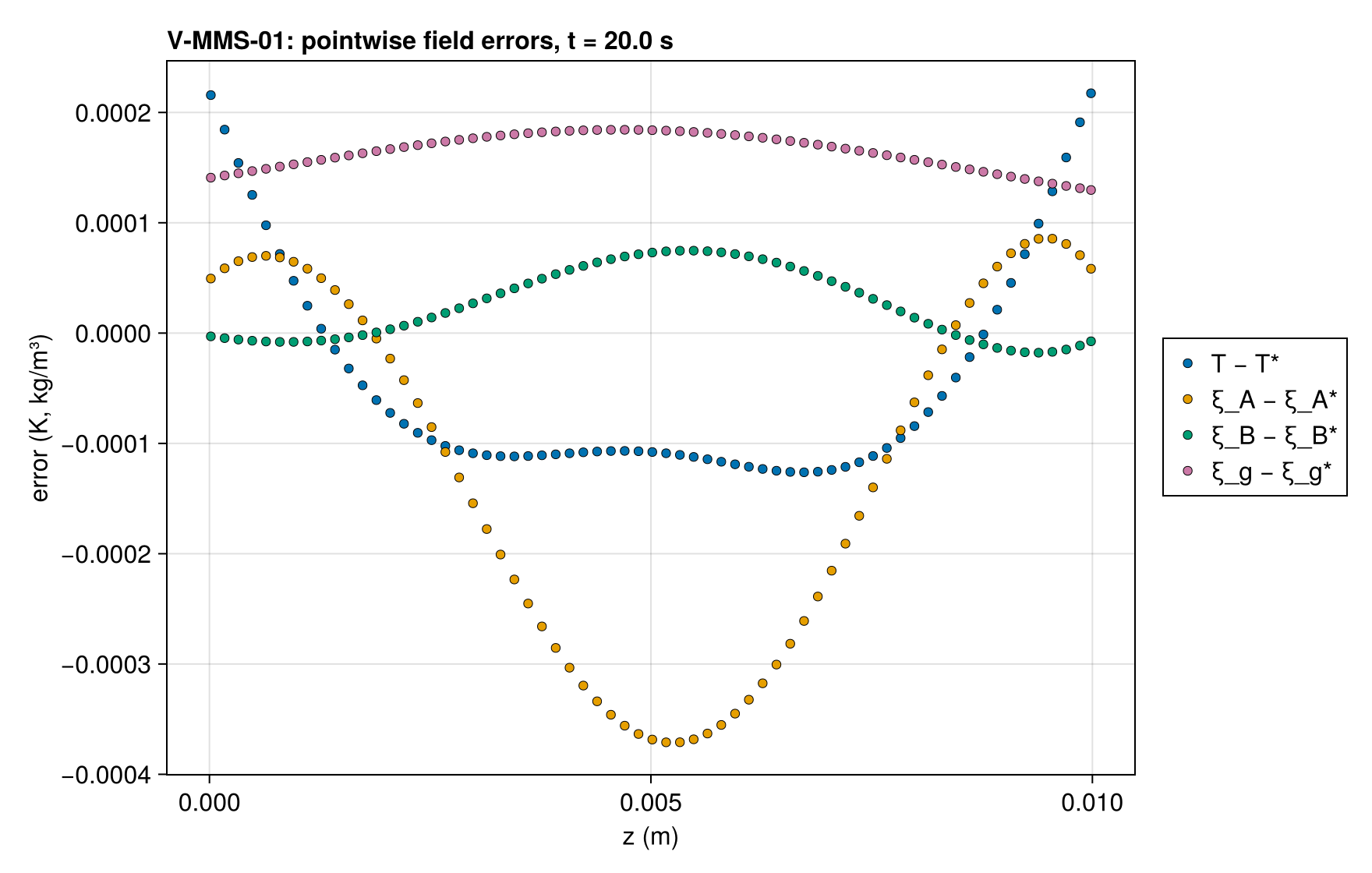
| L∞ T error, t=10.0 s | 0.000254 | — | 0.000254 | 0.05 | yes | manufactured T* recovered on the coupled system; observed 0.0163/0.0124 K at t=10/20 s |
| L∞ T error, t=20.0 s | 0.0002174 | — | 0.0002174 | 0.05 | yes | manufactured T* recovered on the coupled system; observed 0.0163/0.0124 K at t=10/20 s |
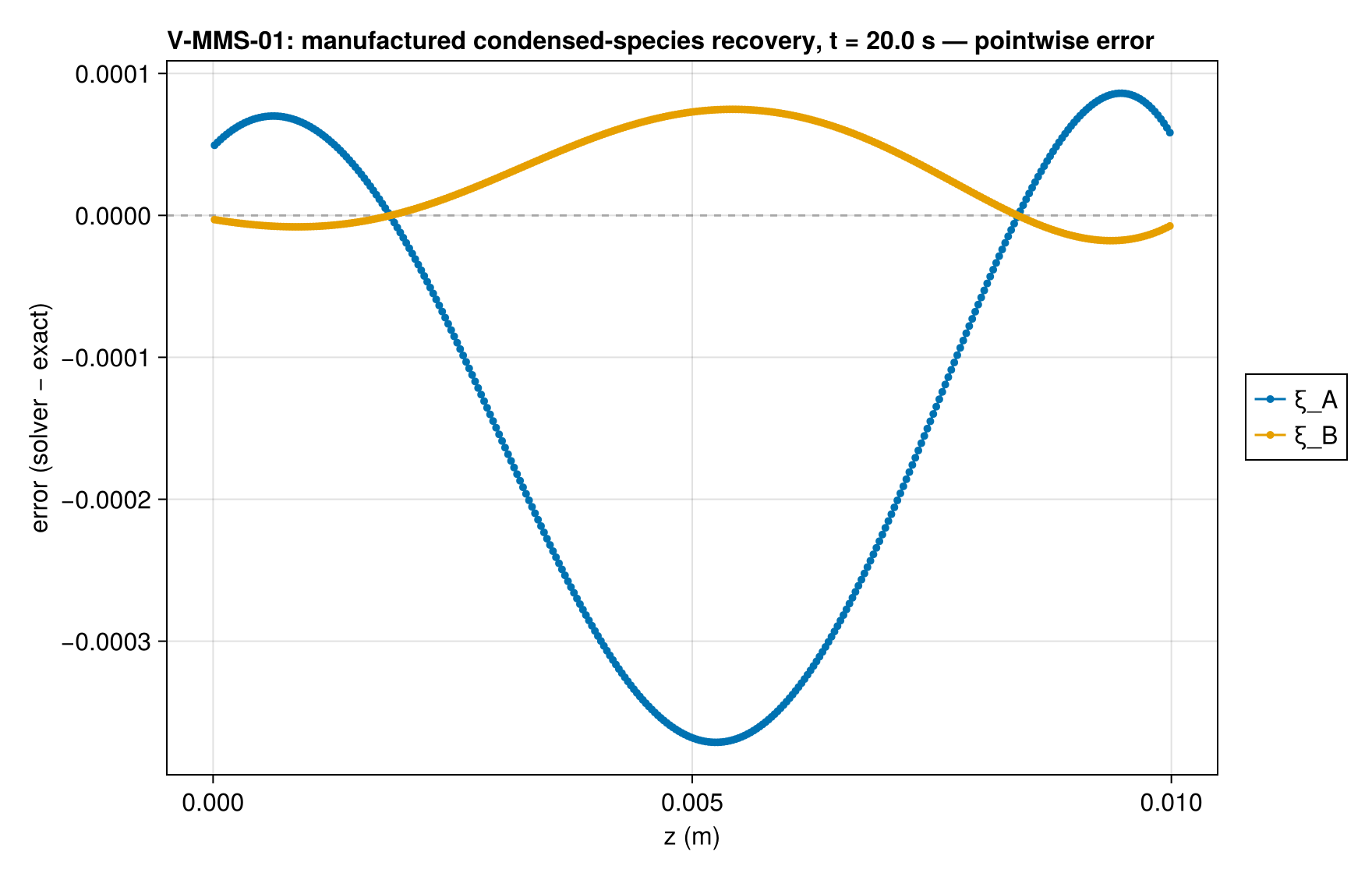
| relative L∞ ξ_A error, t=20.0 s | 1.061e-06 | — | 1.061e-06 | 0.0002 | yes | scale = manufactured baseline; observed 6.8e-5; L∞ ξ orders ≈ 2.0 on [20,40,80] at pin time |
| relative L∞ ξ_B error, t=20.0 s | 3.397e-07 | — | 3.397e-07 | 0.0001 | yes | scale = manufactured baseline; observed 2.2e-5; L∞ ξ orders ≈ 2.0 on [20,40,80] at pin time |
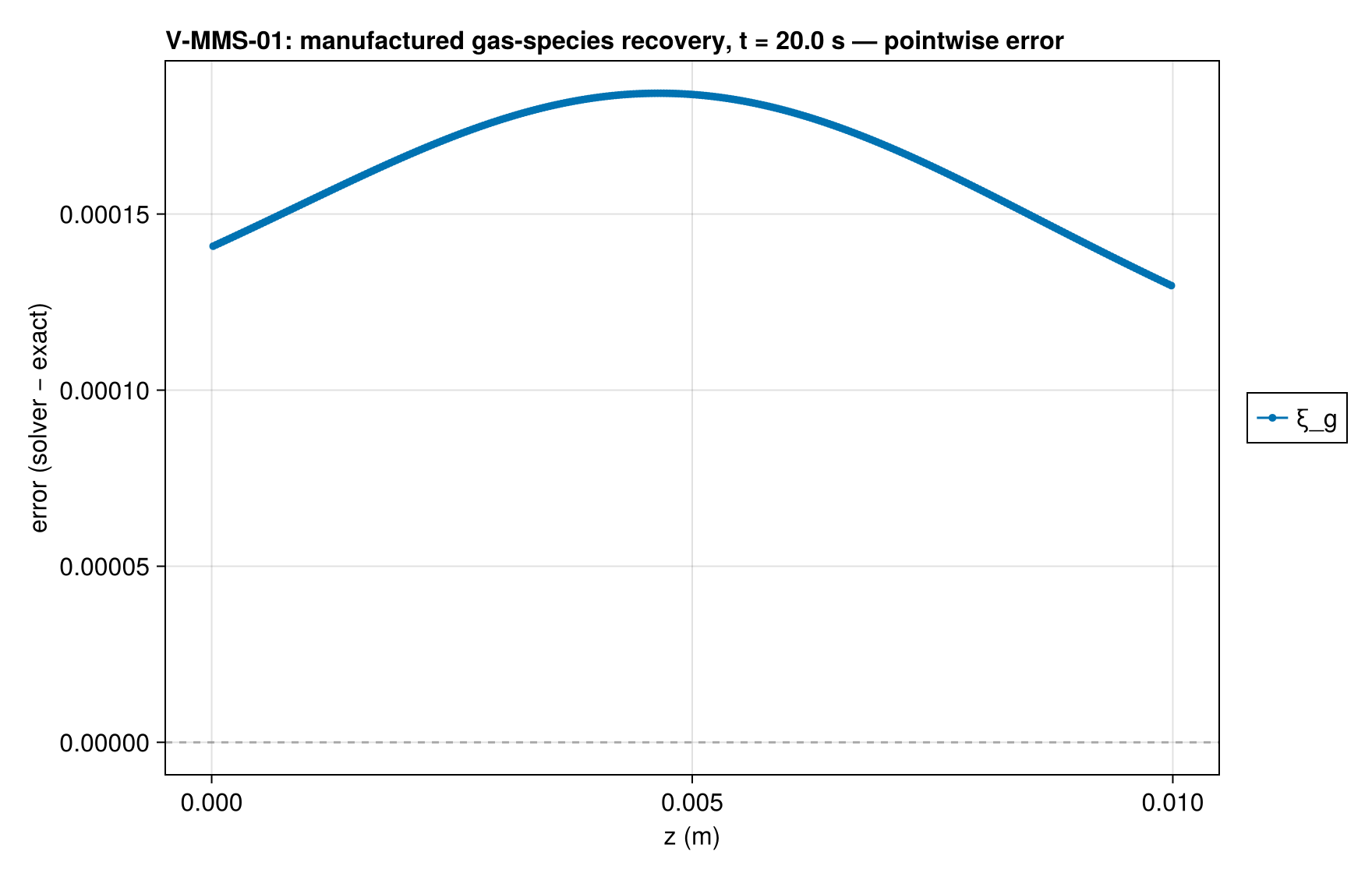
| relative L∞ ξ_gas error, t=20.0 s | 0.0001536 | — | 0.0001536 | 0.03 | yes | scale = manufactured baseline; observed 9.8e-3; L∞ ξ orders ≈ 2.0 on [20,40,80] at pin time |
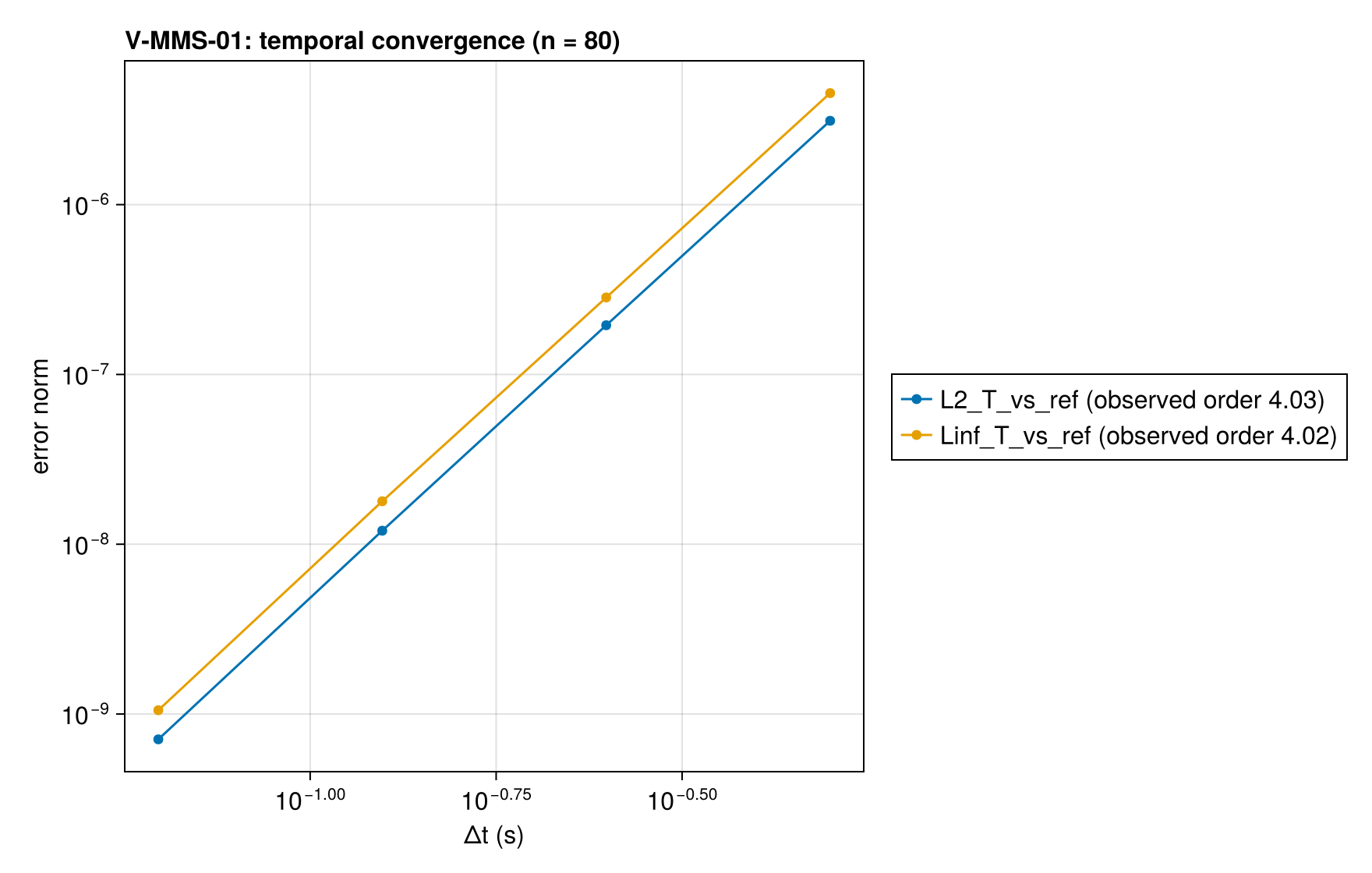
Convergence
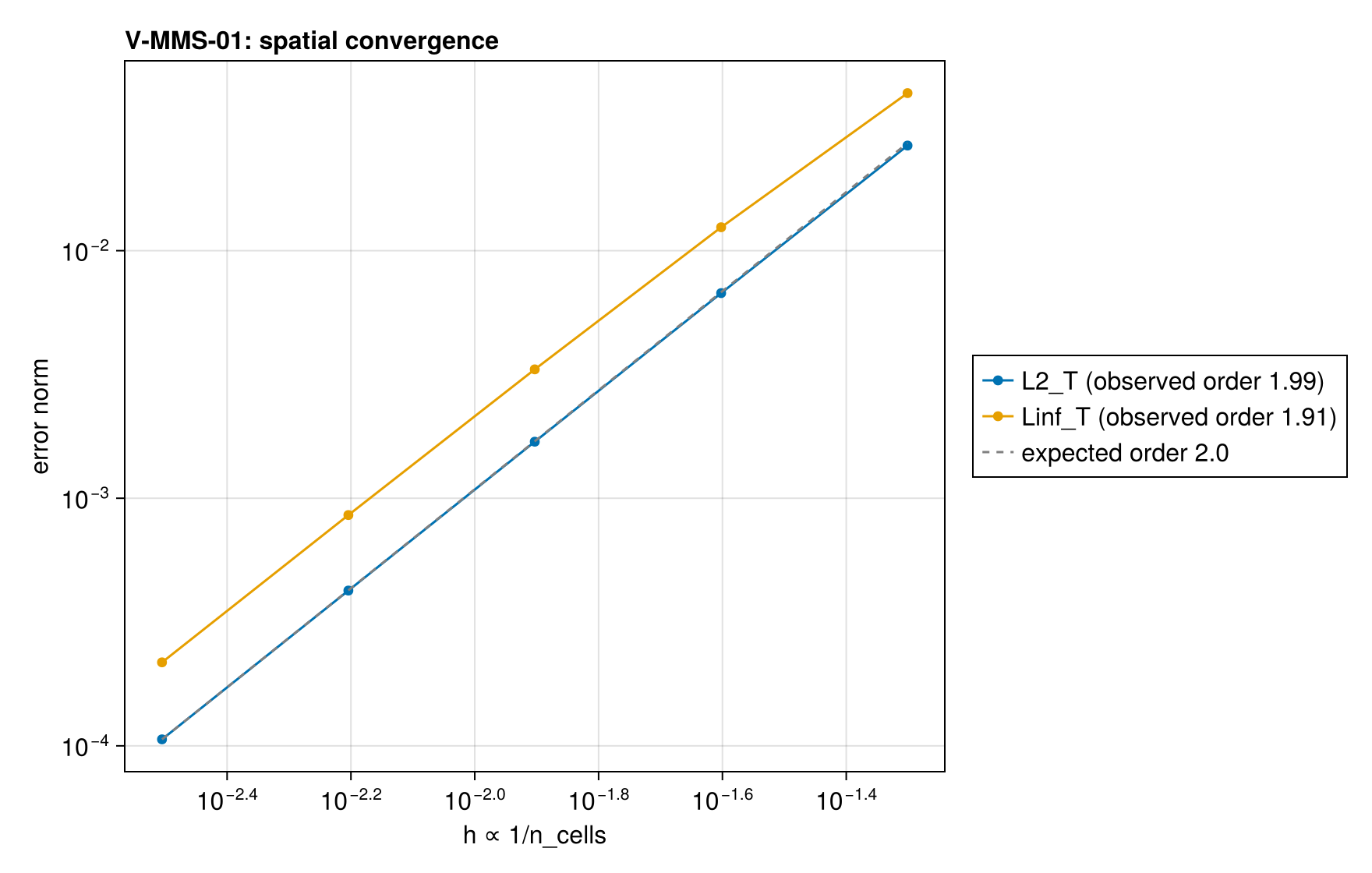
| n_cells | h | wall (s) | L2_T | Linf_T |
|---|---|---|---|---|
| 20 | 0.05 | 0.349 | 0.02658 | 0.04328 |
| 40 | 0.025 | 0.7011 | 0.006738 | 0.01243 |
| 80 | 0.0125 | 1.249 | 0.001692 | 0.003316 |
| 160 | 0.00625 | 2.428 | 0.0004239 | 0.0008554 |
| 320 | 0.003125 | 5.057 | 0.0001062 | 0.0002174 |
Observed order 1.992 (L2_T), expected 2.0.
Solver configuration
| setting | value |
|---|---|
| integrator | KenCarp4 (default) |
| abstol | 1.0e-11 |
| reltol | 1.0e-9 |