V-HC-01 — semi-infinite solid, convective surface BC (erfc)
Tags: heat_conduction, convective_bc, surface_newton
References:
- Carslaw & Jaeger (1959), Conduction of Heat in Solids, §2.7
- Lautenberger dissertation (2007) §3.4.1 (parameters)
- FDS Verification Guide
ht3d_slab; ThermaKin (FSS 9:1141) Eq. 25
Problem statement
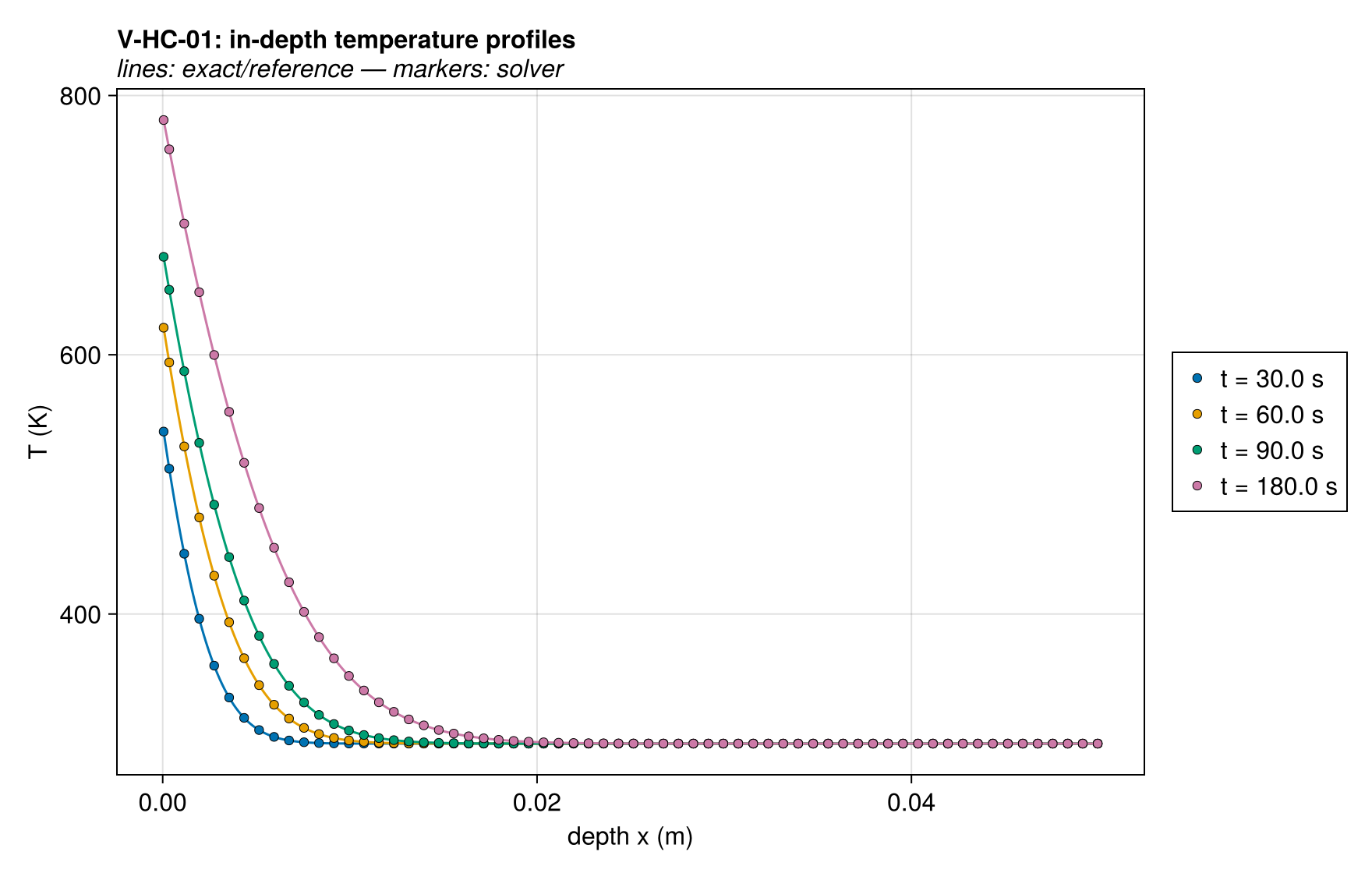
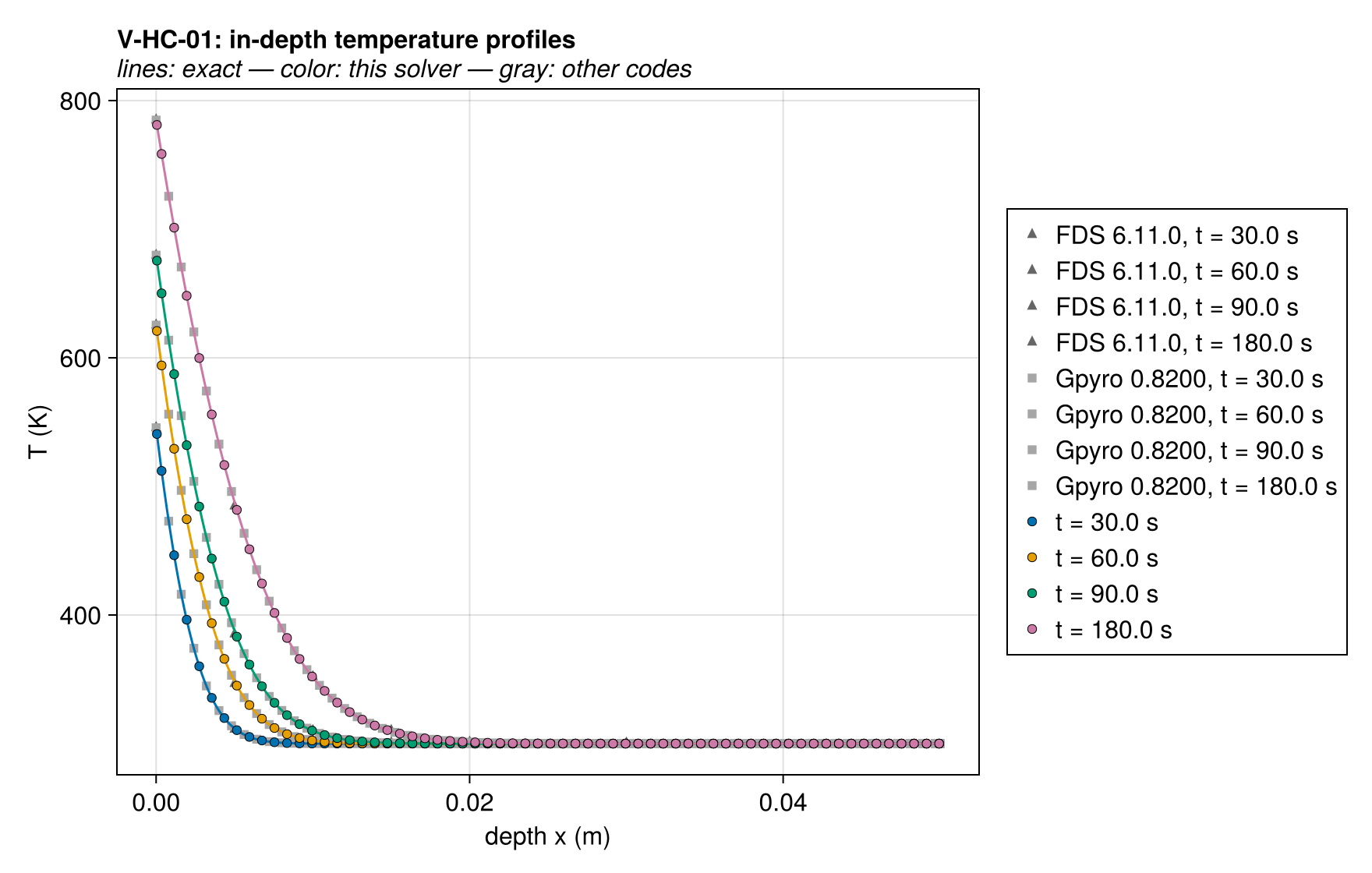
The one verification case shared by all three reference codes (FDS ht3d_slab, Gpyro §3.4.1, ThermaKin Eq. 25), in Gpyro's variant: constant absorbed radiant flux q″ = 25 kW/m² plus convective exchange h = 20 W/m²K with T∞ = T₀ = 300 K; k = 0.2 W/(m·K), ρ = 1000 kg/m³, c = 1400 J/(kg·K), so profiles at t = 30/60/90/180 s are directly comparable to the dissertation figures.
Because the combined surface BC is linear in Ts, absorbed-flux + convection is exactly convection toward T∞eff = T∞ + q″/h = 1550 K, and the Carslaw & Jaeger §2.7 erfc solution (exact/semi_infinite.jl) applies unchanged.
Coverage beyond the existing Dirichlet erf test: HeatFluxBC + ConvectiveBC enter the surface Newton solve, so the surface temperature is an unknown coupled to the interior — the place surface-BC bugs live.
Domain: L = 5 cm ≫ thermal penetration (erfc(η) ≈ 3e-12 at the back face at t = 180 s), so the finite slab is semi-infinite to well below the QoI tolerances; the back-face-rise QoI enforces this assumption explicitly.
Quantities of interest (n = 500)
| QoI | value | exact | error | tolerance | within tol | provenance |
|---|---|---|---|---|---|---|
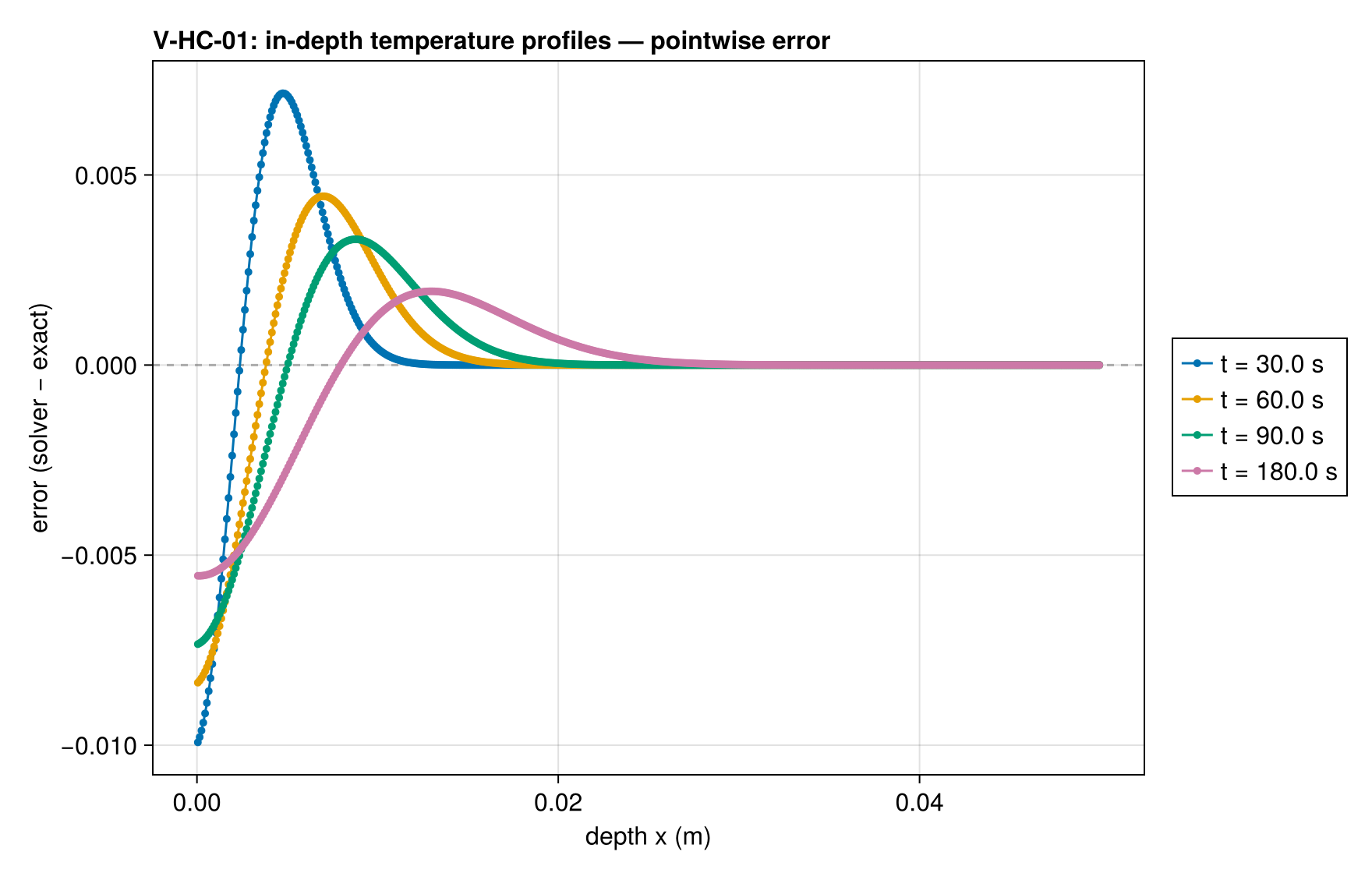
| L∞ T-profile error, t=30.0 s | 0.009924 | — | 0.009924 | 0.75 | yes | observed 0.24/0.21/0.18/0.14 K at t=30/60/90/180 s |
| L∞ T-profile error, t=60.0 s | 0.008354 | — | 0.008354 | 0.75 | yes | observed 0.24/0.21/0.18/0.14 K at t=30/60/90/180 s |
| L∞ T-profile error, t=90.0 s | 0.007341 | — | 0.007341 | 0.75 | yes | observed 0.24/0.21/0.18/0.14 K at t=30/60/90/180 s |
| L∞ T-profile error, t=180.0 s | 0.005544 | — | 0.005544 | 0.75 | yes | observed 0.24/0.21/0.18/0.14 K at t=30/60/90/180 s |
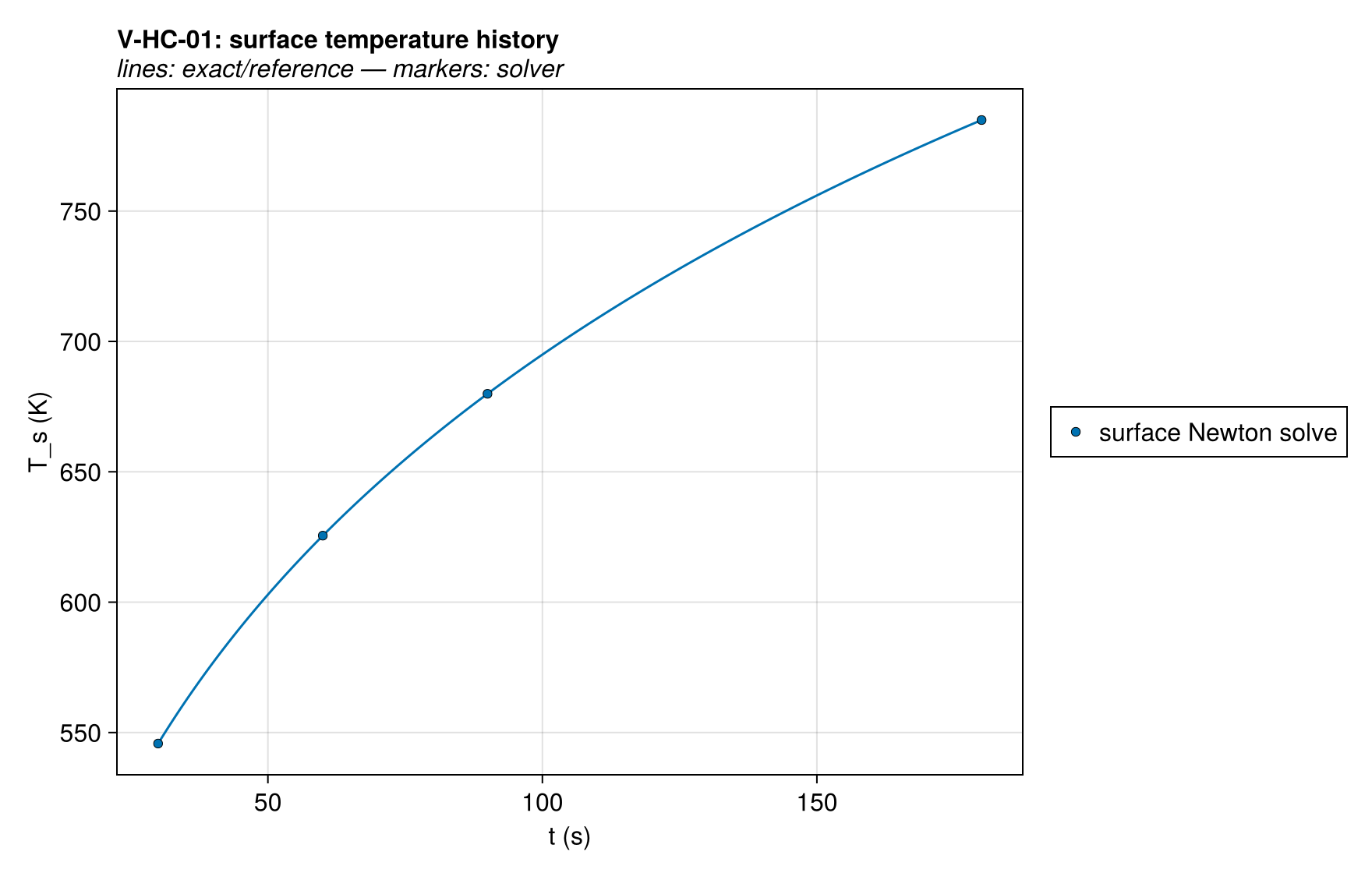
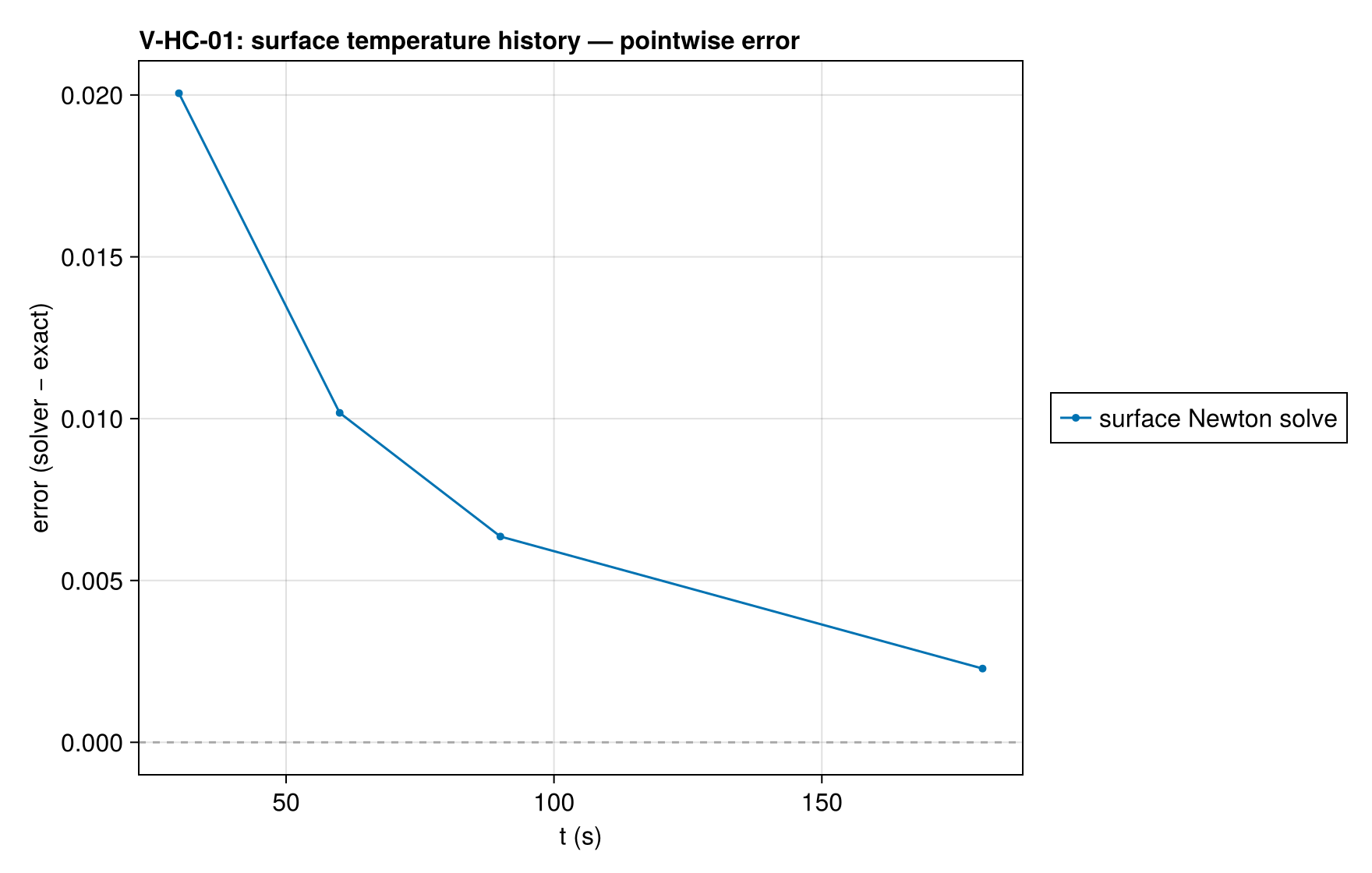
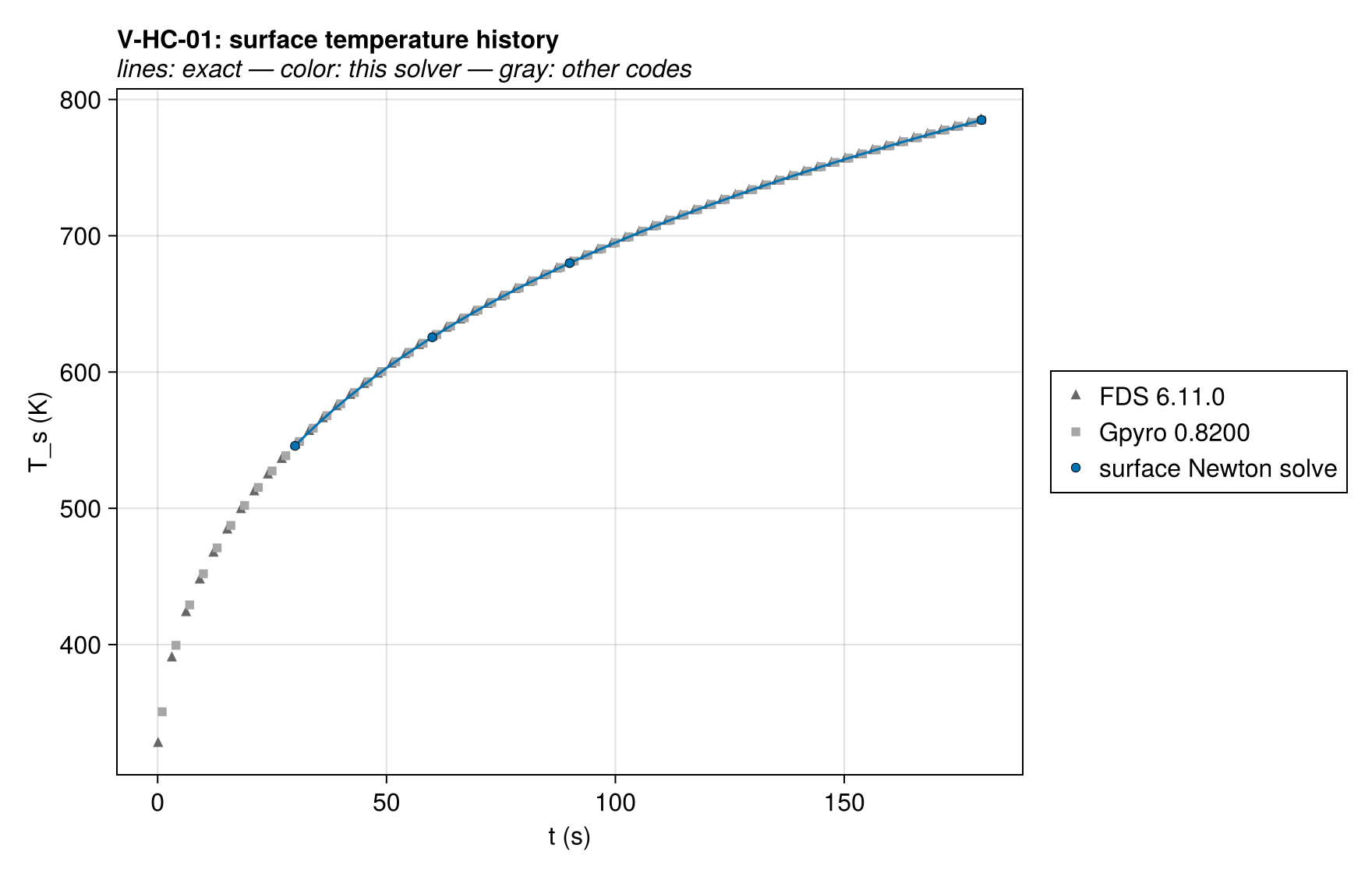
| surface temperature, t=30.0 s | 545.8 | 545.7 | 0.02005 | 1.5 | yes | surface Newton solve vs exact θ_s = 1 − erfcx(h√(αt)/k); observed 0.50/0.26/0.16/0.06 K at t=30/60/90/180 s |
| surface temperature, t=60.0 s | 625.5 | 625.5 | 0.01018 | 1.5 | yes | surface Newton solve vs exact θ_s = 1 − erfcx(h√(αt)/k); observed 0.50/0.26/0.16/0.06 K at t=30/60/90/180 s |
| surface temperature, t=90.0 s | 679.9 | 679.9 | 0.006359 | 1.5 | yes | surface Newton solve vs exact θ_s = 1 − erfcx(h√(αt)/k); observed 0.50/0.26/0.16/0.06 K at t=30/60/90/180 s |
| surface temperature, t=180.0 s | 784.9 | 784.9 | 0.002279 | 1.5 | yes | surface Newton solve vs exact θ_s = 1 − erfcx(h√(αt)/k); observed 0.50/0.26/0.16/0.06 K at t=30/60/90/180 s |
| back-face rise (semi-infinite validity) | 7.188e-10 | 0 | 7.188e-10 | 1e-06 | yes | guards the semi-infinite assumption of the reference solution |
Comparison with other codes
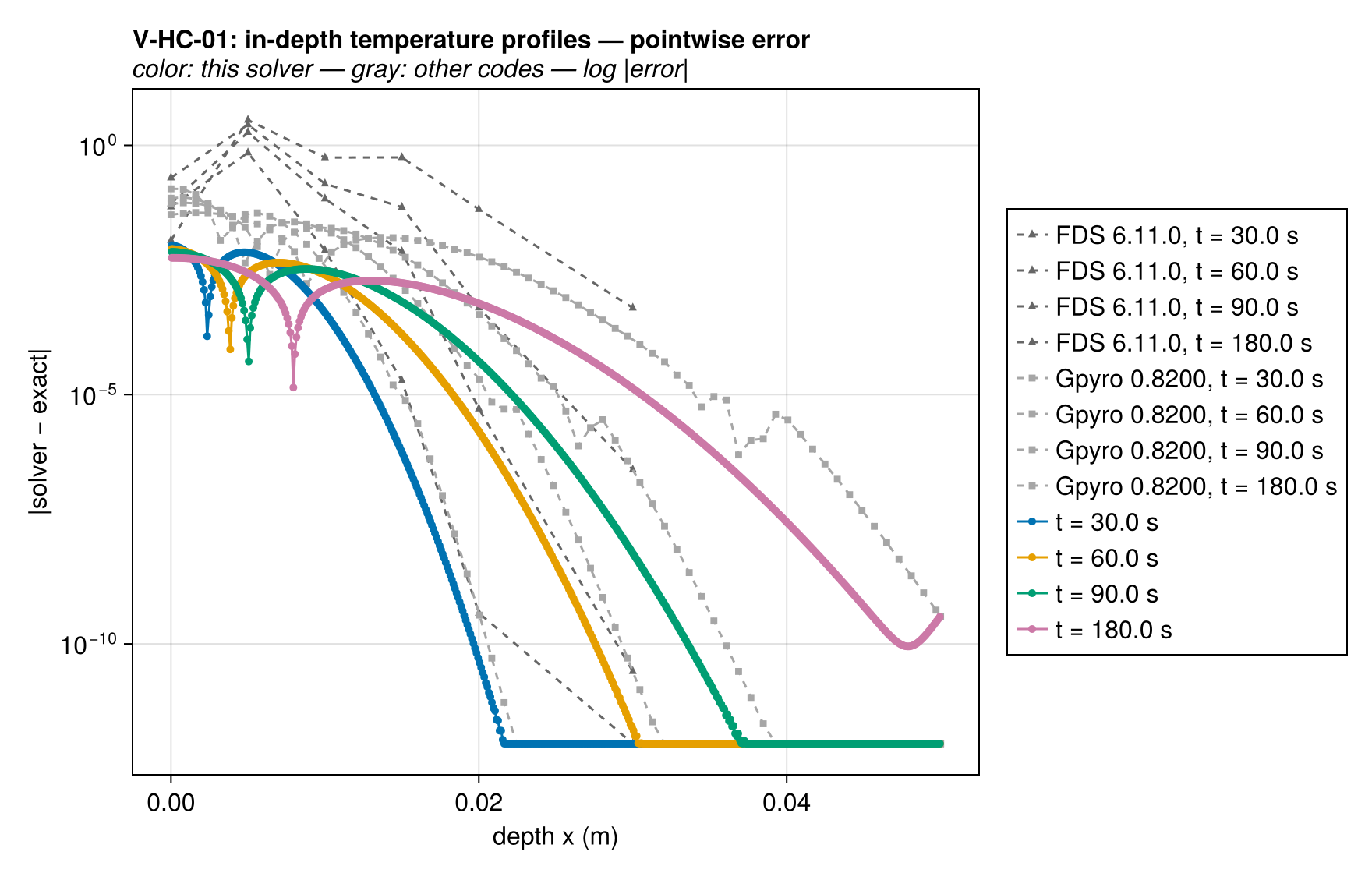
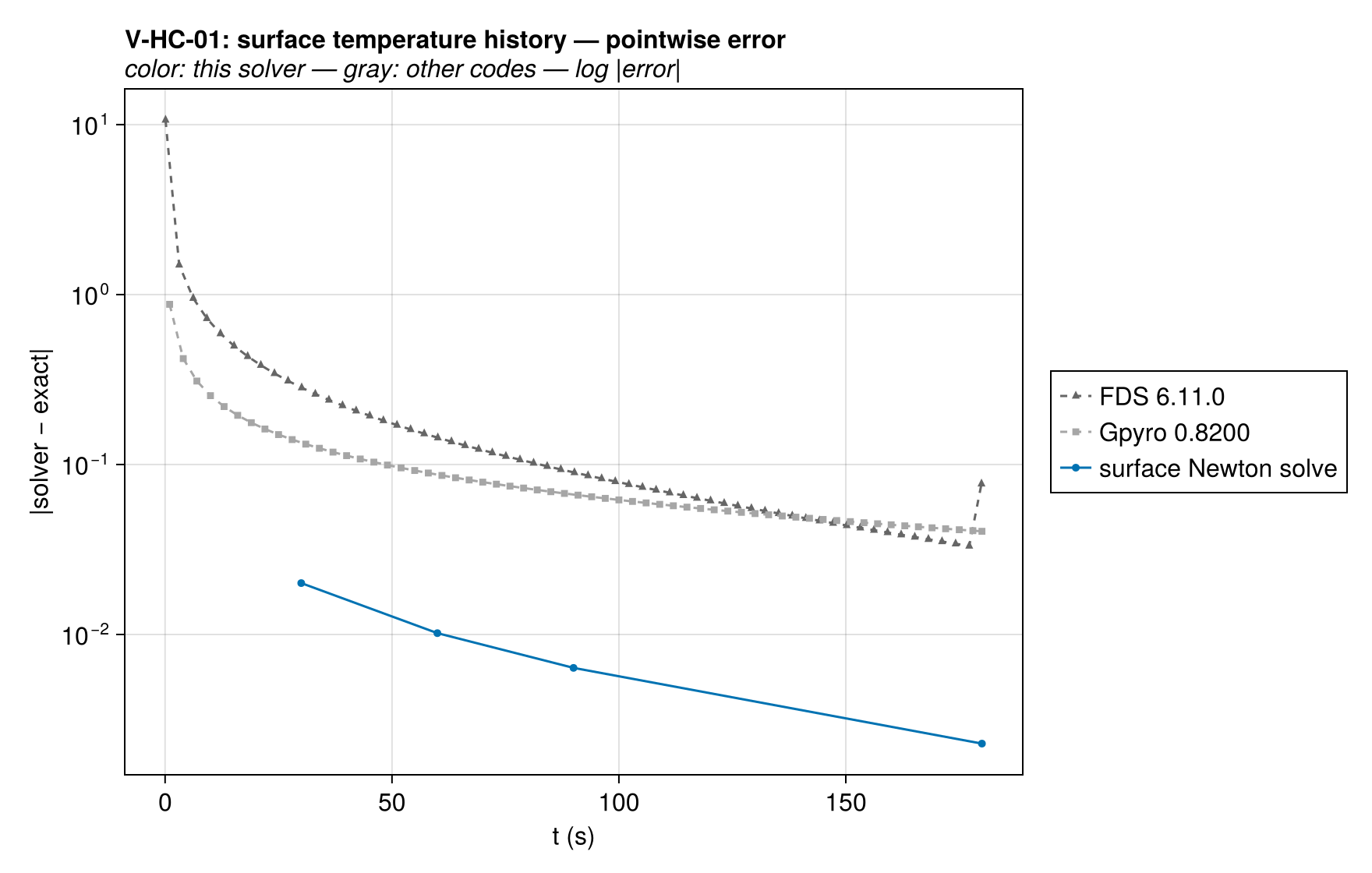
The same case was solved with FDS 6.11.0 at 133 cells (Δx≈0.38 mm) and Gpyro 0.8200 at 500 nodes (Δz=0.1 mm); decks, outputs, and run provenance are committed under test/verification/reference/. Each code's error against the same exact solution is drawn below on a log scale, muted gray behind this solver's series — the signed linear-scale panel above shows where the error lives, this one compares magnitudes across codes.
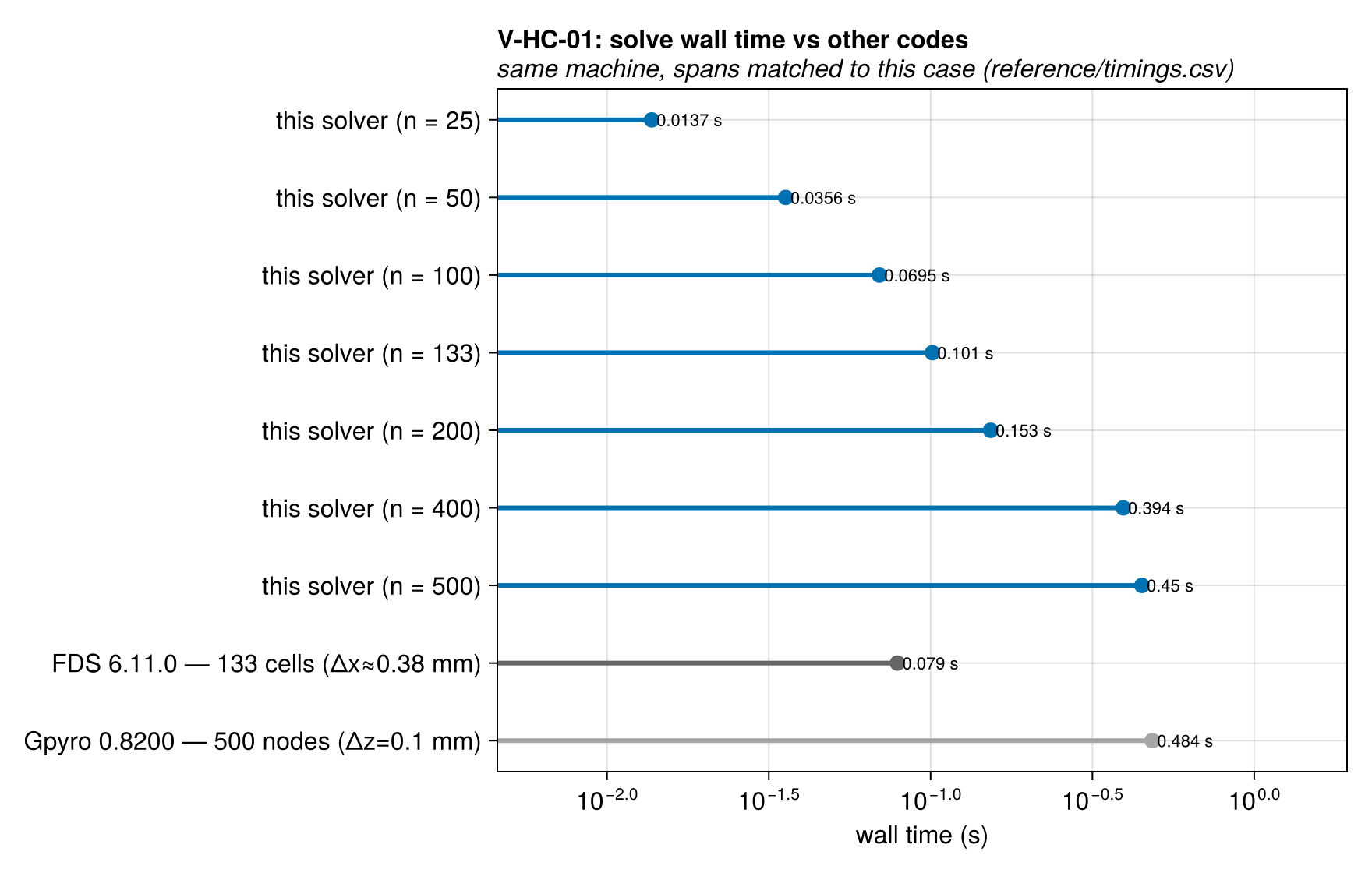
Wall times at every ladder rung against the reference runs. Resolutions and simulated spans differ where noted (details in reference/timings.csv), so cross-code timings are indicative rather than a controlled benchmark; rungs at a matched resolution are directly comparable.
Solution overlays including the other codes' points: Tprofilesvs_codes, surfaceThistoryvscodes.
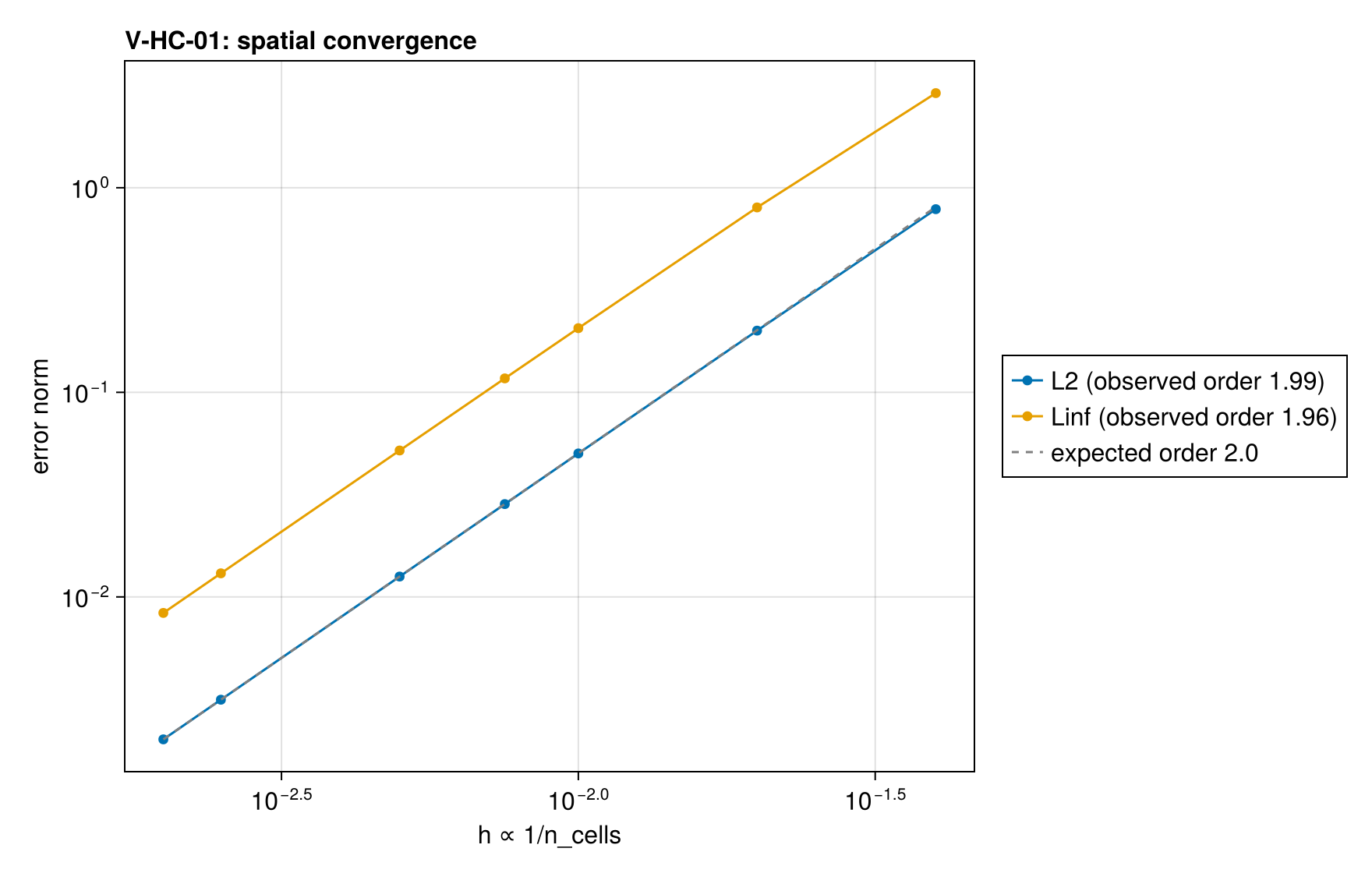
Convergence
| n_cells | h | wall (s) | L2 | Linf |
|---|---|---|---|---|
| 25 | 0.04 | 0.01071 | 0.7857 | 2.901 |
| 50 | 0.02 | 0.02158 | 0.2003 | 0.8012 |
| 100 | 0.01 | 0.04492 | 0.05027 | 0.2059 |
| 133 | 0.007519 | 0.06127 | 0.02844 | 0.117 |
| 200 | 0.005 | 0.09518 | 0.01258 | 0.05197 |
| 400 | 0.0025 | 0.2046 | 0.003146 | 0.01304 |
| 500 | 0.002 | 0.2612 | 0.002013 | 0.008354 |
Observed order 1.993 (L2), expected 2.0.
Solver configuration
| setting | value |
|---|---|
| integrator | KenCarp4 (default) |
| abstol | 1.0e-12 |
| reltol | 1.0e-10 |