V-CPL-02 — Landau ablation: steady surface regression under ALE
Tags: ale, moving_boundary, kinetics, surface_regression, coupled
References:
- H.G. Landau, Q. Appl. Math. 8:81 (1950)
Problem statement
H.G. Landau, Q. Appl. Math. 8:81 (1950). The flagship ALE case: none of FDS/Gpyro/ThermaKin verify against it. Semi-infinite solid, constant net surface flux q″, material removed at ablation temperature Tp with heat of ablation ΔHp. Exact steady traveling wave (exact/landau.jl):
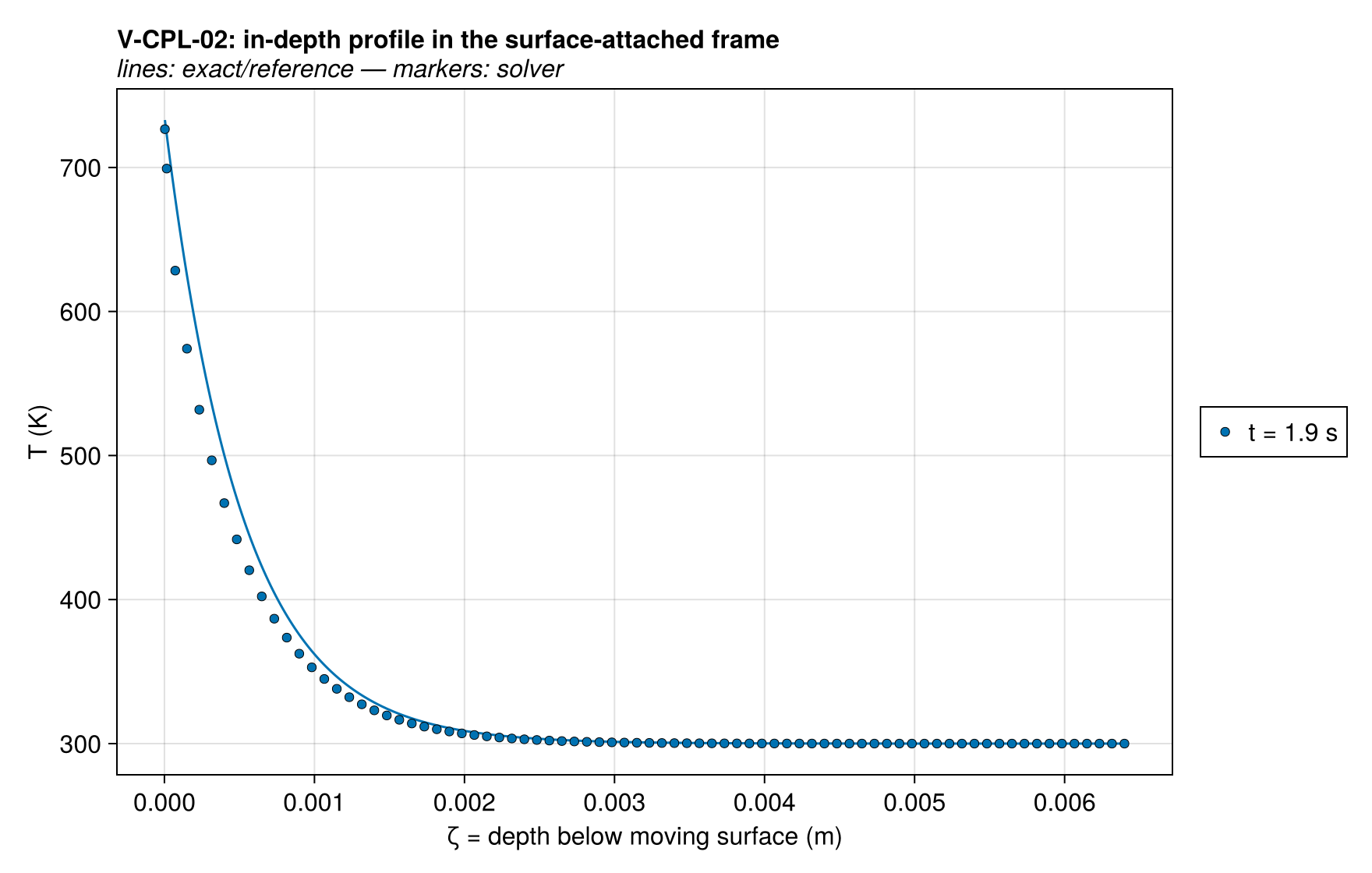
vss = q″/(ρ[c(Tp − T₀) + ΔHp]), T(ζ) = T₀ + (Tp − T₀)e^(−v_ss ζ/α)
Realization: single reaction solid → gas with γgas = 0 (volume loss at intrinsic density ⇒ surface regression) under ALE with depletion-driven cell merging. The kinetics-controlled front approximates the fixed-Tp ablation limit; (A, E) are chosen on the leading-order Laplace locus
A = v² E (Tp − T₀) e^(E/RTp) / (α R T_p²)
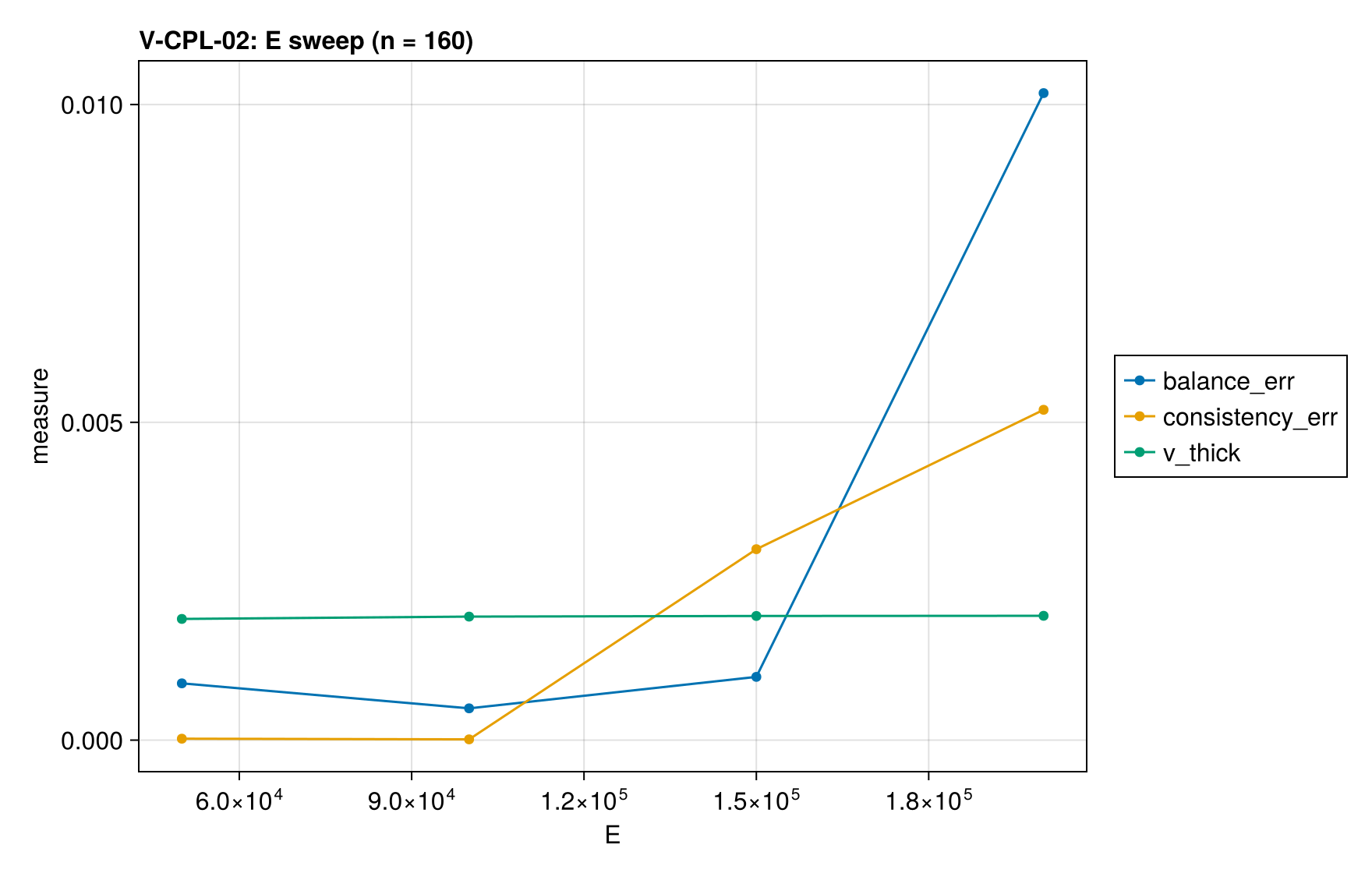
so the designed regression rate is vtarget at ablation temperature ≈ Tp. At finite E the front self-adjusts: the primary QoI therefore compares the measured regression rate v against the Landau balance evaluated at the MEASURED surface temperature — an identity that must hold for the steady wave regardless of kinetics — and the design locus is only a loose check.
Gas heat capacity is set EQUAL to the solid's (cgas = csolid): then the heat of reaction ΔH(T) is T-independent (Kirchhoff) and the traveling-wave identity v = vss(measured Ts) is exact for ANY kinetics — the regression anchor. With cgas ≈ 0 the identity is NOT exact at finite E: the true wave consumes only c(T̄form − T₀) + ΔH per kg (conversion happens at T̄form < Ts), so v runs ≈ +RTs²/E·c/(cΔT+ΔH) fast against vss(T_s) — that configuration belongs to report-mode studies, not to this pinned QoI.
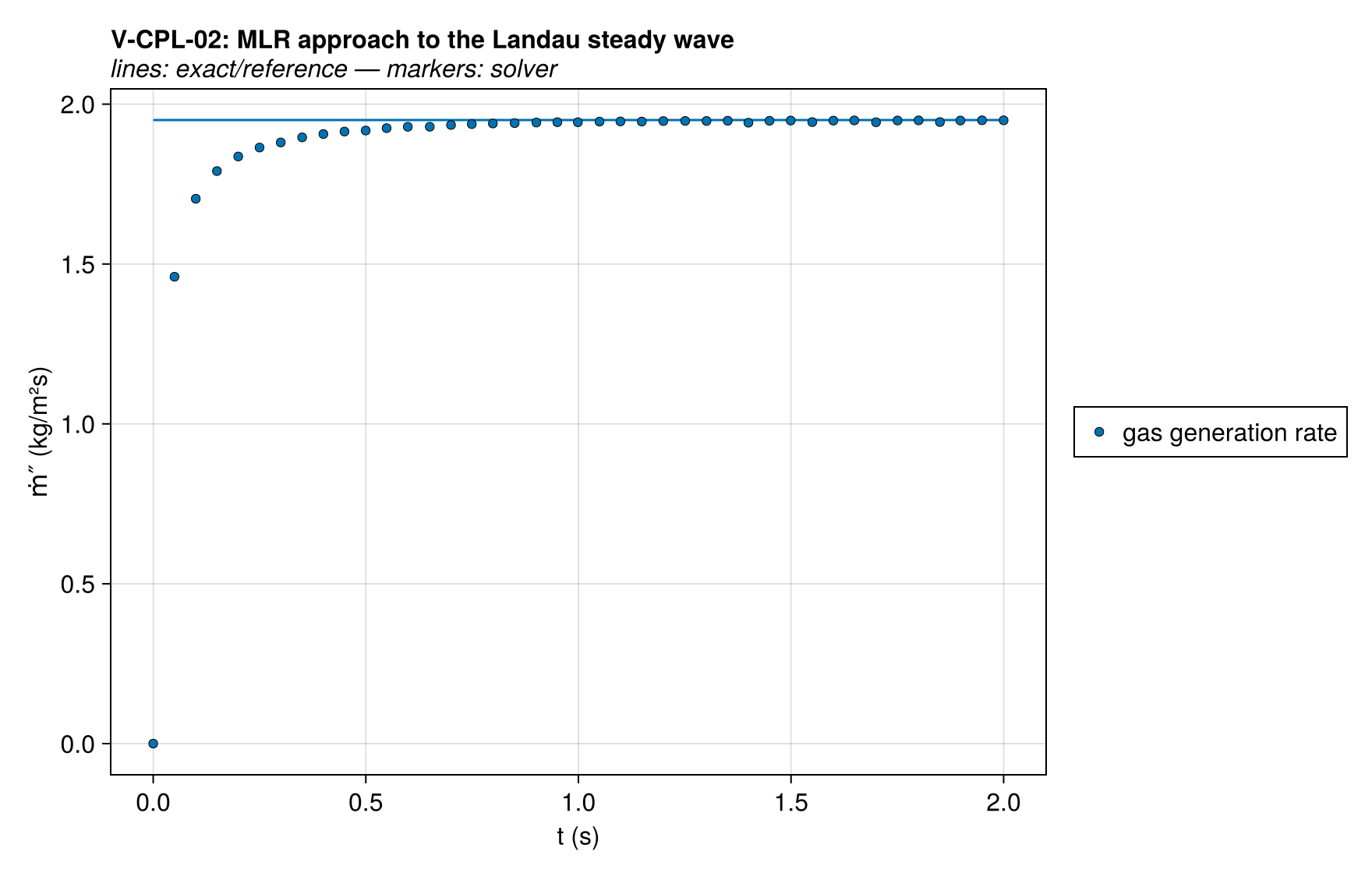
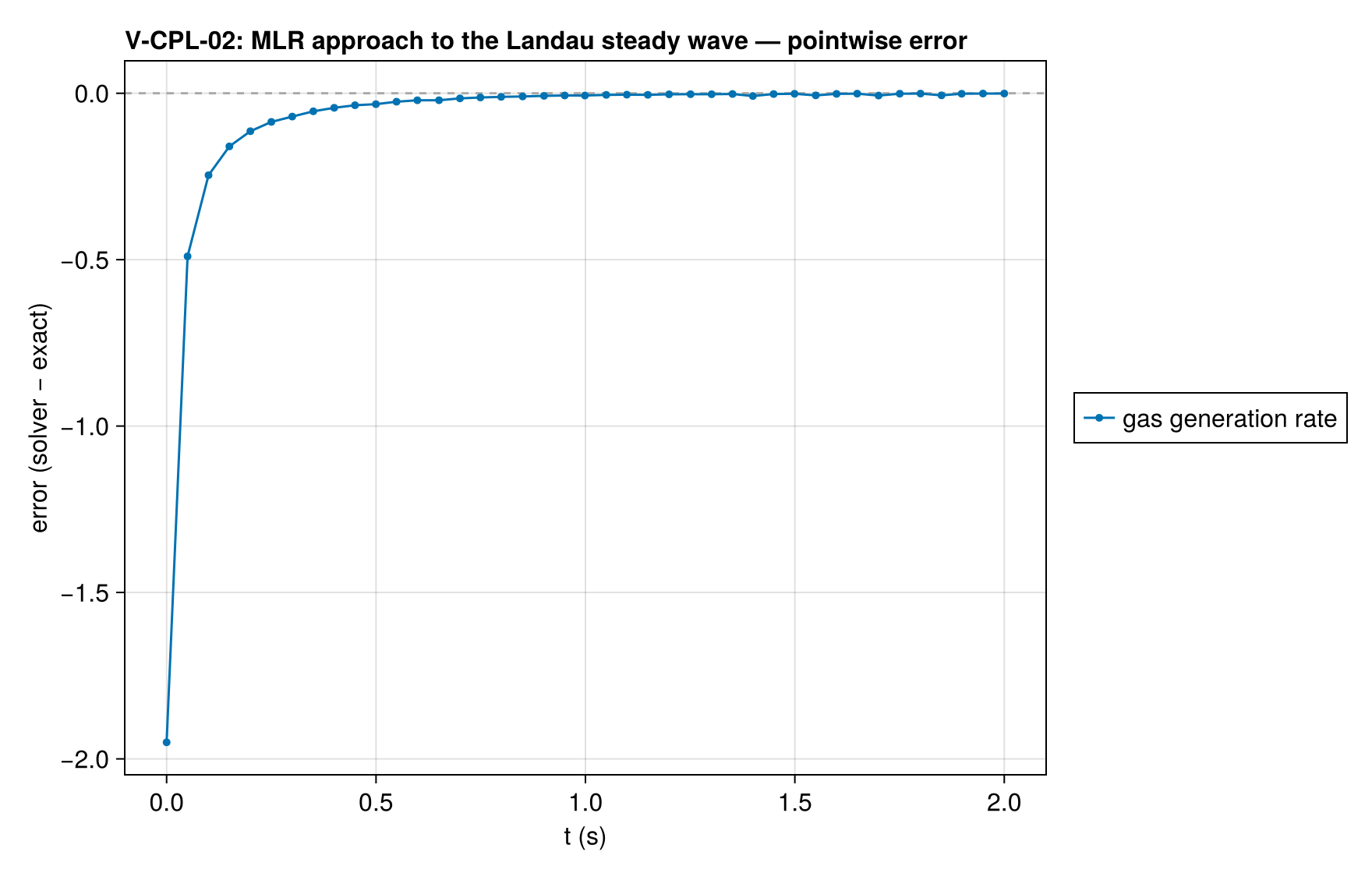
The cgas = csolid anchor also guards the relative-velocity ALE energy formulation (tech-ref §11.2.2): a spurious full-mesh-velocity T-advection term (+w·∂T/∂z applied although the mesh rides the collapsing solid) would break this identity by ≈ c·(Ts − T̄form) ≈ RTs²/E·c per kg — a few-percent deficit. For the identity to be a sharp guard the QoI window must sit deep in the steady wave: from a uniform-T₀ start the true initial-value solution approaches the traveling wave as e^(−t/τ) with τ = α/v² ≈ 0.25 s — heat is still being banked into the growing thermal tail, so v(t) runs below vss(measured Ts) while Ts itself equilibrates early. That deficit is the correct transient of the initial-value problem, not solver error: the windowed first law (q″Δt = ΔEstored + ablation enthalpy) closes throughout the approach, and the pre-ablation phase matches Landau's exact constant-flux heat-up Ts(t) = T₀ + 2q″√(t/(πρck)). The steady exact solution is simply not a valid reference before ~6τ: in a window at 2–4τ the residual deficit is ≈0.9% and mesh-INDEPENDENT (n=60→240 ladder, observed order 0.11). The window therefore sits at ≥6τ, where the remaining residual is the §12.3.2 half-cell Ts closure with the reaction zone inside the boundary half-cell — mesh-DEPENDENT as it should be (it shifts vss(measured Ts) but not the actual regression rate): ~1.3% at Δz ≈ 2δr, ~7e-4 at the CI mesh Δz ≈ δ_r — so the pinned tolerance actually arms the ALE guard.
Blowing correction stays OFF (exact solution assumes prescribed net flux). Depletion limiter stays ON: the tanh roll-off is part of the regression physics here (front cells are consumed to zero) and its effect is contained in the pinned tolerances.
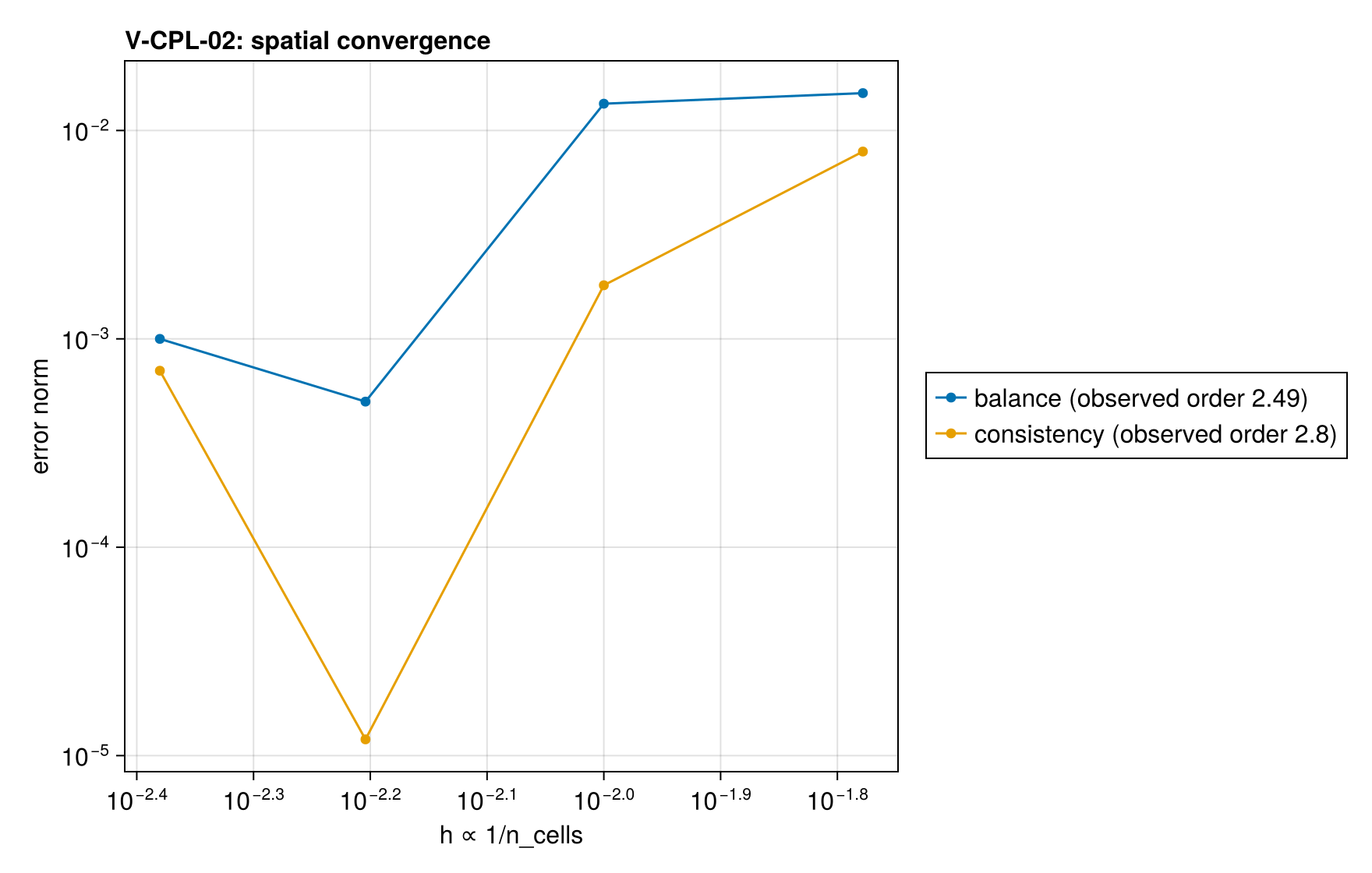
CI runs no ConvergenceSpec: the case resolves a moving reaction front (δr ≈ δ·RTs²/(E(T_s−T₀)) ≈ 53 μm ≈ Δz at the CI mesh) and a meaningful order study requires the report-mode Richardson ladder; the assert-mode QoIs below are all physics identities with pinned headroom instead. V-CPL-02b (broader front, E halved) doubles as the kinetics-limit insensitivity check of the ablation-temperature locus.
Quantities of interest (n = 240)
| QoI | value | exact | error | tolerance | within tol | provenance |
|---|---|---|---|---|---|---|
| steady energy balance: v vs Landau vss(measured Ts) | 0.001948 | 0.00195 | 0.001053 | 0.0021 | yes | traveling-wave identity, exact at any E for cgas = csolid |
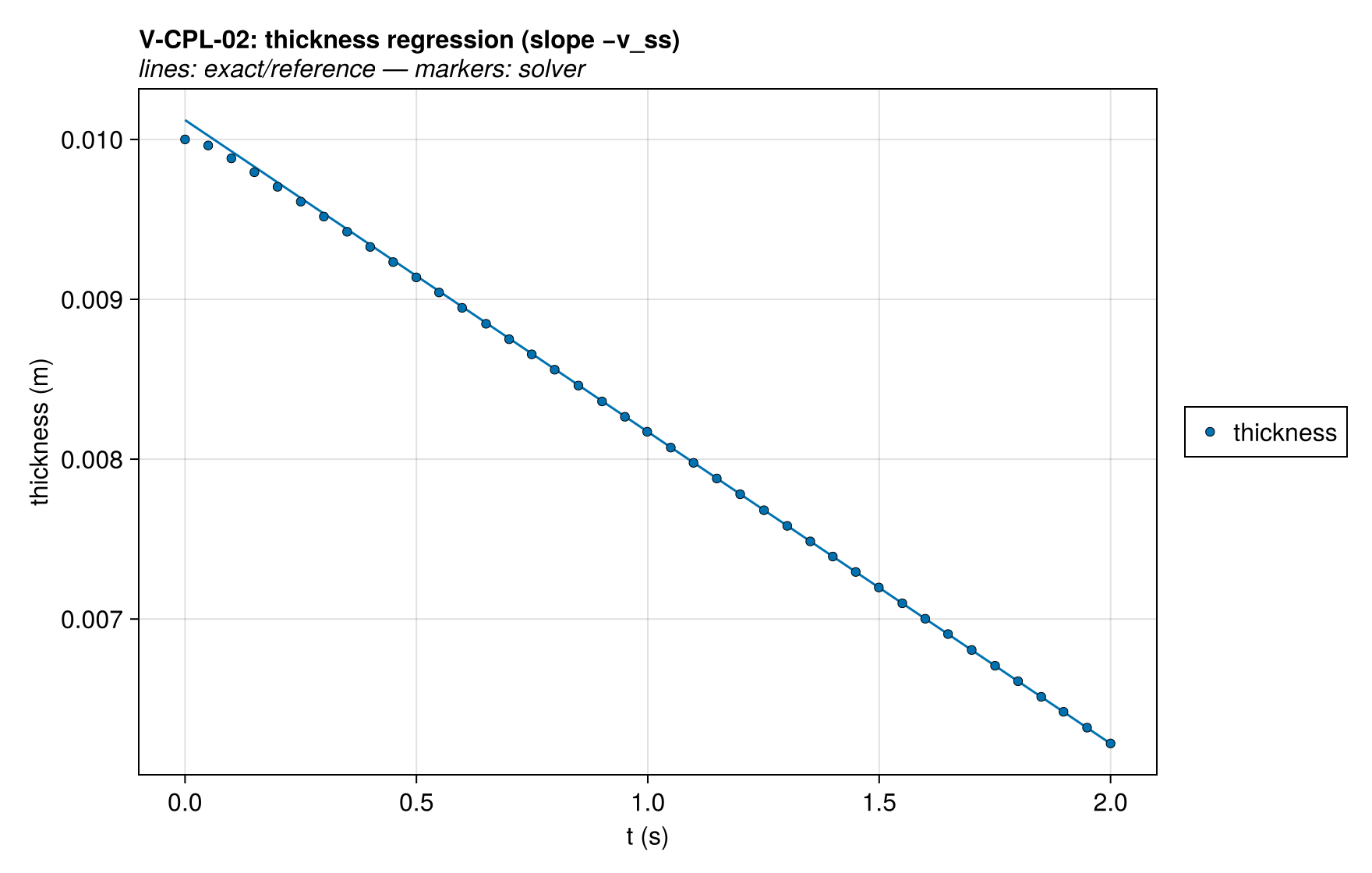
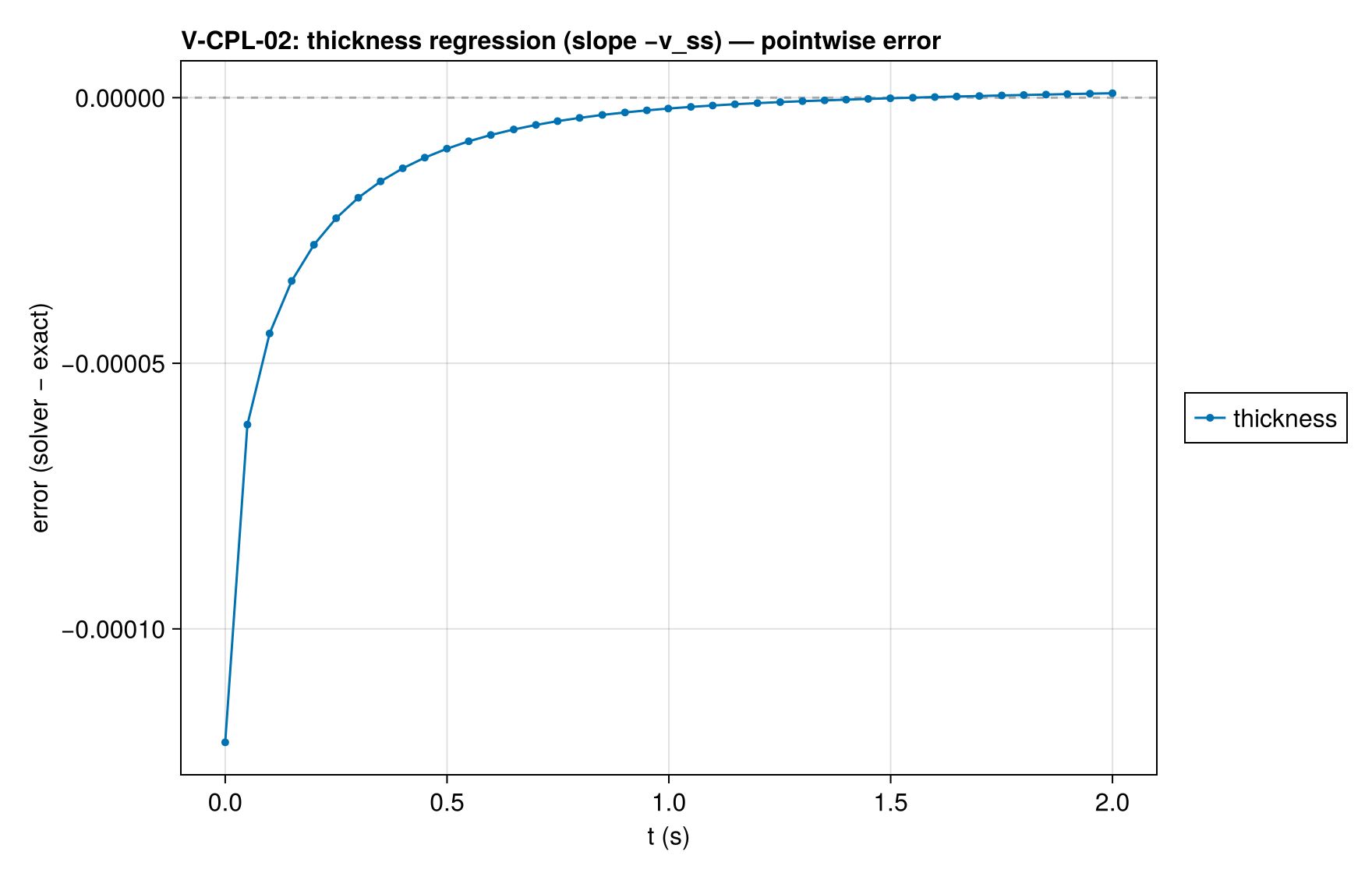
| regression consistency: thickness slope vs gas generation | 0.001948 | 0.001948 | 0.0002359 | 0.0021 | yes | γgas = 0 ⇒ dL/dt = −ṁ‴gas/ρ exactly |
| mass ledger closure over plateau window | 0.7803 | 0.7791 | 0.001598 | 0.0049 | yes | total-mass drop vs ∫ ṁ″ dt; residual = holdup drift |
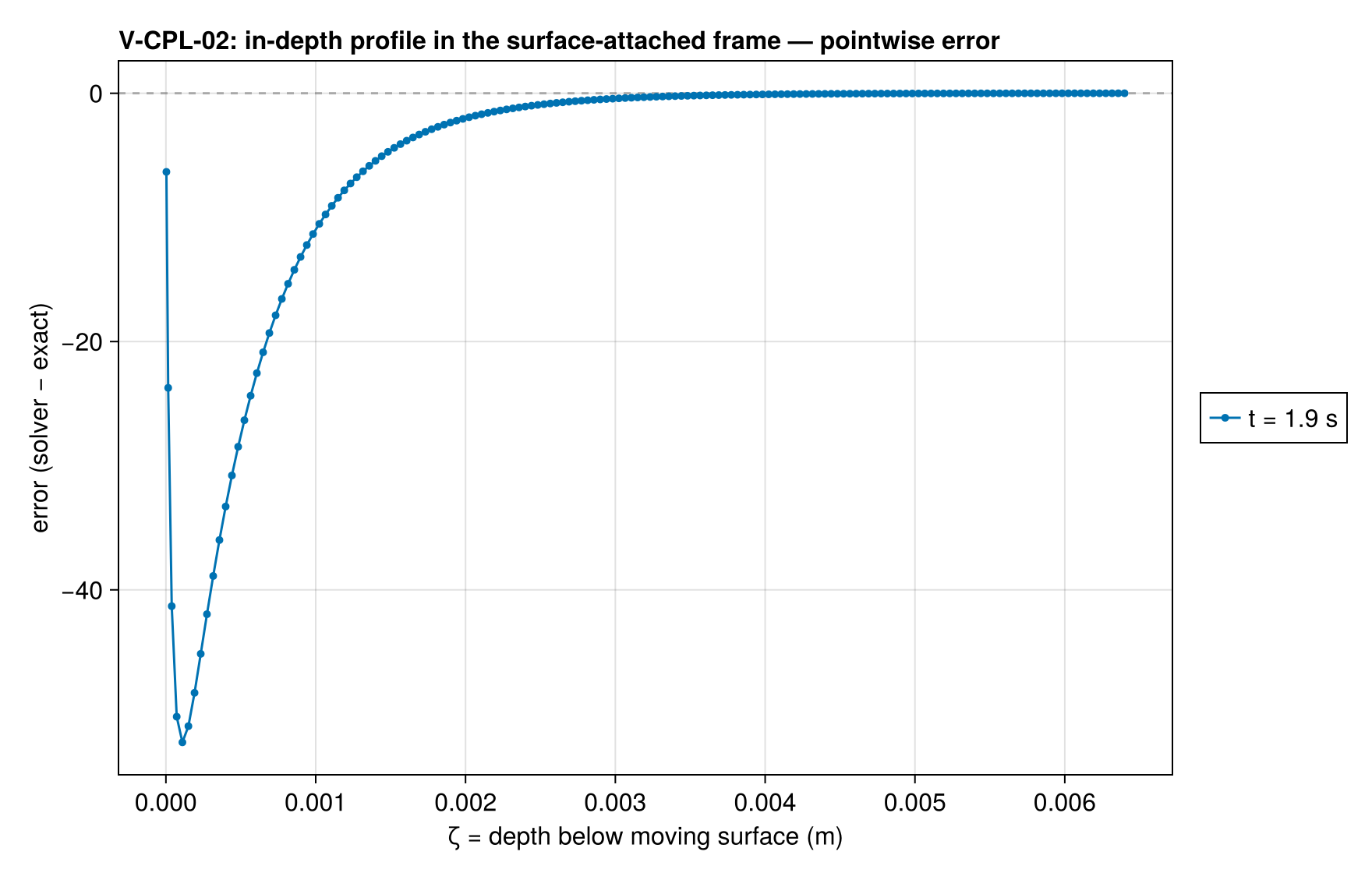
| in-depth profile decay rate (surface-attached frame) | 0.001967 | 0.001948 | 0.00965 | 0.027 | yes | ln(T−T₀) slope over ζ/δ ∈ [0.75, 1.7], 12 cells |
| design-locus regression rate (loose) | 0.001948 | 0.002 | 0.02584 | 0.1 | yes | leading-order Laplace locus only pins Tp to O(RTp²/E); informational, tightens as E ↑ (see V-CPL-02b) |
| back-face rise (semi-infinite validity) | 0.0003587 | 0 | 0.0003587 | 0.01 | yes | guards the semi-infinite assumption |
Convergence
| n_cells | h | wall (s) | balance | consistency |
|---|---|---|---|---|
| 60 | 0.01667 | 0.392 | 0.01111 | 0.00403 |
| 100 | 0.01 | 0.8772 | 0.01338 | 0.0001482 |
| 160 | 0.00625 | 1.596 | 0.0007077 | 0.0002239 |
| 240 | 0.004167 | 3.111 | 0.001053 | 0.0002359 |
Observed order 2.169 (balance).
Solver configuration
| setting | value |
|---|---|
| integrator | KenCarp4 (default) |
| use_ale | true |
| min_thickness | 0.0001 |
| handle_depletion | true |
| depletion_threshold | 0.05 |
| abstol | 1.0e-7 |
| reltol | 1.0e-5 |